Loading
Form preview
  • US Legal Forms
  • Other Templates
  • Tax Forms
  • New York Tax Forms
  • Ny Dtf Et-706-i 2017

Get Ny Dtf Et-706-i 2017

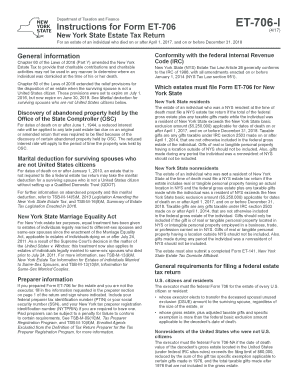
And TSB-M-10(8)M, Enrolled Agents Excluded from the Definition of Tax Return Preparer for the Tax Preparer Registration Program, for more information. Conformity with the federal Internal Revenue Code (IRC) New York State (NYS) Estate Tax Law Article 26 generally conforms to the IRC of 1986, with all amendments enacted on or before January 1, 2014 (NYS Tax Law section 951). Which estates must file Form ET-706 for New York State New York State residents The estate of an individual who was a.

How it works

  1. Open form

    Open form follow the instructions

  2. Easily sign form

    Easily sign the form with your finger

  3. Share form

    Send filled & signed form or save

How to fill out the NY DTF ET-706-I online

Filling out the NY DTF ET-706-I form is a critical step for managing estate taxes in New York. This guide provides you with clear, step-by-step instructions to assist you in completing the form accurately and efficiently online.

Follow the steps to complete the NY DTF ET-706-I form.

  1. Use the ‘Get Form’ button to access the document and display it in your online form editor.
  2. Begin by entering the decedent’s information, including their name, home address at the time of death, social security number, and date of death. Ensure the details are accurate and clearly visible.
  3. Next, if applicable, indicate whether the decedent was a nonresident of New York State at the time of death and attach Form ET-141 if it has not been previously submitted.
  4. Fill out the executor information by entering the name and details of the representative managing the estate. If there are multiple executors, ensure to include the necessary information for each.
  5. If electing to pay estate taxes in installments for closely held businesses, indicate this in the respective section on the form.
  6. Complete the schedules required for the estate. Schedules A, B, C, D, and E should be filled out based on the specific details of the estate and the property involved.
  7. Review all fields to ensure correctness, as inaccuracies may lead to penalties or delays in processing.
  8. Once you have reviewed and confirmed that all information is correct, proceed to save your changes. You can then download, print, or share the completed form as needed.

Get started today by filling out the NY DTF ET-706-I form online!

Get form

Experience a faster way to fill out and sign forms on the web. Access the most extensive library of templates available.

Related content

Instructions for Form ET-706 New York State Estate...
The estate of an individual who was not a resident of New York. State at the time of death...
Learn more
STATE OF NEW YORK GENERAL OBLIGATION BONDS
by GO BONDS — The Bonds are offered when, as and if issued and subject to receipt of an...
Learn more
1401/1440/1460 Emulator Programs Compatibility...
This publication contains information on the emula- tion of 1401, 1440, and 1460 object...
Learn more

Related links form

Canada REG3185 2020 Canada CIT 0407e 2019 North Dakota Form Sfn 13401 Canada HLTH 203 V2 2020

Questions & Answers

Get answers to your most pressing questions about US Legal Forms API.

Contact support

Not every estate is required to file Form 706; it depends on the total value of the estate. If the estate exceeds the exemption limit, filing is mandatory to assess tax liability. The NY DTF ET-706-I is an important form in this process, as it directly relates to New York estate tax regulations. Consulting experts can offer guidance on whether you need to file based on your specific situation.

Form 709, the United States Gift (and Generation-Skipping Transfer) Tax Return, typically does not need to be filed by individuals whose gifts stay below the annual exclusion limit. If your total gifts in a year do not exceed this threshold, you won’t have to report on Form 709. However, if your estate grows significantly, understanding the implications of the NY DTF ET-706-I may still be essential. Stay informed about your obligations as circumstances change.

Yes, you must report the sale of inherited property to the IRS if you sell it. The sale may have tax implications, and it’s critical to determine the fair market value at the time of inheritance. Properly documenting this process can help you when preparing any necessary forms, including the NY DTF ET-706-I. Consulting a tax professional can provide clarity on your reporting obligations.

To avoid the NYS estate tax cliff, consider strategic estate planning. Utilizing trusts can be an effective way to manage your assets while staying below the tax threshold. Additionally, regularly reviewing your estate plan with a knowledgeable professional will ensure compliance with the latest rules surrounding the NY DTF ET-706-I. Effective planning can help minimize potential tax obligations.

You need to file an estate tax return 706 if your estate's value exceeds the New York exemption limit. This form, the NY DTF ET-706-I, ensures that all taxable aspects of the estate are reported accurately. Executors of estates are responsible for filing, and it's essential to adhere to the deadlines set by the state. Not filing when required can lead to penalties, so be diligent.

In New York, the estate tax applies to individuals whose estate exceeds a certain threshold amount. This also includes all assets owned or controlled by the deceased at the time of death. Understanding the NY DTF ET-706-I is crucial in determining if your estate is liable for taxes. If your estate's value meets or surpasses the limit, you must consider filing to comply with the law.

Yes, in New York, you are required to file an estate tax return if the gross estate exceeds the state's exemption limit. The form NY DTF ET-706-I will be necessary for this process. Working with platforms like uslegalforms can simplify filing and ensure that you comply with all state requirements.

A tax return for a deceased individual should be signed by the executor or administrator of the estate. If there's no executor, then a person acting in that capacity can sign on behalf of the deceased. For assistance in navigating tax obligations, consider resources from uslegalforms.

In cases where there is no executor, the person managing the estate can sign form NY DTF ET-706-I. This individual could be a family member or another responsible person designated by the court. It's essential to ensure that the signature has legal backing to avoid complications.

If there is no appointed executor, you may need to petition the probate court to appoint someone to perform this role. Often, a family member or trusted advisor can take on this responsibility. Utilizing resources like uslegalforms can provide clarity and support throughout this process.

Get This Form Now!

Use professional pre-built templates to fill in and sign documents online faster. Get access to thousands of forms.
If you believe that this page should be taken down, please follow our DMCA take down processhere.
Get NY DTF ET-706-I
  • Adoption
  • Bankruptcy
  • Contractors
  • Divorce
  • Home Sales
  • Employment
  • Identity Theft
  • Incorporation
  • Landlord Tenant
  • Living Trust
  • Name Change
  • Personal Planning
  • Small Business
  • Wills & Estates
  • Packages A-Z
  • Affidavits
  • Bankruptcy
  • Bill of Sale
  • Corporate - LLC
  • Divorce
  • Employment
  • Identity Theft
  • Internet Technology
  • Landlord Tenant
  • Living Wills
  • Name Change
  • Power of Attorney
  • Real Estate
  • Small Estates
  • Wills
  • All Forms
  • Forms A-Z
  • Other Templates
  • Legal Hub
  • About Us
  • Help Portal
  • Legal Resources
  • Blog
  • Affiliates
  • Contact Us
  • Delete My Account
  • Site Map
  • Industries
  • Forms in Spanish
  • Localized Forms
  • State-specific Forms
  • Forms Kit
  • Real Estate Handbook
  • All Guides
  • Notarize
  • Incorporation services
  • For Consumers
  • For Small Business
  • For Attorneys
  • USLegal
  • FormsPass
  • pdfFiller
  • signNow
  • altaFlow
  • DocHub
  • Instapage
Form Packages
  • Adoption
  • Bankruptcy
  • Contractors
  • Divorce
  • Home Sales
  • Employment
  • Identity Theft
  • Incorporation
  • Landlord Tenant
  • Living Trust
  • Name Change
  • Personal Planning
  • Small Business
  • Wills & Estates
  • Packages A-Z
Form Categories
  • Affidavits
  • Bankruptcy
  • Bill of Sale
  • Corporate - LLC
  • Divorce
  • Employment
  • Identity Theft
  • Internet Technology
  • Landlord Tenant
  • Living Wills
  • Name Change
  • Power of Attorney
  • Real Estate
  • Small Estates
  • Wills
  • All Forms
  • Forms A-Z
  • Other Templates
Customer Service
  • Legal Hub
  • About Us
  • Help Portal
  • Legal Resources
  • Blog
  • Affiliates
  • Contact Us
  • Delete My Account
  • Site Map
  • Industries
  • Forms in Spanish
  • Localized Forms
  • State-specific Forms
  • Forms Kit
Legal Guides
  • Real Estate Handbook
  • All Guides
Prepared for you
  • Notarize
  • Incorporation services
Our Customers
  • For Consumers
  • For Small Business
  • For Attorneys
Our Sites
  • USLegal
  • FormsPass
  • pdfFiller
  • signNow
  • altaFlow
  • DocHub
  • Instapage
Social Media
Call us now toll free:
+1 833 426 79 33
As seen in:
© Copyright 1999-2026 airSlate Legal Forms, Inc. 17 Station Street, Ste. 203, Brookline, MA 02445
  • Your Privacy Choices
  • Terms of Service
  • Privacy Notice
  • Content Takedown Policy
  • Bug Bounty Program
NY DTF ET-706-I
This form is available in several versions.
Select the version you need from the drop-down list below.
2022 NY DTF ET-706-I
Select form
  • 2022 NY DTF ET-706-I
  • 2021 NY DTF ET-706-I
  • 2020 NY DTF ET-706-I
  • 2019 NY DTF ET-706-I
  • 2017 NY DTF ET-706-I
  • 2016 NY DTF ET-706-I
  • 2015 NY DTF ET-706-I
  • 2014 NY DTF ET-706-I
  • 2012 NY DTF ET-706-I
  • 2011 NY DTF ET-706-I
  • 2010 NY DTF ET-706-I
Select form