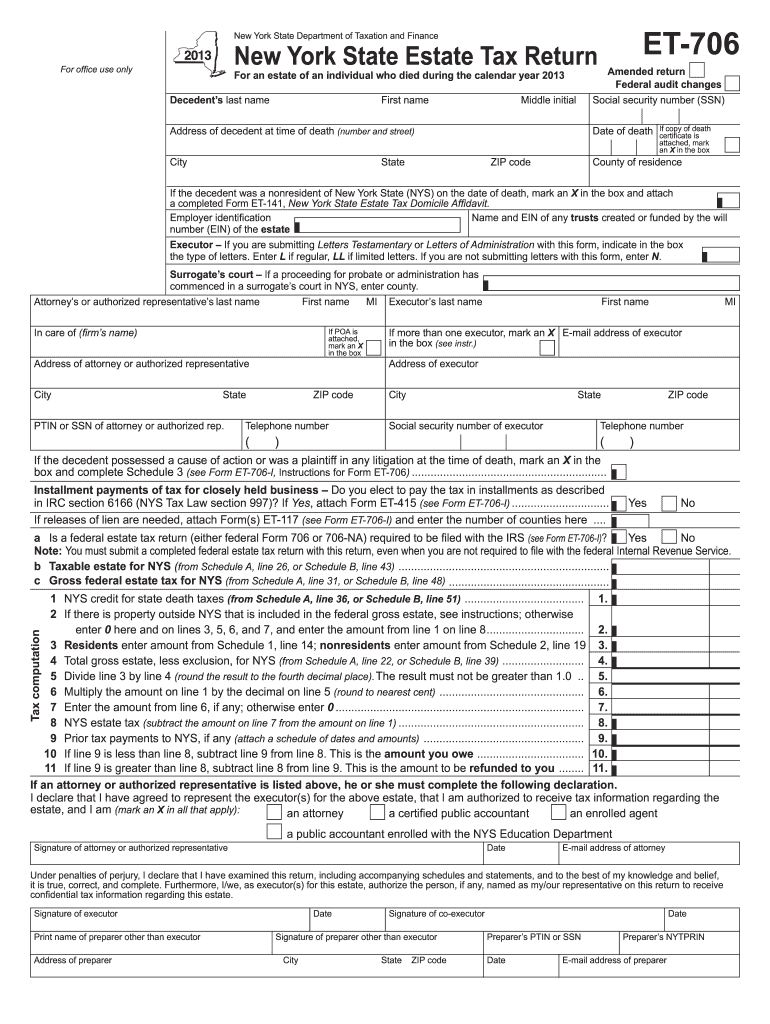
(from Schedule A, line 36, or Schedule B, line 51) ....................................... 1. 2 If there is property outside NYS that is included in the federal gross estate, see instructions; otherwise enter 0 here and on lines 3, 5, 6, and 7, and enter the amount from line 1 on line 8. .............................. 2. . 3 Residents enter amount from Schedule 1, line 14; nonresidents enter amount from Schedule 2, line 19 3. 4 Total gross estate, less exclusion, for NYS (.
Loading

Open form follow the instructions

Easily sign the form with your finger

Send filled & signed form or save
How to fill out the NY DTF ET-706 online
The New York State Estate Tax Return, commonly referred to as the NY DTF ET-706, is a crucial form for reporting estate taxes in New York State. This guide provides step-by-step instructions to assist users in completing the form accurately and efficiently online.
Follow the steps to complete the NY DTF ET-706 online.
- Click the ‘Get Form’ button to obtain the NY DTF ET-706 and access it in the online editor.
- Begin by entering the decedent's last name, first name, and middle initial in the respective fields.
- Fill in the address of the decedent at the time of death, including the city, state, and ZIP code.
- Enter the date of death in the designated field. If a copy of the death certificate is attached, mark an X in the box provided.
- Indicate the county of residence and if the decedent was a nonresident of New York State. If applicable, attach Form ET-141.
- Provide the employer identification number (EIN) for any trusts created or funded by the will.
- Indicate the type of letters (regular or limited) being submitted, or enter ‘N’ if none are being submitted.
- Enter the name of the executor, and if applicable, provide the name and address of the attorney or authorized representative.
- Complete the sections for tax computation by filling out the taxable estate amounts and any applicable deductions.
- Address the schedules regarding any out-of-state property and any cause of action or pending litigation related to the estate.
- Review all entries for accuracy and completeness before proceeding.
- Once all information is entered, save your changes, and choose to download, print, or share the completed form.
Complete your NY DTF ET-706 online to ensure proper estate tax processing.
Experience a faster way to fill out and sign forms on the web. Access the most extensive library of templates available.
Related content
Yes. No. Note: You must submit a completed federal estate tax return with this return...
by GB Born · Cited by 82 — The United Nations Convention on the Recognition and...
This publication contains information on the emula- tion of 1401, 1440, and 1460 object...
Get answers to your most pressing questions about US Legal Forms API.
What is DTF payment NY?
A DTF payment in New York refers to payments made to the New York State Department of Taxation and Finance for various tax obligations. This could include income tax, sales tax, or other state-imposed taxes. It is crucial to stay on top of these payments to avoid penalties and ensure compliance with state regulations.
How do I avoid NYS estate tax cliff?
To navigate the NYS estate tax cliff, strategic estate planning is vital. Utilize tools such as trusts to help reduce the taxable amount of your estate. Additionally, understanding the exemptions related to the NY DTF ET-706 can significantly impact your estate tax liability.
How do I get a New York State withholding account number?
To acquire a New York State withholding account number, complete Form NYS-1 to register your business. After submitting this form, the New York State Department of Taxation and Finance will provide your account number. This account number is essential for filing withholdings and payments correctly.
How do I get a NY withholding identification number?
To obtain a New York withholding identification number, you must complete Form NYS-1, which is the New York State Employer Registration for Withholding Tax. You can apply online through the New York State Department of Taxation and Finance website. Receiving your ID generally occurs quickly, enabling you to manage your tax responsibilities effectively.
Who signs 706 if there is no executor?
If there is no appointed executor for the estate, the NY DTF ET-706 form can be signed by an authorized party. This might include beneficiaries or individuals who are legally involved with the estate. It is important to establish authority, often with documentation, to ensure the filing meets New York state requirements.
Do I have to report the sale of inherited property to the IRS?
Yes, you must report the sale of inherited property to the IRS. While you may not owe taxes on the property itself, any gain from the sale can be taxable. Understanding the nuances of both estate tax and the reporting requirements associated with the NY DTF ET-706 is essential for accurate tax filing.
How much can you inherit in NYS without paying taxes?
In New York State, you can inherit up to a certain amount, currently set by the estate tax exemption, without incurring taxes. This amount can change based on legislation, so staying updated is crucial. Utilizing the NY DTF ET-706 can ensure you are compliant and clear on any tax obligations.
Does every estate have to file a form 706?
Not every estate is required to file Form 706. Only estates that exceed the New York estate tax exemption limit need to submit this form. If you're unsure, it's wise to consult resources or professionals who can clarify requirements related to the NY DTF ET-706.
Who is not required to file Form 709?
Form 709 is not required for individuals who have not made gifts exceeding the annual exclusion limit set by the IRS. Generally, if your gifting does not surpass this limit, you may not need to worry about filing. Understanding your gifting strategy can help simplify your tax obligations, avoiding unnecessary complexity with forms like the NY DTF ET-706.
Who is subject to estate tax?
In New York, any individual whose estate value exceeds the set threshold upon death is subject to estate tax. This includes all assets owned at the time of death, including property, investments, and bank accounts. Understanding the implications of the NY DTF ET-706 is essential for proper estate planning.
Use professional pre-built templates to fill in and sign documents online faster. Get access to thousands of forms.
If you believe that this page should be taken down, please follow our DMCA take down process here.
This form is available in several versions. Select the version you need from the drop-down list below.