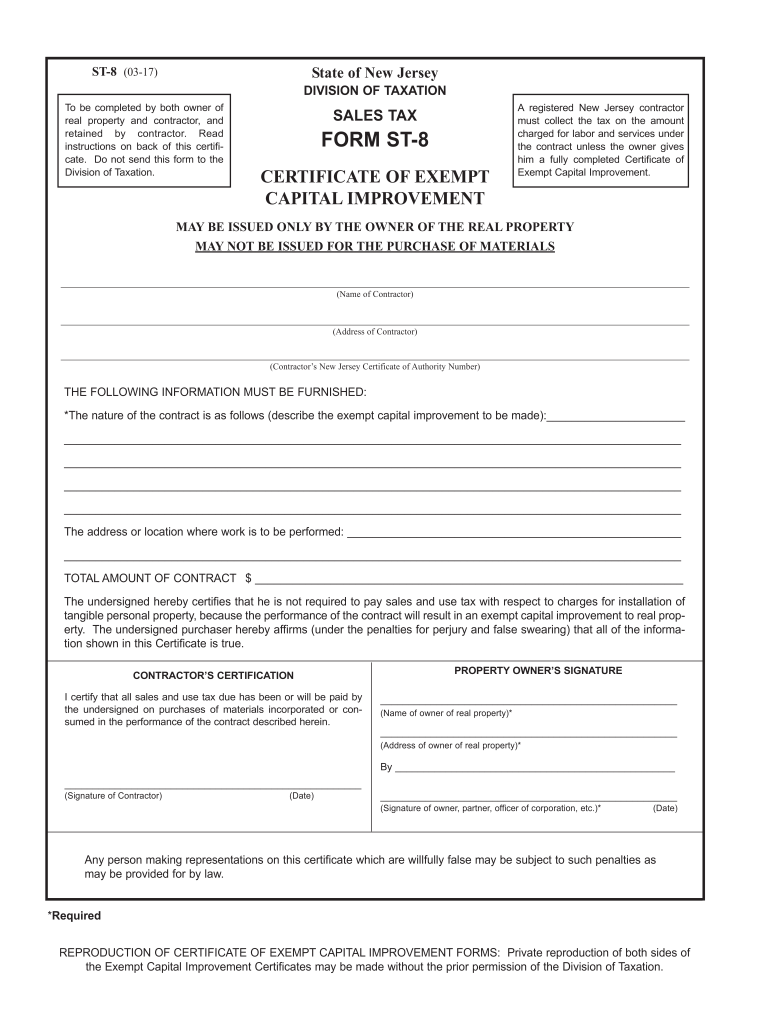
Alse may be subject to such penalties as may be provided for by law. *Required REPRODUCTION OF CERTIFICATE OF EXEMPT CAPITAL IMPROVEMENT FORMS: Private reproduction of both sides of the Exempt Capital Improvement Certificates may be made without the prior permission of the Division of Taxation. INSTRUCTIONS TO THE PROPERTY OWNER: In cases where the contractor performs work which results in an exempt capital improvement to your house or land (real property), he may NOT charge you any sales tax.
Loading

Open form follow the instructions

Easily sign the form with your finger

Send filled & signed form or save
How to fill out the NJ DoT ST-8 online
The NJ DoT ST-8 form, known as the Certificate of Exempt Capital Improvement, allows property owners to claim exemption from sales tax for certain types of capital improvements made to real property. This guide provides a clear and comprehensive approach to completing the form online, ensuring you meet all requirements.
Follow the steps to complete the NJ DoT ST-8 form online.
- Press the ‘Get Form’ button to obtain the form and open it in your preferred document editor.
- Fill in the name of the contractor and their address in the designated fields at the top of the form. Ensure the information is accurate to avoid any issues.
- Enter the contractor’s New Jersey Certificate of Authority Number. This information is essential for validating the contractor's registration.
- In the section labeled ‘Nature of the contract’, describe the exempt capital improvement to be made. Provide a detailed explanation to ensure clarity.
- Specify the address or location where the work is to be performed. This must be precise to allow for any necessary inspections.
- Input the total amount of the contract in the provided space. This amount should reflect the total charge for labor and services, exclusive of any materials that do not qualify for exemption.
- Both the property owner and contractor must sign the document. The property owner should sign and provide their name and address, while the contractor must also sign and date the form.
- Once all sections are completed and signed, you can save your changes, download the document for your records, print it if needed, or share it according to your requirements.
To ensure proper documentation, complete the NJ DoT ST-8 form online today!
Experience a faster way to fill out and sign forms on the web. Access the most extensive library of templates available.
Related content
New Jersey Department of Transportation - Official Home Page.
by EY Hajj · 2021 · Cited by 6 — (8) Training and certification. (9) Implementation...
Oct 1, 2017 — The New Jersey Highway Safety Plan (HSP) is required by federal law to...
Get answers to your most pressing questions about US Legal Forms API.
How to fill out a certificate of exemption?
Filling out a certificate of exemption involves listing your details and the basis for the exemption clearly. Make sure to provide accurate information to avoid complications down the line. When utilizing the NJ DoT ST-8, you can simplify this process by following the provided guidelines, ensuring all relevant details are included.
Can I file myself as an exemption?
Yes, you can file yourself as an exemption if you meet the criteria established by New Jersey law. While the process can be complex, completing the necessary forms, such as the NJ DoT ST-8, allows you to officially document your exempt status. However, review all requirements carefully to ensure your application is valid.
How to apply for an exemption certificate?
To apply for an exemption certificate in New Jersey, you will first need to complete the appropriate application forms and gather necessary documentation. This process may require you to demonstrate your eligibility based on your status or the purpose of the exemption. Utilizing the NJ DoT ST-8 can expedite your application process, ensuring you meet all legal requirements.
What qualifies as a capital improvement in NJ?
In New Jersey, a capital improvement qualifies as a permanent enhancement that adds value to your property. This can include extensive renovations, new structures, or upgrades that prolong the property's life. Understanding these qualifications is essential when using the NJ DoT ST-8 to claim exemptions on expenditures related to capital improvements.
What is an ST-8 tax exempt form for in NJ?
The ST-8 tax exempt form is used in New Jersey to claim exemption from sales tax on specific purchases. This form is especially crucial for non-profits, government entities, and other qualifying organizations. By submitting the NJ DoT ST-8, you can appropriately document your tax-exempt status and facilitate smoother transactions.
How to fill out ST3 form?
To fill out the ST3 form, start by obtaining the form from the New Jersey Department of Taxation. Gather the required information, such as your business details and the nature of the transaction. Each section should be completed correctly, as inaccuracies can lead to delays in processing your NJ DoT ST-8 request.
What is an example of a tax exemption?
A common example of a tax exemption in New Jersey includes exemptions for certain non-profit organizations or religious institutions. These exemptions reduce or eliminate tax liabilities, allowing these entities to allocate more resources to their mission. The NJ DoT ST-8 can be useful in formalizing your claim for such an exemption.
How do I fill out an exemption?
Filling out an exemption requires you to gather the necessary documents and information, including your personal details and the reason for the exemption. Make sure to obtain the NJ DoT ST-8 form and carefully follow the instructions provided. It's beneficial to double-check your entries to ensure accuracy and avoid mistakes.
How to get a sales tax exemption certificate?
To acquire a sales tax exemption certificate, you’ll usually need to fill out the appropriate state form specific to your situation. In New Jersey, leveraging the NJ DoT ST-8 is key for property-related exemptions. Ensure that you have all required documents ready for submission to streamline the process.
Are new countertops a capital improvement?
New countertops typically qualify as a capital improvement, as they significantly upgrade the functionality and appearance of a property, increasing its value. These enhancements can fall under the NJ DoT ST-8 exemptions if they are part of broader renovations. Always confirm eligibility by reviewing the specific improvement types recognized by your state.
Use professional pre-built templates to fill in and sign documents online faster. Get access to thousands of forms.
If you believe that this page should be taken down, please follow our DMCA take down process here.