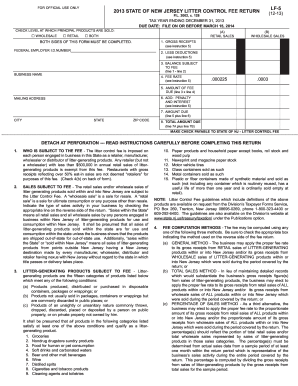
Ded, placed or deposited by a person on public property, or on private property not owned by him. It shall be presumed that all products in the following categories listed satisfy at least one of the above conditions and qualify as a littergenerating product. 1. Groceries 2. Nondrug drugstore sundry products 3. Food for human or pet consumption 4. Soft drinks and carbonated waters 5. Beer and other malt beverages 6. Wine 7. Distilled sprits 8. Cigarettes and tobacco products 9. Cleaning agents a.
Open form follow the instructions
Easily sign the form with your finger
Send filled & signed form or save
How to fill out the NJ DoT LF-5 online
Filling out the New Jersey Department of Transportation LF-5 form is an essential task for businesses that are subject to the litter control fee. This guide provides you with clear, step-by-step instructions to complete the form efficiently and accurately.
Follow the steps to complete the NJ DoT LF-5 form online.
- Press the ‘Get Form’ button to access the document and open it in your preferred digital editing tool.
- Complete the business name, mailing address, city, state, and ZIP code fields to identify your business accurately.
- Indicate your sales type by selecting either wholesale, retail, or both on the form. This helps determine your respective fee obligations.
- Enter your gross receipts from litter-generating products in the provided fields. Make sure to report in whole dollars based on sales during the appropriate period.
- List any deductions applicable to your business on the form. These can include certain sales that are exempt from the litter control fee.
- Calculate the balance subject to the fee by subtracting the deductions from your gross receipts.
- Choose the appropriate fee rate based on your type of sales and enter it into the designated field on the form.
- Calculate the amount of fee due by multiplying your balance subject to the fee by the applicable fee rate.
- Add any penalties and interest if applicable to determine the final amount due.
- Review all the completed fields for accuracy and make sure to sign and date the form where required.
- Save your changes, and you may choose to download, print, or share the completed form as needed.
Complete the NJ DoT LF-5 form online today to ensure compliance with litter control fee regulations.
Experience a faster way to fill out and sign forms on the web. Access the most extensive library of templates available.
Related content
WHO IS SUBJECT TO THE FEE – The litter control fee is imposed on each person engaged in...
by EY Hajj · 2021 · Cited by 6 — NJDOT developed and implemented PBS for five...
Dec 17, 2007 — THE CLEAR SPACE IN THE CURB OPENING. (OR EACH INDIVIDUAL CLEAR SPACE, IF...
Get answers to your most pressing questions about US Legal Forms API.
Does the post office have tax forms?
Typically, local post offices do not stock NJ tax forms. However, they may have limited IRS forms available. For New Jersey tax forms, your best bet is to use the NJ DoT LF-5 form or visit the New Jersey Division of Taxation's website where you can download exactly what you need.
How do I order tax forms to be mailed?
To order tax forms to be mailed, complete the NJ DoT LF-5, where you can request a variety of forms according to your needs. Once submitted, the Division of Taxation will process your request and send the forms directly to you. This method ensures you have all the necessary documentation for your tax preparations.
Who needs to file NJ 500?
Individuals who earn income in New Jersey and do not meet the conditions for filing the NJ 1040 may need to file NJ 500. This can include those who are non-residents or have specific income thresholds. Make sure to review the filing requirements on the New Jersey Division of Taxation's website or consult the NJ DoT LF-5 form for relevant details.
How do I order tax forms in New Jersey?
To order tax forms in New Jersey, you can use the New Jersey Division of Taxation’s online services. Alternatively, complete the NJ DoT LF-5 form, which allows you to specify which tax forms you need for your filing. This process saves you time and ensures you get accurate information.
How to order NJ tax forms?
Ordering NJ tax forms is straightforward. You can access the New Jersey Division of Taxation's website for immediate downloads or complete the NJ DoT LF-5 form to request forms to be mailed to you. This ensures you receive the specific forms you need without hassle.
How do I get my NJ 1040?
To get your NJ 1040, visit the New Jersey Division of Taxation's website where you can easily find the form. You can download it directly as a PDF and print it at home. If you prefer a physical copy, you can order it through the mail by using the NJ DoT LF-5 form that guides you on how to access tax forms efficiently.
Is NJ Transit part of NJ DOT?
NJ TRANSIT functions independently but collaborates with the New Jersey Department of Transportation (NJ DOT). While NJ DOT oversees overall transportation policy, NJ TRANSIT focuses specifically on public transportation services. This relationship ensures comprehensive transit solutions for the state's residents. For any related legal transactions, the NJ DoT LF-5 may be the required form to navigate these processes.
Are NJ TRANSIT employees state employees?
NJ TRANSIT employees are not state employees in a traditional sense, although they work closely with the state government. They do receive benefits and job protections similar to state employees due to their roles within a government agency. This distinction is vital for understanding eligibility for certain employee benefits and legal forms, including those associated with the NJ DoT LF-5.
Is NJ TRANSIT part of the government?
Yes, NJ TRANSIT operates as a public agency in New Jersey, making it part of the government structure. It was established to provide transportation services across the state and ensure accessibility for residents. By being a public entity, it is accountable to the state and the residents it serves. Understanding this relationship is important when considering legal forms like the NJ DoT LF-5.
At what age do you no longer have to file taxes?
When seniors must file For tax year 2018, you will need to file a return if you are unmarried and at least 65 years of age, and your gross income is $13,600 or more. However, if you live on Social Security benefits, you don't include this in gross income.
Use professional pre-built templates to fill in and sign documents online faster. Get access to thousands of forms.
If you believe that this page should be taken down, please follow our DMCA take down process here.
This form is available in several versions. Select the version you need from the drop-down list below.