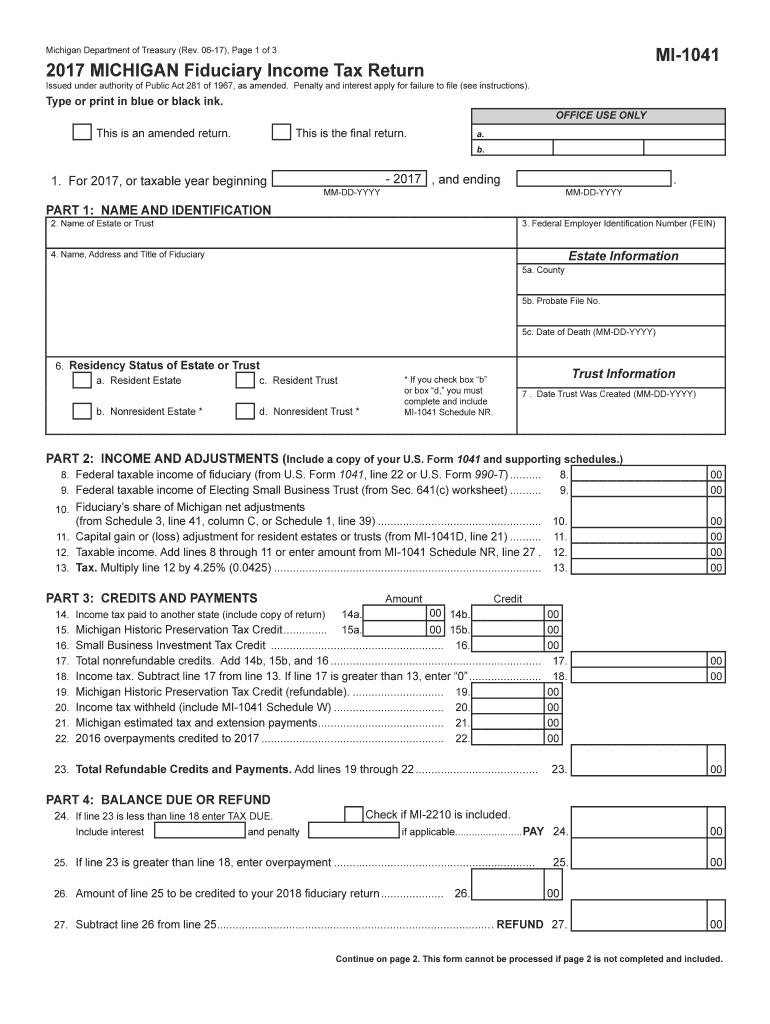
1 of 1967, as amended. Penalty and interest apply for failure to file (see instructions). Type or print in blue or black ink. OFFICE USE ONLY This is an amended return. This is the final return. a. b. 1. For 2017, or taxable year beginning MM-DD-YYYY - 2017 , and ending PART 1: NAME AND IDENTIFICATION 2. Name of Estate or Trust MM-DD-YYYY . 3. Federal Employer Identification Number (FEIN) 4. Name, Address and Title of Fiduciary 5a. County Estate Information 5b. Probate File No. 5c.
Loading

Open form follow the instructions

Easily sign the form with your finger

Send filled & signed form or save
How to fill out the MI DoT MI-1041 online
Filling out the Michigan Department of Treasury MI-1041 form can be a straightforward process if you follow the appropriate steps. This guide provides clear, detailed instructions designed to support users in accurately completing the form online.
Follow the steps to fill out the MI DoT MI-1041 online.
- Press the ‘Get Form’ button to access the MI-1041 document and open it in your preferred editor.
- Begin with Part 1, where you will enter the name and identification details of the estate or trust. Provide the name of the estate or trust, along with the federal employer identification number (FEIN). Also, include the name, address, and title of the fiduciary.
- Next, indicate the residency status of the estate or trust by selecting the appropriate option: resident estate, nonresident estate, resident trust, or nonresident trust. If applicable, make sure to complete and include the MI-1041 Schedule NR.
- In Part 2, move on to income and adjustments. Provide the federal taxable income of the fiduciary, followed by the fiduciary’s share of Michigan net adjustments, and any necessary capital gain or loss adjustments.
- Calculate the taxable income by adding together the amounts from the previous fields, and then compute the tax by multiplying this amount by 4.25%.
- Continue to Part 3, where you will report any credits and payments. Include the amounts for Michigan credits, income tax withheld, and any overpayments from the previous year that are being credited.
- In Part 4, evaluate whether there is a balance due or a refund. Calculate accordingly and include any applicable interest and penalty.
- Ensure that all fields are completed on all pages of the form. If necessary, complete the additional schedules, including Schedule 1 for adjustments and Schedules 2 and 3 for beneficiary information.
- Finally, review the entire form for accuracy. Save your changes, and then download, print, or share the completed form as needed.
Complete your MI DoT MI-1041 online today to ensure timely submission.
Experience a faster way to fill out and sign forms on the web. Access the most extensive library of templates available.
Related content
Form 1041 is prepared after an interdisciplinary team (IDT) meeting when a person who is...
1041 Propylene Dichloride (FL, P). 3409 Propylene Glycol (I). 1043 Propylene Glycol...
A PARTE I deste manual é a 9ª edição do manual genérico. Parte ii. Contém...
Get answers to your most pressing questions about US Legal Forms API.
Are state refunds taxable on Form 1041?
State refunds are generally not taxable on Form 1041 if the state taxes were not deducted in a previous year. However, if the state taxes contributed to a tax benefit, that may change the situation. For accurate guidance on this matter, consider consulting with a tax professional when dealing with your MI DoT MI-1041.
Who has to file an MI 1040?
Typically, residents of Michigan with taxable income must file an MI 1040. This includes individuals who earned wages, self-employment income, or had other sources of income. It’s crucial to determine your filing status related to your MI DoT MI-1041 obligations.
How do I know if I need to file a 1041?
You need to file a 1041 if your trust or estate has generated income during the tax year that meets or exceeds the IRS thresholds. Additionally, it is essential to consider any distributions made to beneficiaries, as these can impact your filing requirements. Clarifying these details will help you understand if you must file the MI DoT MI-1041.
Do I have to file a 1041 for an estate with no income?
If your estate has no income, you generally do not need to file a 1041. However, there can be exceptions, so it is vital to assess the specifics of your situation. For clarity, seek guidance on this aspect during your MI DoT MI-1041 preparation.
How to report sale of residence on form 1041?
To report the sale of a residence on Form 1041, you will typically include the details of the sale in the income section. If the trust or estate owned the property, any profit from the sale should be reported as income. It is prudent to consult a tax professional while preparing your MI DoT MI-1041 for accurate reporting.
Can an IRS form 1041 be filed electronically?
Yes, the IRS allows for the electronic filing of Form 1041. This option can streamline the filing process and often results in quicker processing times. Utilizing electronic platforms can assist in ensuring your MI DoT MI-1041 is filed accurately and efficiently.
Do I need to file a MI 1041?
You need to file a MI 1041 if your estate or trust has taxable income. Additionally, if you are handling an estate with a gross income that exceeds a certain limit, the MI DoT MI-1041 must be filed. It is essential to understand the income status of the estate or trust to determine the filing requirement.
What trusts must file Form 1041?
Certain trusts need to file Form 1041, specifically those that generate income during the tax year. This includes revocable trusts while the grantor is living as well as irrevocable trusts. If your trust has received income exceeding the filing threshold, you are required to file the MI DoT MI-1041.
Who pays the tax on form 1041?
The estate itself is typically responsible for paying taxes reported on Form 1041. The fiduciary managing the estate handles tax submissions on behalf of the estate. Utilizing the MI DoT MI-1041 ensures compliance, making tax obligations clearer for all involved.
What is the exemption for Form 1041?
The exemption for Form 1041 varies based on estate income and specific regulations set forth by tax authorities. Generally, estates with minimal income may qualify for an exemption. Understanding the MI DoT MI-1041 and its parameters can help identify your liability and eligibility for exemptions.
Use professional pre-built templates to fill in and sign documents online faster. Get access to thousands of forms.
If you believe that this page should be taken down, please follow our DMCA take down process here.
This form is available in several versions. Select the version you need from the drop-down list below.