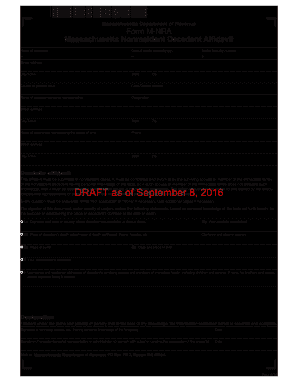
State Zip County of probate court Case/Docket number Name of executor/personal representative Designation Street address City/Town State Name of attorney(s) representing the estate (if any) Phone Zip Street address City/Town State Zip Domicile affidavit This affidavit must be submitted in nonresident cases. It must be completed and sworn to by the surviving spouse or member of the immediate family of the nonresident decedent having personal knowledge of the facts; or, if such sp.
Open form follow the instructions
Easily sign the form with your finger
Send filled & signed form or save
How to fill out the MA DoR M-NRA online
Filling out the Massachusetts Nonresident Decedent Affidavit, known as the MA DoR M-NRA, can be a straightforward process when guided properly. This document is essential for nonresidents to establish the domicile of the decedent at the time of death and requires accurate information regarding the decedent's estate.
Follow the steps to complete the MA DoR M-NRA accurately.
- Click the ‘Get Form’ button to download the MA DoR M-NRA document and open it for editing.
- Provide the name of the decedent in the specified field at the top of the form, followed by their date of death in the format mm/dd/yyyy.
- Enter the decedent's social security number and their street address, city or town, state, and zip code.
- Specify the county of the probate court and the case/docket number associated with the estate.
- Fill out the name and designation of the executor or personal representative responsible for the estate.
- If applicable, provide the name of the attorney representing the estate along with their contact number and address.
- Complete the domicile affidavit section, ensuring that it is signed by either the surviving spouse, an immediate family member, or the executor, all of whom should have personal knowledge of the facts.
- Answer all questions in the affidavit. In case a question does not apply, indicate 'Not applicable' or 'None' as necessary.
- Fill in the information regarding the decedent's domicile, place of death, burial, and their relationship to you.
- Provide details on the decedent's will or lack thereof, including court names, appointment dates, and additional documentation as needed.
- Continue filling out the sections pertaining to the decedent's residency history, voting record, tax payments, and relationships with Massachusetts during the five years preceding their death.
- Once all fields are completed, review the information for accuracy before either saving changes, downloading a copy, or printing the form for submission.
Complete your MA DoR M-NRA online to ensure accurate processing of the decedent's estate.
Experience a faster way to fill out and sign forms on the web. Access the most extensive library of templates available.
Related content
Form M-NRA is a Massachusetts Nonresident Decedent Affidavit used in nonresident cases to...
When did I switch from nonresident to resident for tax purposes? Generally, most...
Finalmente, você terá a opção de doar TokKul em um cofre perto da entrada do...
Get answers to your most pressing questions about US Legal Forms API.
Do I have to file a nonresident state tax return in Massachusetts?
Nonresidents may need to file a state tax return if they have earned income sourced from Massachusetts or if their estate falls into tax categories. It's advisable to examine your residency status and income sources carefully. For further clarification on tax obligations, the MA DoR M-NRA would be a valuable resource.
How much can you inherit in Massachusetts without paying taxes?
In Massachusetts, you can inherit any amount without facing an inheritance tax, as there is none. However, it’s important to note that estates above $1 million may incur estate taxes. Reviewing your situation in light of the MA DoR M-NRA can provide insights into your inheritance and any tax implications.
Who needs to file a Massachusetts estate tax return?
A Massachusetts estate tax return is required if the estate's value exceeds $1 million at the time of death. The personal representative responsible for managing the estate must file the return. Missing the filing can lead to penalties, so understanding your obligations is vital. For assistance, you may refer to the MA DoR M-NRA resources.
How to avoid inheritance tax in Massachusetts?
Since Massachusetts does not impose an inheritance tax, the focus should be on estate tax management. You can reduce potential estate taxes by utilizing various estate planning strategies, such as trusts or gifting during your lifetime. Consulting with professionals familiar with the MA DoR M-NRA can provide tailored strategies for minimizing your estate's tax burden.
What is the most you can inherit without paying taxes?
In Massachusetts, there is no inheritance tax; however, estates valued over a certain threshold may be subject to estate tax. Estates with a value exceeding $1 million generally require tax consideration. It is essential to assess your estate’s value to determine if taxes apply. The MA DoR M-NRA can provide guidance on estate valuation and tax obligations.
What are the rules for inheritance in Massachusetts?
In Massachusetts, inheritance rules dictate that assets pass directly to beneficiaries based on the decedent's estate plan. If there is no will, the state laws will determine the distribution of the estate. Typically, immediate family members have priority, but it is crucial to understand the specifics. For more clarity on your situation, consider using the MA DoR M-NRA guidelines.
How to calculate MA estate tax?
To calculate MA estate tax, first determine the total value of the estate, including all assets. Then, refer to the MA DoR M-NRA estate tax table to find the appropriate tax rate. This calculation can be complex, so consider using tools offered by platforms like uslegalforms for accurate preparation.
What is the DoR in Massachusetts?
The DoR, or Department of Revenue, in Massachusetts, oversees the state's tax policies and administration. This agency ensures accurate tax collection, helps enforce tax compliance, and maintains the integrity of the tax system, including guidelines like the MA DoR M-NRA. Understanding its functions can help you stay informed about your tax responsibilities and rights in Massachusetts.
What does dor mean in tax?
The term 'DoR' in tax refers to the Department of Revenue, the state agency responsible for tax collection, enforcement, and policy in Massachusetts. This agency plays a vital role in how taxes are administered, including interpretations relevant to the MA DoR M-NRA. Knowing how the DoR operates can provide valuable insights into compliance and tax planning.
What does dor mean for payment terms?
In this context, 'DoR' refers to the Department of Revenue, which sets the payment terms for tax obligations in Massachusetts. Understanding these terms is crucial for managing your financial responsibilities effectively, especially under the MA DoR M-NRA guidelines. Keeping track of deadlines can help avoid unnecessary fees and maintain good standing with the state.
Use professional pre-built templates to fill in and sign documents online faster. Get access to thousands of forms.
If you believe that this page should be taken down, please follow our DMCA take down process here.