Dent decedent who did not own real estate and/or tangible personal property in another state, omit Parts 2 and 3 and enter this amount in Part 4, line 1. If this return is for the estate of a Massachusetts resident decedent who owned real estate and/or tangible personal property in other states, complete Parts 2 and 4 and omit Part 3. If this return is for the estate of a nonresident decedent with Massachusetts property, omit Part 2 and complete Parts 3 and 4 . . . . . . . . . . . . . . . . . .
Open form follow the instructions
Easily sign the form with your finger
Send filled & signed form or save
How to fill out the MA DoR M-706 online
Filling out the Massachusetts Estate Tax Return (Form M-706) online can seem daunting. This guide is designed to provide clear instructions to help you navigate through each section of the form with ease.
Follow the steps to complete the form effectively.
- Click ‘Get Form’ button to obtain the form and open it in the editor.
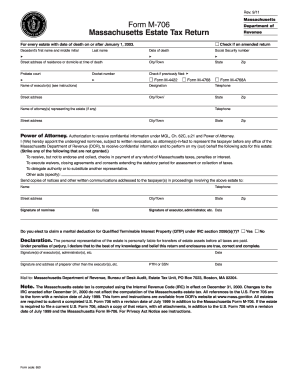
- Begin filling in the decedent’s personal information, including their first name, middle initial, last name, date of death, and Social Security number. Ensure accuracy in these fields as they establish the identity of the estate.
- Provide the residential address of the decedent at the time of death, including street address, city/town, state, and ZIP code.
- Indicate the probate court handling the estate and its docket number, if applicable. This information is crucial for legal documentation and processing.
- Complete the section for the executor(s) of the estate, including their name, designation, telephone number, and complete address.
- If an attorney is representing the estate, fill in their information in the designated fields, ensuring to include their telephone number and address.
- In the Power of Attorney section, appoint a nominee to represent the taxpayer and check off the actions that you are authorizing them to perform on your behalf.
- Decide on claiming a marital deduction for Qualified Terminable Interest Property (QTIP) and mark ‘Yes’ or ‘No’ accordingly.
- As the personal representative of the estate, sign and date the declaration, affirming the accuracy of the information provided.
- Finally, review all completed sections. You can save changes, download, or print the form for submission. Ensure you mail it to the Massachusetts Department of Revenue's Bureau of Desk Audit, Estate Tax Unit, at the specified address.
Complete your estate tax document online today for a smoother filing process.
Experience a faster way to fill out and sign forms on the web. Access the most extensive library of templates available.
Related content
May 14, 2025 — The Department now issues, Certificate Releasing Massachusetts Estate...
To compute the maximum federal credit for state estate taxes, the July 1999 revision of...
Conecte essa TV LED Smart Philips à Internet e descubra um novo mundo de televisão...
Get answers to your most pressing questions about US Legal Forms API.
What is Schedule M on Form 706?
Schedule M on Form 706 specifically pertains to the marital deduction. It includes information about property transferred to a spouse and can significantly affect estate tax calculations. Utilizing resources like uslegalforms can help you ensure that your Schedule M is completed accurately when filing the MA DoR M-706.
What is IRS Schedule M?
IRS Schedule M allows executors to report property that qualifies for the marital deduction. This schedule simplifies the process of determining the tax implications of property passed to a surviving spouse. If you are navigating the MA DoR M-706, understanding Schedule M is crucial for accurate reporting.
What are the filing requirements for the estate tax return 706?
The filing requirements for Form 706 depend on the gross estate value. Generally, if the value exceeds the federal estate tax exemption amount, you must file. It's important to review the MA DoR M-706 guidelines to ensure compliance with state-specific rules as well.
What schedule does IRA go on a 706?
IRAs are reported on Schedule B of Form 706. This schedule details the value of the gross estate, including retirement accounts. If you need assistance with these details, consider using uslegalforms to guide you through the specifics of the MA DoR M-706.
What is Schedule M used for?
Schedule M is used to report the value of certain property that is transferred to a surviving spouse. It plays a crucial role in determining the marital deduction for the estate tax return. Understanding how to fill out Schedule M accurately is essential for those submitting the MA DoR M-706.
When must form 706 be filed electing portability?
Form 706 must be filed within nine months of the decedent's death if you choose to elect portability. This election allows the unused portion of the estate tax exemption to be transferred to the surviving spouse, providing significant tax benefits. Make sure to consult with a professional or use resources like uslegalforms to ensure proper filing for the MA DoR M-706.
Can I file MA state taxes online?
Yes, you can file MA state taxes online. The MA Department of Revenue offers a streamlined process to file your taxes electronically, which can save you time and reduce errors. Using services like uslegalforms can help you understand and complete the necessary forms, including the MA DoR M-706, with ease.
What is the most you can inherit without paying taxes?
In Massachusetts, you can inherit any amount without facing inheritance taxes, as the state does not apply this type of tax. Nevertheless, estates valued over $1 million may face estate taxes, which are governed by the MA DoR M-706 guidelines. Effective estate planning can help ensure that you maximize your inheritance while minimizing tax implications.
How much can you inherit in Massachusetts without paying taxes?
In Massachusetts, there is no specific threshold for inheritance taxes, as the state does not impose an inheritance tax on recipients. However, estates valued above $1 million may be subject to estate tax under the MA DoR M-706. It's important to plan accordingly, as proper strategies can protect your inheritance from unnecessary taxes.
How to avoid inheritance tax in Massachusetts?
While Massachusetts does impose an estate tax, there is no inheritance tax on beneficiaries. To manage estate taxes effectively, consider strategies such as gifting assets during your lifetime or establishing trusts. Familiarizing yourself with the MA DoR M-706 and its implications can aid in planning to minimize your estate's tax burden.
Use professional pre-built templates to fill in and sign documents online faster. Get access to thousands of forms.
If you believe that this page should be taken down, please follow our DMCA take down process here.
This form is available in several versions. Select the version you need from the drop-down list below.