Loading
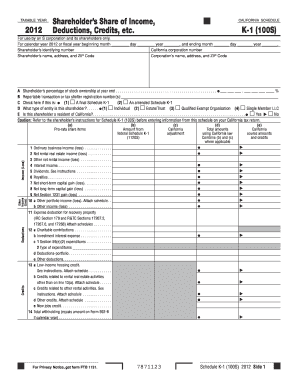
Get Ca Ftb 100s Schedule K-1 2012
How it works
-

Open form follow the instructions
-

Easily sign the form with your finger
-

Send filled & signed form or save
How to fill out the CA FTB 100S Schedule K-1 online
Filling out the CA FTB 100S Schedule K-1 online can be a straightforward process when you follow clear guidance. This document is essential for S corporations and their shareholders to report financial information accurately.
Follow the steps to complete the CA FTB 100S Schedule K-1 online.
- Click ‘Get Form’ button to obtain the form and open it in the editor.
- Enter the taxable year at the top of the form, ensuring that you specify either the calendar year or fiscal year as needed.
- Fill in the shareholder's identifying number and California corporation number in the designated fields.
- Provide the shareholder’s name, address, and ZIP Code, followed by the corporation’s name, address, and ZIP Code.
- In section A, indicate the shareholder’s percentage of stock ownership at year-end as a percentage.
- Complete section B if there are reportable transactions or tax shelter registration numbers; provide the necessary details.
- Use section C to check whether this is a final or amended Schedule K-1.
- In section D, select the type of entity that the shareholder represents by marking the appropriate box.
- In section E, confirm whether the shareholder is a resident of California by checking yes or no.
- Proceed to fill out the credits and deductions sections in accordance with the provided instructions, including amounts for total expenses and income.
- Carefully review all entries for accuracy, making any necessary corrections.
- Once you have completed the form, you can save changes, download it, print, or share your filled-out Schedule K-1.
Start filling out your CA FTB 100S Schedule K-1 online today!
Get form
Experience a faster way to fill out and sign forms on the web. Access the most extensive library of templates available.
Related links form
Not all income counts as gross receipts; certain items such as capital gains and non-operating income are typically excluded. For instance, loans received or funds raised through financing are not part of gross receipts. When preparing your CA FTB 100S Schedule K-1, it’s crucial to correctly identify and exclude these items for accurate reporting. This attention to detail helps maintain compliance and accuracy in your tax filings.
Get This Form Now!
Use professional pre-built templates to fill in and sign documents online faster. Get access to thousands of forms.