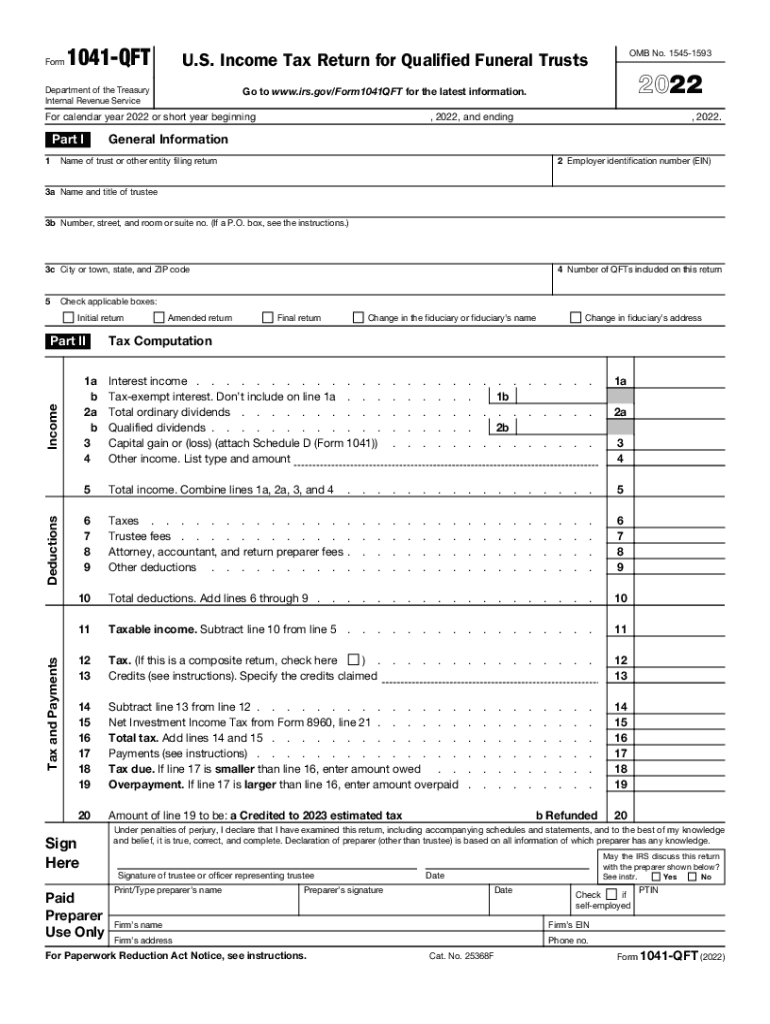
Form1041QFTDepartment of the Treasury Internal Revenue Service12022Go to www.irs.gov/Form1041QFT for the latest information. For calendar year 2022 or short year beginningPart BOMB No. 15451593U.
Loading

Open form follow the instructions

Easily sign the form with your finger

Send filled & signed form or save
How to fill out the IRS 1041-QFT online
Filling out the IRS 1041-QFT form online is an essential step for trustees managing qualified funeral trusts. This guide provides a clear, step-by-step approach to help users navigate through each section and field of the form effectively.
Follow the steps to complete the IRS 1041-QFT online.
- Click ‘Get Form’ button to obtain the form and open it in the editor.
- In Part I, enter the employer identification number (EIN) of the trust in Section 2. This identification number is crucial for filing the trust's tax return.
- For line 1, input the exact name of the trust as it appears on the form SS-4 used to apply for the EIN.
- Provide the name and title of the trustee in line 3a. Fill in the contact address in lines 3b and 3c, ensuring all relevant details are accurate.
- Select the applicable box under General Information to indicate if this is an initial, amended, or final return, or if there has been a change in fiduciary details.
- Moving to Part II, calculate the income by summing up the amounts reported in lines 1a through 4, making sure to categorize the types of income correctly.
- Enter total deductions in line 10 by adding up the values from lines 6 through 9.
- Compute the taxable income by subtracting line 10 from line 5 and enter the result in line 11.
- Determine your tax liability on line 12, applying the appropriate tax rate schedule based on your taxable income.
- If claiming any credits, specify the type in line 13 and attach any required documentation.
- Finalize your tax by adding any additional taxes and previous payments; record this in lines 15 to 19.
- After reviewing all entered information for accuracy, sign and date the form in the designated area.
- Save your changes, and then download, print, or share the completed form as needed.
Begin filling out your IRS 1041-QFT form online today for a seamless filing experience.
Experience a faster way to fill out and sign forms on the web. Access the most extensive library of templates available.
Related content
The trustee of a trust that has elected to be taxed as a qualified funeral trust (QFT)...
Jun 8, 2018 - ... Electing Alaska Native Settlement,” or Form 1041-QFT, “U.S. Income...
Instructions for Form 7004 Department of the Treasury Internal Revenue Service (Rev....
Get answers to your most pressing questions about US Legal Forms API.
Is an estate tax return required?
IRS Form 1041, U.S. Income Tax Return for Estates and Trusts, is required if the estate generates more than $600 in annual gross income. The decedent and their estate are separate taxable entities. Before filing Form 1041, you will need to obtain a tax ID number for the estate.
Do all estates have to file Form 706?
Not all estates must file Form 706. Not all estates must file a federal estate tax return. IRS Form 706, the United States Estate (and Generation-Skipping Transfer) Tax Return, is required by the federal government only for estates that meet certain criteria.
Who must file estate tax return?
The executor must file a federal income tax return (Form 1041) if the estate has: gross income for the tax year of $600 or more, or. a beneficiary who is a nonresident alien.
Who Must File Form 706?
IRS Form 706 must be filed on behalf of a U.S. citizen or resident whose gross estate, plus adjusted taxable gifts and specific exemptions, exceeds $11,180,000 in 2018, which is also known as the exclusion amount. The executor also has to file the form should the executor transfer any amount to the surviving spouse.
Do you have to file a 1041 if there is no income?
Not every estate is required to file Form 1041 for income earned. If the estate has no income producing assets or the annual gross income is less than $600, no return is necessary. ... The executor or personal representative of the estate must file the return.
Who must file a 1041 tax return?
Which Estates Must File IRS Form 1041? The executor or personal representative of an estate must file Form 1041 when a domestic estate has gross income for the tax year of $600 or more or when one or more of its beneficiaries are nonresident aliens.
How do I file a tax return for a trust?
In case the Trust is required to file income tax return due to taxable income being over Rs.2.5 lakhs, then ITR 5 can be filed. In case the Trust is required to file income tax return mandatorily under Sections 139(4A) or139(4B) or 139(4C) or 139(4D) or 139(4E) or139(4F) of the Income Tax Act, then ITR 7 must be filed.
Does an irrevocable trust need to file a tax return?
An irrevocable trust is treated as a separate taxpayer and must file a federal income tax return on Form 1041 each year. ... However, if the trustee has no obligation to distribute earnings to beneficiaries and accumulates income within the trust, she must pay tax on those earnings using money from the trust.
Does a trust need to file a tax return?
A: Trusts must file a Form 1041, U.S. Income Tax Return for Estates and Trusts, for each taxable year where the trust has $600 in income or the trust has a non-resident alien as a beneficiary. ... Thus, the grantor/individual would pay the total tax liability upon the filing of his return for that taxable year.
Do I need to file an estate tax return for 2018?
You must file Form 1041 (U.S. Income Tax Return for Estates and Trusts) by the 15th day of the fourth month after the tax year-end (adjusted for weekends and holidays). So for a person who died in 2018, the deadline is April 15, 2019, when the standard Dec. 31 tax year-end is chosen.
Use professional pre-built templates to fill in and sign documents online faster. Get access to thousands of forms.
If you believe that this page should be taken down, please follow our DMCA take down process here.