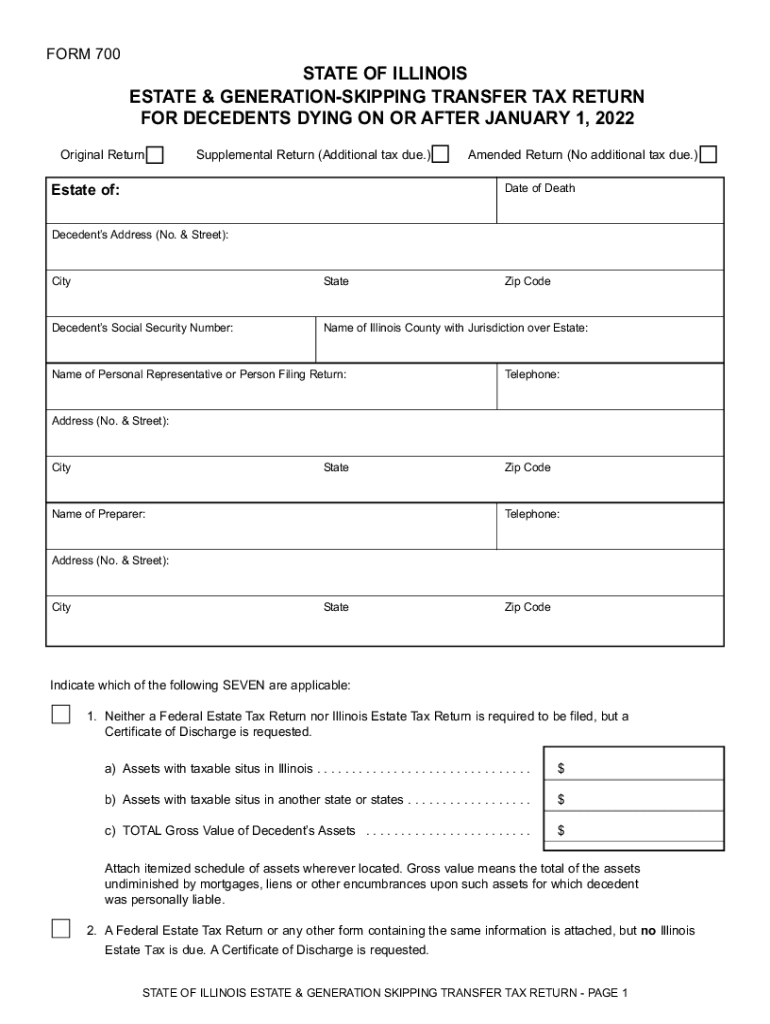
FORM 700STATE OF ILLINOIS ESTATE & GENERATIONSKIPPING TRANSFER TAX RETURN FOR DECEDENTS DYING ON OR AFTER JANUARY 1, 2022, Original Return Supplemental Return (Additional tax due.) Estate of: of:.
Loading

Open form follow the instructions

Easily sign the form with your finger

Send filled & signed form or save
How to fill out the IL 700 online
Filling out the IL 700 form can seem daunting, but understanding its components and following the right steps can simplify the process. This guide will provide a clear and supportive outline to assist you in completing the Estate & Generation-Skipping Transfer Tax Return for decedents who died on or after January 1, 2022.
Follow the steps to successfully complete the IL 700 form online.
- Select the 'Get Form' button to obtain the IL 700 form and open it in your designated editing tool.
- Indicate whether this is an Original Return, Supplemental Return, or Amended Return by checking the appropriate box provided.
- Enter the decedent's information, including their name, date of death, address, social security number, and the name of the county with jurisdiction over the estate.
- List the name and contact information of the personal representative or person filing the return, including their address and telephone number.
- Identify the applicable options by checking one of the seven scenarios provided in the form regarding the necessity of filing federal or Illinois estate tax returns.
- Fill in the financial details related to the decedent’s assets, including gross value, Illinois QTIP election amounts, and any requested forms or schedules.
- Complete the Recapitulation section by calculating the total tax, penalties, and interest payable, ensuring all lines are filled out accurately.
- Review all information for accuracy before signing the declaration section at the end of the form, which must be completed by the personal representative and preparer.
- Once the form is completed, save your changes, and proceed to download, print, or share the completed document as necessary.
Start completing the IL 700 online now to ensure timely filing!
Experience a faster way to fill out and sign forms on the web. Access the most extensive library of templates available.
Related content
2015 Decedents, 2014 Decedents, 2013 Decedents, 2012 Decedents. 2011 Decedents, 2010...
4/20/2015. Hinsdale Central (unlimited division), Vernon Hills (700 division), University...
Il est strictement interdit d'utiliser des antennes ayant un gain sup_rieur ˆ 6 dBi avec...
Get answers to your most pressing questions about US Legal Forms API.
What is the tax withholding rate in Illinois?
Generally, the rate for withholding Illinois Income Tax is 4.95 percent. For wages and other compensation, subtract any exemptions from the wages paid and multiply the result by 4.95 percent.
What is the inheritance tax threshold for 2019?
IHT thresholds and rates 2019-20. Everyone in the 2019-20 tax year has a tax-free inheritance tax allowance of £325,000 known as the nil-rate band. The allowance has remained the same since 2010-11. The standard inheritance tax rate is 40% of anything in your estate over the £325,000 threshold.
How much money can you inherit before you have to pay taxes on it?
The federal government doesn't impose an inheritance tax, and inheritances generally aren't subject to income tax. If your aunt leaves you $50,000, that's not considered income so the cash is tax-free at least as far as the IRS is concerned.
Which states have estate taxes 2019?
The U.S. states that collect an inheritance tax as of 2019 are Iowa, Kentucky, Maryland, Nebraska, New Jersey, and Pennsylvania.
Does Illinois have an estate tax or inheritance tax?
An inheritance tax is imposed on someone who actually receives an inheritance. But there's no federal or Illinois tax on inheritances. ... So, to summarize so far, there's a chance of a federal and state estate tax for Illinois residents, but no chance of any inheritance tax.
What is the state of Illinois estate tax exemption?
Illinois Estate Tax Exemption The estate tax threshold for Illinois is $4 million. This means that if you die and your total estate is worth less than $4 million, the estate won't owe anything to the state of Illinois.
What is a taxable estate in 2018?
It's official. For 2018, the estate and gift tax exemption is $5.6 million per individual, up from $5.49 million in 2017. That means an individual can leave $5.6 million to heirs and pay no federal estate or gift tax.
What is the Illinois estate tax rate 2018?
The Illinois estate tax rate is graduated and goes up to 16%. It is applied on estates worth more than $4 million.
What is the Illinois estate tax exemption for 2018?
The Illinois exemption continues at $4 million as of 2018 tax year. Estates are valued after all applicable tax deductions have been made, such as the costs associated with settling the estate. The Illinois estate tax exemption the amount of value of each estate that's tax-free was $2 million in 2009.
What is an estate tax exemption?
The federal estate tax is collected on the transfer of a person's assets to heirs and beneficiaries after death. ... An estate valued at $10,000 more than the 2019 federal estate tax exemption is taxed at a rate of 18%, while an estate that exceeds the exemption amount by $1 million or more is taxed at 40%.
Use professional pre-built templates to fill in and sign documents online faster. Get access to thousands of forms.
If you believe that this page should be taken down, please follow our DMCA take down process here.