Get Ks Dor Kw-3 2011
How it works
-

Open form follow the instructions
-

Easily sign the form with your finger
-

Send filled & signed form or save
How to fill out the KS DoR KW-3 online
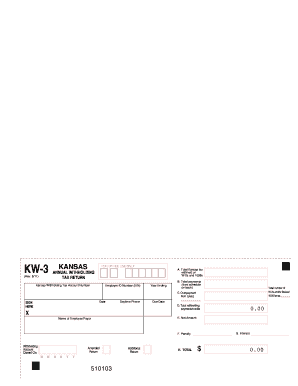
Filling out the Kansas DoR KW-3 form is essential for employers reporting annual withholding tax. This guide will provide you with clear, step-by-step instructions to easily complete this form online, ensuring that you meet all filing requirements.
Follow the steps to complete the KS DoR KW-3 effectively.
- Click ‘Get Form’ button to obtain the form and open it in your online editor.
- Enter your Kansas withholding tax account number in the designated field at the top of the form.
- Provide your employer identification number (EIN), ensuring this is accurate as it is required for processing.
- Fill in the date and specify the year ending information relevant to the taxable year you are reporting.
- Under line A, record the total Kansas income tax that has been withheld from all employees or payees, as shown on your W-2 and federal 1099 forms.
- For line B, enter the total payments made throughout the year, referencing the completed payment schedule located on the back of the form.
- If there was an overpayment in the previous year, report it in line C.
- Calculate the total payments and credits for line D by adding lines B and C. Do not include any penalties or prior year liabilities.
- On line E, compare the amounts from line A and line D. Enter either the underpayment or overpayment amount as appropriate.
- If there is an underpayment, complete the necessary KW-5 report and submit it alongside this form.
- For any penalties or interest due, fill out lines F and G accordingly, using the calculated rates provided.
- On line H, add the amounts from lines E, F, and G, and ensure any underpayment is included with your submission.
- Finally, sign and date the form before mailing it with the required Wage and Tax Statement and any applicable 1099 forms to the Kansas Department of Revenue.
Complete your KS DoR KW-3 form online today for efficient and accurate submission.
Get form
A tax ID number and an Employer Identification Number (EIN) often refer to the same concept but can differ slightly. While an EIN is a type of tax ID number specifically assigned for business purposes by the IRS, various tax ID numbers are available for different uses. When managing your tax responsibilities, understanding these differences and correctly identifying your EIN is vital. Using platforms like USLegalForms can guide you through this process efficiently.