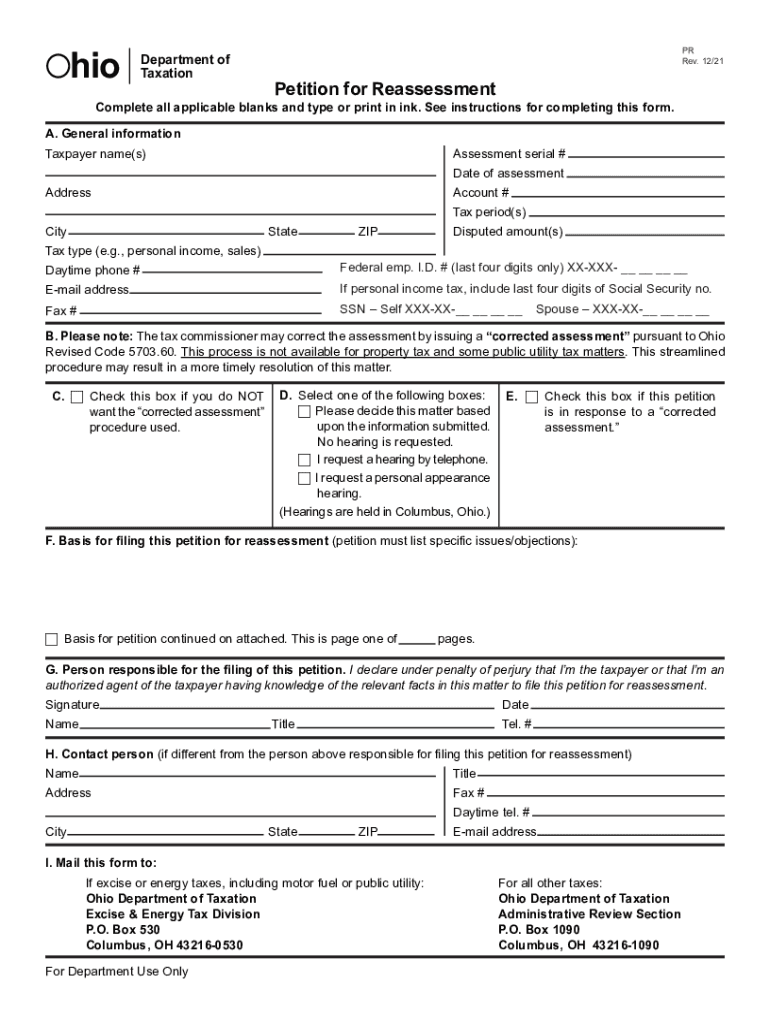
PR Rev. 10/15Petition for Reassessment Complete all applicable blanks and type or print in ink. See instructions for completing this form. A. General information Taxpayer name(s) Address City State.

Open form follow the instructions

Easily sign the form with your finger

Send filled & signed form or save
How to fill out the OH ODT PR online
The OH ODT PR form, or the Petition for Reassessment, is a crucial document for addressing tax assessment disputes with the Ohio Department of Taxation. This guide aims to assist users in completing the form accurately and efficiently, ensuring a smooth filing process.
Follow the steps to complete the OH ODT PR form online
- Press the ‘Get Form’ button to access the OH ODT PR form and open it in your preferred online editor.
- In section A, enter general information such as your name, address, and contact details. Use the assessment document as a reference to ensure accuracy.
- Fill in the assessment serial number, which can be located on your assessment notice. Include the date of assessment and the tax period(s) in question.
- Indicate the disputed amount that you are contesting. In most cases, you do not need to pay this amount before filing the petition.
- If applicable, check the boxes in section C to indicate if you want to request a corrected assessment or a hearing.
- In section F, provide a detailed basis for your filing. List specific objections related to the assessment.
- In section G, declare your status as the taxpayer or an authorized agent with knowledge of the case, and provide your signature and date.
- If different from the person responsible for the filing, fill out section H with the contact person's details.
- Finally, review the completed form for accuracy. You can then save changes, download, print, or share the form as necessary.
Complete your OH ODT PR form online today to address your tax assessment dispute!
Experience a faster way to fill out and sign forms on the web. Access the most extensive library of templates available.
Related content
Prior to adopting this rule, ODT is seeking public comment on the draft of this rule....
The Ohio State University, Columbus, OH Expected Graduation Date: May 2019 ... Service...
Get answers to your most pressing questions about US Legal Forms API.
How many years can IRS go back?
Generally, the IRS can include returns filed within the last three years in an audit. If we identify a substantial error, we may add additional years. We usually don't go back more than the last six years. The IRS tries to audit tax returns as soon as possible after they are filed.
How many years can a sales tax audit go back?
In general, the statute of limitations for a sales tax audit (or any tax audit) is three years, if you have filed sales tax returns. This means that the BOE can audit the three previous tax years. So an audit by the BOE conducted in 2017 can cover 2016, 2015, and 2014, but not 2013 and earlier.
Is there a statute of limitations on sales tax?
State Limitations Most states have adopted the general IRS statute of limitations meaning that they have 3 years from the filing date to audit your tax return. However, if the tax liability is understated by 25% or more many states can go back 6 years to conduct an audit.
Does the IRS forgive tax debt after 10 years?
In general, the Internal Revenue Service (IRS) has 10 years to collect unpaid tax debt. After that, the debt is wiped clean from its books and the IRS writes it off. This is called the 10 Year Statute of Limitations. It is not in the financial interest of the IRS to make this statute widely known.
What can the IRS do to collect back taxes?
The IRS may levy (seize) assets such as wages, bank accounts, social security benefits, and retirement income. The IRS also may seize your property (including your car, boat, or real estate) and sell the property to satisfy the tax debt.
How long does the state of California have to collect back taxes?
This is a long time when you consider that the IRS only has 10 years to collect its tax debts. Back in 2005, the California legislature enacted, for the first time in history, a 20-year collection statute of limitations for taxes owing to the Franchise Tax Board (FTB).
Can the IRS collect after 7 years?
Usually the IRS has ten years to collect money you owe. Fortunately, the answer is usually "no." As a general rule, there is a ten year statute of limitations on IRS collections. This means that the IRS can attempt to collect your unpaid taxes for up to ten years from the date they were assessed.
How long can a state collect back taxes?
As a general rule, there is a ten year statute of limitations on IRS collections. This means that the IRS can attempt to collect your unpaid taxes for up to ten years from the date they were assessed. Subject to some important exceptions, once the ten years are up, the IRS has to stop its collection efforts.
How long can the state of Ohio collect back taxes?
The following is a quote from the blog: The Ohio Attorney General has seven years from the date of the assessment to file a law suit to collect the tax, such as filing a garnishment of a bank account, IRA or brokerage account, or conducting an examination of the taxpayer's financial information by deposition.
How much can you make without having to file taxes?
The minimum income amount depends on your filing status and age. In 2018, for example, the minimum for single filing status if under age 65 is $12,000. If your income is below that threshold, you generally do not need to file a federal tax return.
Use professional pre-built templates to fill in and sign documents online faster. Get access to thousands of forms.
If you believe that this page should be taken down, please follow our DMCA take down process here.