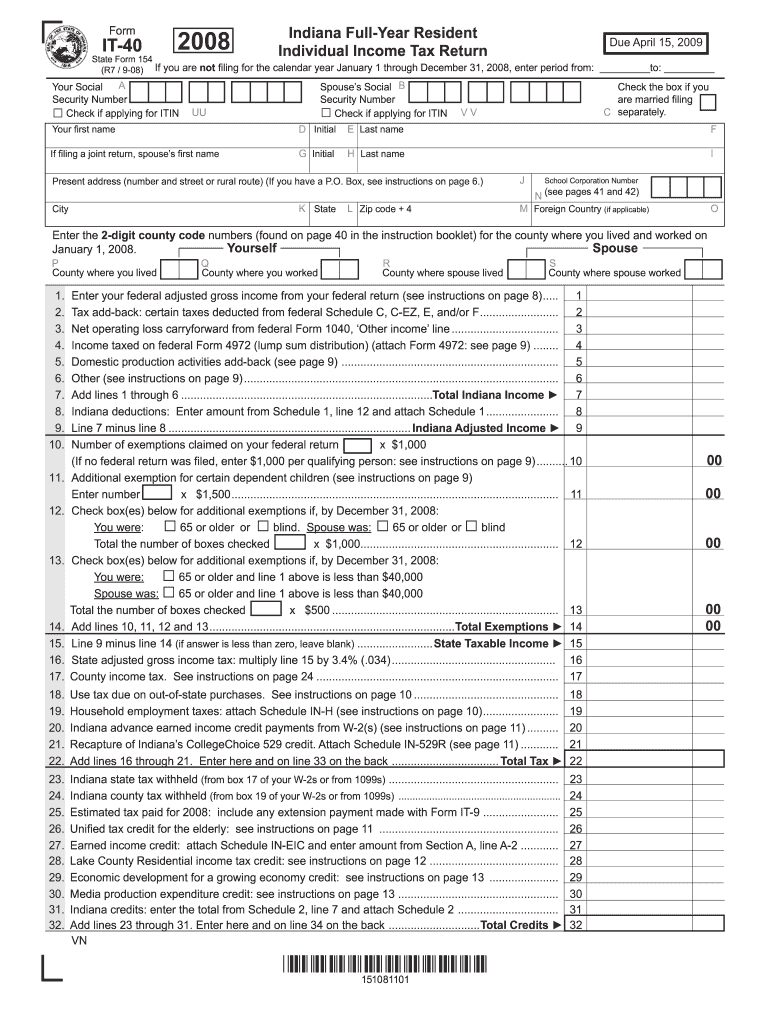
Separately. State Form 154 (R7 / 9-08) If you are not filing for the calendar year January 1 through December 31, 2008, enter period from: to: A Your Social Security Number Check if applying for ITIN UU VV Your first name D Initial E Last name F If filing a joint return, spouse s first name G Initial H Last name I Present address (number and street or rural route) (If you have a P.O. Box, see instructions on page 6.) K State City L Zip code + 4 J School Cor.
Loading

Open form follow the instructions

Easily sign the form with your finger

Send filled & signed form or save
How to fill out the IN DoR IT-40 online
Filing your Indiana Full-Year Resident Individual Income Tax Return (IT-40) can be straightforward with the right guidance. This guide will walk you through each section of the form, ensuring you have the necessary information to complete it accurately and efficiently online.
Follow the steps to complete your IT-40 form effectively.
- Click ‘Get Form’ button to obtain the form and open it in the editor.
- Begin by filling in your Social Security Number in the 'Your Social Security Number' section. If you are applying for an Individual Taxpayer Identification Number (ITIN), check the corresponding box.
- In the next section, provide your first name, middle initial, and last name. If you are filing jointly, include your spouse’s first name, middle initial, and last name as well.
- Enter your present address including number, street or rural route, city, state, and zip code. If you have a P.O. Box, refer to the instructions.
- Locate the section for county codes and enter the two-digit county code for where you lived and worked on January 1, 2008.
- In the income section, enter your federal adjusted gross income from your federal return on line 1. Follow the instructions for any applicable add-backs on lines 2 to 6.
- Calculate your total Indiana income by adding the amounts from lines 1 through 6 and enter it on line 7. Include any Indiana deductions from Schedule 1 on line 8.
- Subtract line 8 from line 7 to find your Indiana adjusted income, which you will enter on line 9.
- Next, state the number of exemptions you are claiming as reported on your federal return and multiply it by $1,000. Enter this value on line 10. Include any additional exemptions applicable on lines 11 to 13.
- Add all exemptions from lines 10, 11, 12, and 13 to calculate your total exemptions, which is to be entered on line 14.
- Subtract your total exemptions from your Indiana adjusted income to find your state taxable income, which goes on line 15.
- Determine your state adjusted gross income tax by multiplying line 15 amount by 3.4% and enter this on line 16.
- Include any applicable taxes, credits, or withholdings from lines 17 to 34. Ensure you accurately calculate your total credits on line 32.
- Review your refund or amount owed based on the calculations throughout the form. Complete the necessary lines to designate this information.
- Finally, sign and date the return, and ensure all information is accurate before saving changes, downloading, printing, or sharing the completed form.
Start completing your IN DoR IT-40 online today to ensure timely filing!
Experience a faster way to fill out and sign forms on the web. Access the most extensive library of templates available.
Related content
IT-40 Form, 154, 2024 IT-40 Income Tax Form. Important. When filing, you must include...
Download Form IT-40PNR from this page (scroll down to the IT-40PNR section). · IN DOR...
- Possuem 14 Modelos, com vazões que variam de 1200 m3/h a 40000 m3/h e composições...
Get answers to your most pressing questions about US Legal Forms API.
What is CC 40 credit in Indiana?
The CC 40 credit in Indiana refers to a tax credit available for certain eligible individuals, often aimed at low-income families. This credit can help reduce the amount you owe on your Indiana taxes, which is important when filing your IN DoR IT-40 form. By taking advantage of available credits, you can optimize your tax outcome. For more details on credits, visit uslegalforms for comprehensive resources.
What is IRS form 40?
IRS form 40 is not an official form; however, it is often confused with Form 1040, which is used for federal income tax returns. This federal form allows you to report your income and calculate the taxes owed to the IRS. While the IN DoR IT-40 pertains to state taxes, understanding federal obligations is equally important. For a clear overview, uslegalforms provides helpful explanations regarding federal and state tax forms.
Is Indiana a tax-friendly state?
Opinions on Indiana's tax-friendliness can vary. The state has a moderate income tax rate compared to many others in the U.S. Additionally, Indiana offers various deductions and credits that can reduce your overall tax burden. When filing your taxes, especially with the IN DoR IT-40 form, be sure to explore available benefits.
What is an or 40 tax form?
The OR-40 is the Oregon state income tax return form, which is separate from the IN DoR IT-40. This form is used by residents of Oregon to report their income and compute their tax due. While both forms serve similar functions for their respective states, it's important to use the correct one for your residency. If you need assistance with tax forms, uslegalforms offers helpful resources.
What is an IT-40 form in Indiana?
The IN DoR IT-40 form is the primary state income tax return form for residents of Indiana. This form allows you to report your income and calculate your state tax liability. Filing the IT-40 is essential for meeting your state tax obligations and ensuring compliance. You can easily complete this form with resources available through uslegalforms.
Do I have to file taxes if I worked less than 6 months?
Whether you need to file taxes after working less than six months hinges on your total income and tax obligations. If your earnings exceed the set limits outlined in the IN DoR IT-40 form, filing becomes necessary, regardless of your work duration. Therefore, evaluating your earnings is essential. Uslegalforms can assist you in determining your filing requirements based on your specific situation.
How much do I have to make at a job to file taxes for it?
Your earning requirement to file taxes can depend on your overall income and tax situation. Generally, if your income exceeds the state's specified threshold for your filing status, you will need to complete IRS forms, including the IN DoR IT-40. To assess your particular situation accurately, consider consulting resources from uslegalforms that outline income requirements for tax filing.
Is there a minimum income for filing taxes?
Yes, there is a minimum income level that determines whether you must file taxes in Indiana. This threshold can vary based on your filing status and age. The IN DoR IT-40 will provide you with the necessary criteria to assess your situation. If you're uncertain, using a platform like uslegalforms can guide you through your filing requirements.
What is an IT-40 tax form?
The IT-40 tax form is Indiana's individual income tax return form used for reporting your state taxes. It facilitates the reporting of income, adjustments, and deductions specific to Indiana. Completing the IN DoR IT-40 accurately is essential for calculating your tax liability or refund. Additionally, uslegalforms offers clear instructions to help you fill out this form correctly.
Do I have to file taxes if I made less than $5000?
If you made less than $5000, you may not need to file a tax return, but specific conditions can change that requirement. Reviewing your income against the thresholds detailed in the IN DoR IT-40 tax guidelines is vital. Always consider other factors, like dependents or special income types, that could affect your filing obligation. Platforms such as uslegalforms can clarify your tax duties.
Use professional pre-built templates to fill in and sign documents online faster. Get access to thousands of forms.
If you believe that this page should be taken down, please follow our DMCA take down process here.
This form is available in several versions. Select the version you need from the drop-down list below.