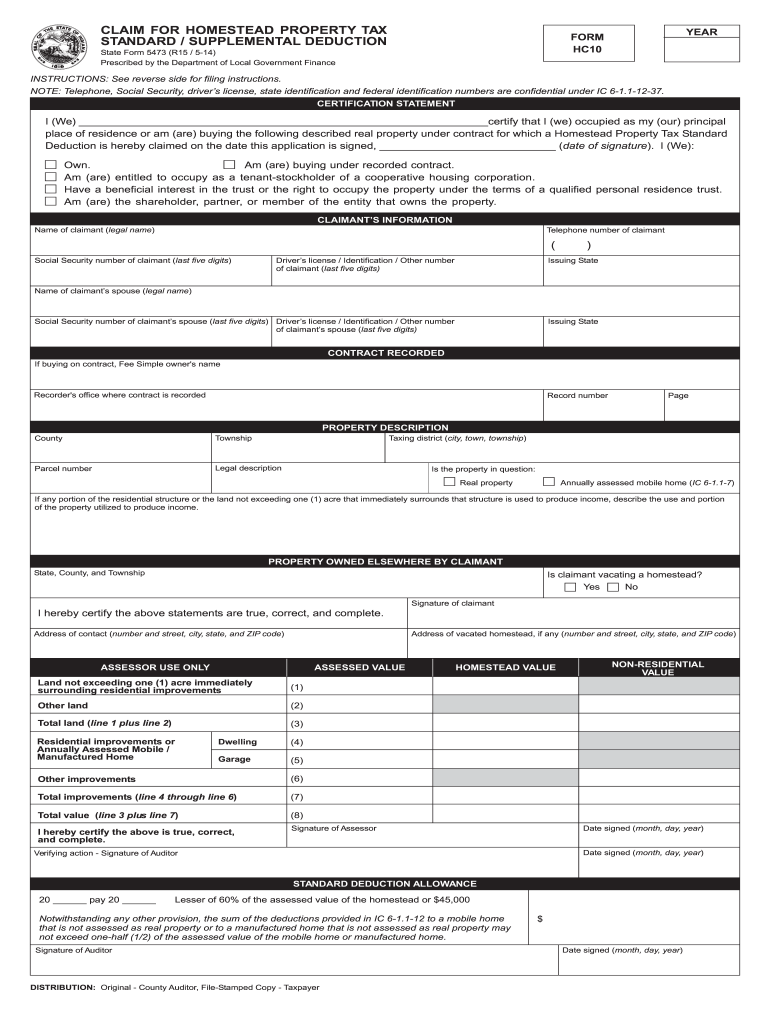
Nature of Auditor STANDARD DEDUCTION ALLOWANCE 20 pay 20 Lesser of 60% of the assessed value of the homestead or $45,000 Notwithstanding any other provision, the sum of the deductions provided in IC 6-1.1-12 to a mobile home that is not assessed as real property or to a manufactured home that is not assessed as real property may not exceed one-half (1/2) of the assessed value of the mobile home or manufactured home. Signature of Auditor DISTRIBUTION: Original - County Auditor,.
Loading

Open form follow the instructions

Easily sign the form with your finger

Send filled & signed form or save
How to fill out the IN DLGF HC10 online
This guide provides clear and step-by-step instructions for completing the IN DLGF HC10 form online, which is essential for claiming a homestead property tax deduction in Indiana. By following these directions, users can ensure their application is filled out accurately and efficiently.
Follow the steps to complete the IN DLGF HC10 form online.
- Press the ‘Get Form’ button to access the IN DLGF HC10 form and open it in the designated editor.
- In the certification statement section, enter your name as the claimant, indicating your occupancy status of the property and signing on the date of completion.
- Provide your contact information, including your telephone number, Social Security number (last five digits), and driver’s license or identification number (last five digits) along with the issuing state.
- If applicable, fill in the information for your spouse, including their name, Social Security number (last five digits), and identification number (last five digits) with the issuing state.
- If you are purchasing the property under a contract, include the fee simple owner’s name, the recorder's office where the contract is recorded, the record number, and the page number.
- In the property description section, enter the county, township, taxing district, parcel number, and legal description of the property.
- Indicate whether the property is real property or an annually assessed mobile home and describe any income-producing use of a portion of the property, if applicable.
- List any other properties owned elsewhere by the claimant, specifying the state, county, and township.
- Indicate if you are vacating a homestead and provide the address of the vacated homestead, if applicable.
- Review the completed form for accuracy. Once verified, save your changes, and proceed to download, print, or share the form as needed.
Complete your IN DLGF HC10 form online today to ensure your homestead deduction is processed.
Experience a faster way to fill out and sign forms on the web. Access the most extensive library of templates available.
Related content
(Form HC10), Homestead Deductions, Claim for Homestead Property Tax Standard /...
Sales Disclosure Form 46021 or. DLGF Form HC10 (State Form. 5473). One form filed for both...
Get answers to your most pressing questions about US Legal Forms API.
What happens if I forgot to file my homestead exemption in Indiana?
If you forgot to file your homestead exemption in Indiana, you should act quickly to remedy the situation. Contact your local county auditor or assessor's office to discuss your options, as there might be a specific timeframe for late application submissions. You can potentially still receive a partial exemption, depending on your circumstances and local regulations. Consulting IN DLGF HC10 can provide further insights into how to resolve this issue effectively.
How do I apply for a tax exemption in Indiana?
Applying for a tax exemption in Indiana involves checking eligibility for various programs that may apply to your circumstances. Start by gathering necessary documents to prove your eligibility, such as income statements or age verification. Submit your application to the appropriate tax authority along with the required documentation. For detailed guidelines, refer to IN DLGF HC10, ensuring you follow the correct process for your exemption.
How do I apply for a property tax exemption in Indiana?
To apply for a property tax exemption in Indiana, visit your county's assessor's office or website to obtain the necessary application form. Complete the form with accurate information about your property and your eligibility criteria, such as age or disability status. Submit the application along with any required documentation to finalize your request. IN DLGF HC10 can guide you through the steps and documentation needed.
How to fill out a withholding exemption form?
Filling out a withholding exemption form involves gathering relevant personal information first. You need to indicate your filing status and the number of exemptions you claim based on your situation. After entering this information, you should review it for accuracy and then submit the form to your employer. Utilize resources provided by IN DLGF HC10 to ensure you meet all requirements.
Is $80,000 a personal property tax exemption in Indiana?
No, $80,000 is not a standard personal property tax exemption in Indiana. Property tax exemptions generally depend on specific criteria such as the type of property or demographic factors like age or disability. For the most accurate and detailed information regarding exemptions in Indiana, refer to IN DLGF HC10. It helps clarify which exemptions you may be eligible for.
At what age do you stop paying property tax in Indiana?
In Indiana, the age for stopping property tax payments varies based on eligibility for exemption programs. Typically, individuals who are 65 years or older may qualify for certain exemptions, which can reduce or eliminate their property tax burden. It is essential to review the specific guidelines provided by IN DLGF HC10 to understand your options. Make sure to consult with your local tax authority about your eligibility.
How to fill out a withholding allowance form?
To fill out a withholding allowance form, start by obtaining the correct version from the IRS or your employer. Next, provide your personal information, including your name, address, and Social Security number. You will then need to list your allowances based on your personal situation, such as dependents or tax credits, and finally, sign and date the form. By using resources like IN DLGF HC10, you can ensure that you're filling out this form correctly.
Do I have to claim my homestead every year?
No, once you have your homestead exemption, you typically do not need to claim it every year. However, it’s wise to verify your status periodically through the IN DLGF HC10 to make sure there are no changes that could affect your exemption.
How do I file a property tax exemption in Indiana?
To file a property tax exemption in Indiana, you will need to complete the appropriate forms available from your county auditor’s office or online. Typically, submitting the application before the deadline is crucial. The IN DLGF HC10 can guide you through this process for successful filing.
How long do you have to file homestead exemption in Indiana?
In Indiana, you typically need to file for the homestead exemption before the county's deadline, which is usually on or before May 10th for the current tax year. However, it’s important to refer to the IN DLGF HC10 for the precise date and any updates. Being proactive can help you avoid issues.
Use professional pre-built templates to fill in and sign documents online faster. Get access to thousands of forms.
If you believe that this page should be taken down, please follow our DMCA take down process here.
This form is available in several versions. Select the version you need from the drop-down list below.