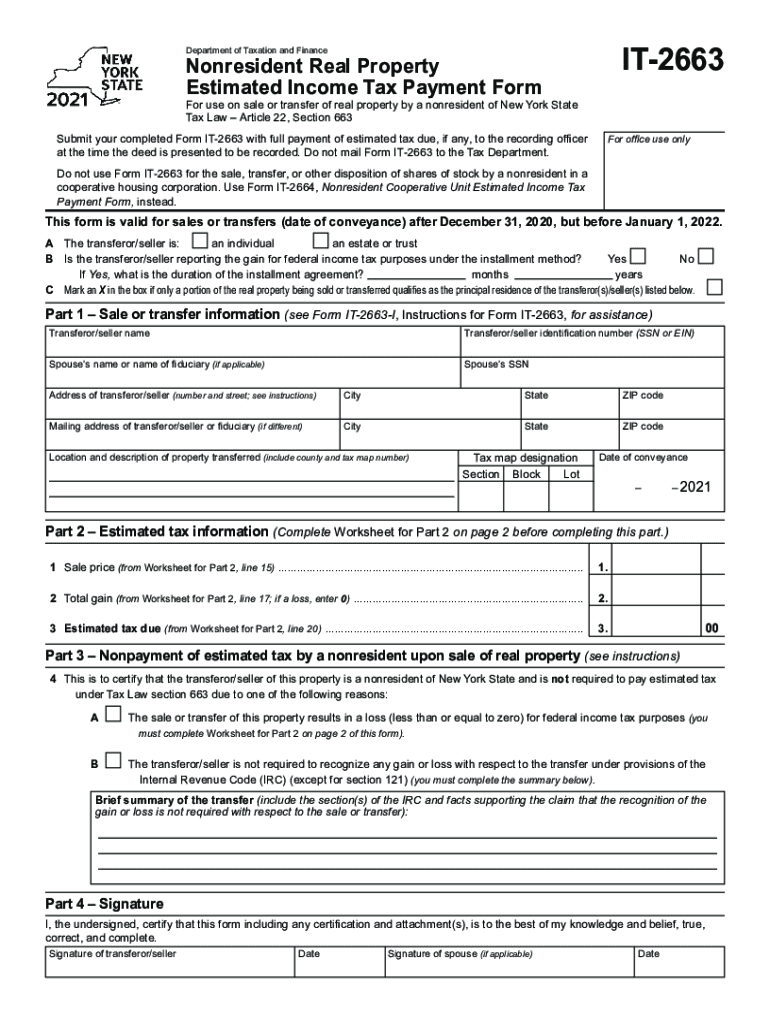
IT2663Department of Taxation and FinanceNonresident Real Property Estimated Income Tax Payment FormFor use on sale or transfer of real property by a nonresident of New York State Tax Law Article 22,.
Loading

Open form follow the instructions

Easily sign the form with your finger

Send filled & signed form or save
How to fill out the NY DTF IT-2663 online
The NY DTF IT-2663 is an essential form for nonresidents of New York State involved in the sale or transfer of real property. This guide provides clear and supportive instructions for completing the form online, helping you navigate each section with confidence.
Follow the steps to complete your NY DTF IT-2663 online.
- Click the ‘Get Form’ button to access the NY DTF IT-2663 and open it in your online editor.
- Begin by identifying the transferor/seller. Select whether the transferor is an individual, estate, or trust. Complete the transferor's full name and their identification number (either SSN or EIN). If applicable, provide the spouse's name and SSN.
- Fill in the address details for the transferor/seller, including the street number, city, state, and ZIP code. If there is a different mailing address, complete that section as well.
- Provide a detailed description of the property being sold or transferred, including the county and tax map number. Note the date of conveyance and tax map designation.
- Proceed to Part 2 to complete the estimated tax information. Ensure you have the worksheet for Part 2 ready to fill in sale price and total gain figures accurately.
- Input the sale price and total gain on the relevant lines in Part 2. Calculate the estimated tax due based on the provided worksheet and enter the result in the designated field.
- In Part 3, certify whether you are a nonresident required to pay estimated tax. If applicable, explain why you may not have to make an estimated tax payment. Be sure to provide a brief summary of your circumstances.
- Complete Part 4 by signing the form. The transferor/seller must date their signature. If applicable, include the spouse's signature and date as well.
- Once the form is accurately filled, save your changes and ensure you have a downloadable version for your records. You can also print and share the completed form as needed.
Complete your documents online with ease and ensure all necessary forms are submitted accurately.
Experience a faster way to fill out and sign forms on the web. Access the most extensive library of templates available.
Related content
Oct 1, 2019 - IT-112.1 (Fill-in), Instructions on form, New York State Resident Credit...
Apr 6, 2015 - ... be able to get ahold of a template 2015 NY DTF IT-2663 version to edit ?...
... Column2016, Column2017, Column2018, Column2019, Column2020, Column2021...
Get answers to your most pressing questions about US Legal Forms API.
Who pays the mansion tax in NYS?
Who pays the tax. The base tax and additional base tax are paid by the seller (grantor). However, if the seller doesn't pay the tax, or is exempt from the tax, the buyer (grantee) must pay the tax. The mansion tax and supplemental tax are paid by the buyer.
Who pays NJ mansion tax?
New Jersey enacted a 'mansion tax' in 2004 that applies to residential properties, including condos and co-ops, said Robert Tierman, a real estate lawyer who has offices in Hackensack, N.J. and New York City. The tax is equal to 1 percent of the total consideration if the purchase price exceeds $1 million.
Who pays the mansion tax?
Anyone who buys a piece of real estate for $1 million or more is subject to the mansion tax. The tax rate is a simple percentage of the purchase price.
What is NY transfer tax?
What is a transfer tax? A transfer tax is a one-time fee imposed on the transfer of property, usually paid by the seller. Both New York City and New York state already have one. Statewide, the tax is imposed on any property transfer over $500 at a flat rate of $2 for every $500, or 0.4 percent.
Does seller or buyer pay transfer taxes?
Transfer tax is a tax imposed by states, counties, and cities on the transfer of the title of real property from one person (or entity) to another within the jurisdiction. It is based on the property's sale price and is paid by the buyer, seller, or both parties upon transfer of real property.
Who pays transfer tax in Westchester NY?
The second cost is the NY STATE TRANSFER TAX, the SELLER is usually required to pay the transfer tax due on the sale of the property. The NYS transfer tax is computed at a rate of .4% of the sales price or $4 per thousand of the sale price.
Who pays property transfer tax in NY?
The transfer tax is a tax imposed on the seller (or grantor ) during the conveyance of real property so it is typically their responsibility to pay. If the seller finds a way to not pay the tax (or just disappears), the responsibility to pay falls on the buyer. One way or another, the tax is going to get paid.
Who pays the transfer tax in NY?
The buyer is usually responsible for the 1% additional real estate transfer tax on properties worth $1 million or more. That said, if the buyer is exempt, the seller must pay. Whatever the situation whether the buyer or seller pays New York requires the full tax amount be paid.
Does buyer or seller pay transfer tax?
However, if the seller doesn't pay or is exempt from the tax, the buyer must pay. The buyer is usually responsible for the 1% additional real estate transfer tax on properties worth $1 million or more. That said, if the buyer is exempt, the seller must pay.
How much is the property transfer tax in BC?
Home buyers in BC pay a provincial Property Transfer Tax (PTT) when they buy a home. The tax is charged at a rate of 1% on the first $200,000 of the purchase price and 2% on the remainder up to and including $2 million.
Use professional pre-built templates to fill in and sign documents online faster. Get access to thousands of forms.
If you believe that this page should be taken down, please follow our DMCA take down process here.