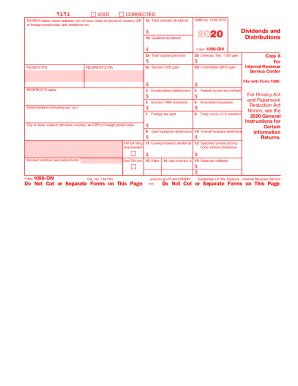
But the online version of it, printed from this website, is not. Do not print and file copy A downloaded from this website; a penalty may be imposed for filing with the IRS information return forms that can t be scanned. See part O in the current General Instructions for Certain Information Returns, available at www.irs.gov/form1099, for more information about penalties. Please note that Copy B and other copies of this form, which appear in black, may be downloaded and printed and used to sat.

How it works
  • Open form

    Open form follow the instructions

  • Easily sign form

    Easily sign the form with your finger

  • Share form

    Send filled & signed form or save

How to fill out the IRS 1099-DIV online

The IRS 1099-DIV form is essential for reporting dividends and distributions to the IRS and recipients. This guide offers clear, step-by-step instructions on how to fill out this form online efficiently and accurately.

Follow the steps to complete the IRS 1099-DIV form online.

  1. Click ‘Get Form’ button to obtain the form and open it in your preferred editing application.
  2. Begin by entering the payer’s information, including their name, street address, city or town, state or province, country, ZIP or foreign postal code, and telephone number.
  3. Input the payer’s taxpayer identification number (TIN) along with the recipient’s TIN and name.
  4. In box 1a, report the total ordinary dividends. This amount should be included on the recipient's income tax return.
  5. In box 1b, indicate the amount of qualified dividends that may qualify for reduced capital gains rates.
  6. Fill out boxes 2a through 2d, which include details about capital gain distributions and various gains related to real estate and collectibles.
  7. Complete additional boxes, such as those for foreign tax paid and cash or noncash liquidation distributions, as applicable.
  8. In box 4, note any federal income tax withheld. Ensure each box is correctly filled to avoid penalties.
  9. Once all required information is inputted, save your changes, then download, print, or share the form as needed.

Be sure to complete your IRS 1099-DIV online to ensure accurate reporting.

Get form

Experience a faster way to fill out and sign forms on the web. Access the most extensive library of templates available.

Related content

About Form 1099-DIV, Dividends and Distributions |...

Form 1099-DIV is used by banks and other financial institutions to report dividends and...

Learn more
IRS Form 1099-MISC

Find out about 1099-MISC forms. ... IRS Form 1099-MISC. Last Updated: June 19, 2018...

Learn more
1099-k-instructions suggestion - ???????? ???????...

1099-MISC & 1099-K Explained + Help with Double Reporting, PayPal, and Coinbase! ... How...

Learn more
Questions & Answers

Get answers to your most pressing questions about US Legal Forms API.

Contact support

What is the qualified dividend tax rate for 2018?

The dividend tax rate you will pay on ordinary dividends is 22%. Qualified dividends, on the other hand, are taxed at the capital gains rates, which are lower. For the 2018 tax year, you will not need to pay any taxes on qualified dividends as long as you have $38,600 or less of ordinary income.

You'll report dividend income on your 2018 tax return in the following places: Ordinary dividends are reported on Line 3b of your Form 1040. Qualified dividends are reported on Line 3a of your Form 1040.

Exempt-interest dividends are often associated with mutual funds that invest in municipal bonds. ... The dividend income must be reported on the income tax return, and it is reported by mutual funds on Form 1099-INT.

Yes, it counts as capital gain. No, do not put it on line 9a of the full Form 1040. It goes on Schedule D then to line 13 of the Form 1040.

According to IRS regulations, any amount reported in Box 11 of Form 1099-DIV is to be treated as "Tax-Exempt Interest Income". To report, please go to: Federal Section. ... Complete this screen as if your Tax-Exempt Dividend Income was reported in Box 8 of a 1099-INT.

Yes, you have report dividends received, even if they are less than $10. The stockbroker (or bank) is not required to issue a form 1099-DIV if dividends are less than$10, but you have to report them.

Who needs to file 1099-DIV? Any business that has paid dividends on stock of $10 or more, withheld foreign or federal tax on dividends or has paid $600 or more as part of a liquidation must file Form 1099-DIV. See the official IRS instructions.

Even if you don't received a Form 1099-DIV, you are required to still report all of your taxable dividend income. ... However, Schedule B doesn't change the amount of tax you'll pay; it just requires you to report information about the dividend and interest income you receive from each source.

Reporting Requirements Keep in mind that you must report all dividends received on your taxes, but the company that paid dividends doesn't have to send you a 1099-DIV unless you received more than $10 that year. In other words, maintain a record of how much you earned in case you don't receive a 1099-DIV.

You'll need at least $10 in earnings You'll get a 1099-DIV each year you receive a dividend distribution, capital gains distribution, or foreign taxes paid for your taxable investments. But if the amount is less than $10 for the year, no 1099-DIV is sent.

Get This Form Now!

Use professional pre-built templates to fill in and sign documents online faster. Get access to thousands of forms.

If you believe that this page should be taken down, please follow our DMCA take down process here.

IRS 1099-DIV Form

This form is available in several versions. Select the version you need from the drop-down list below.

Get IRS 1099-DIV