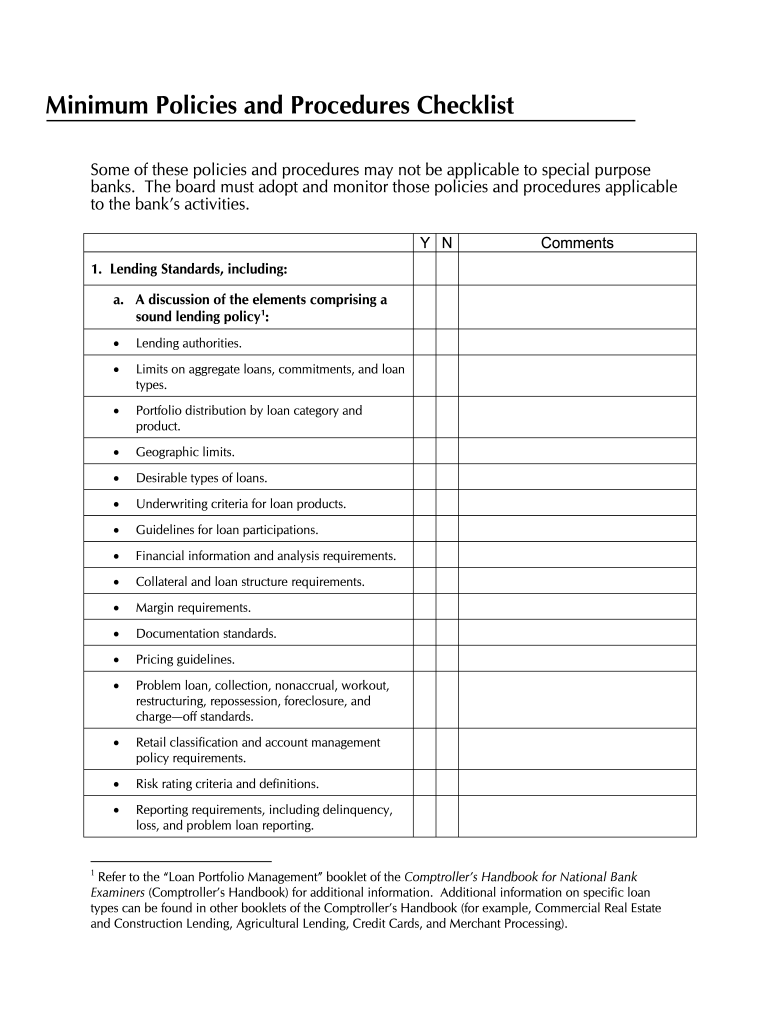
Minimum Policies and Procedures Checklist Some of these policies and procedures may not be applicable to special purpose banks. The board must adopt and monitor those policies and procedures applicable.
Loading

Open form follow the instructions

Easily sign the form with your finger

Send filled & signed form or save
How to fill out the Treasury OCC Minimum Policies and Procedures Checklist online
Filling out the Treasury OCC Minimum Policies and Procedures Checklist online is essential for ensuring that your institution meets regulatory requirements. This guide provides clear, step-by-step instructions to help users effectively complete the form, focusing on its important components.
Follow the steps to complete the checklist accurately.
- Click ‘Get Form’ button to access the checklist and open it in your preferred online tool.
- Review the introduction section of the checklist to ensure you understand the context and requirements of the policies listed.
- Begin with the Lending Standards section. Carefully read each item and indicate whether it applies to your organization by selecting 'Yes' or 'No.' Provide comments where necessary to clarify your responses.
- Proceed to the Funds Management and Interest Rate Risk Policies. For each policy, confirm its applicability and comment if any specific conditions or procedures need further explanation.
- Continue to the Capital Policy and Internal and External Audit section, following the same process of acknowledgment and commenting. Be thorough in documenting adherence to the proposed policies.
- In the Compliance Policies section, indicate your management's commitment to compliance, and provide examples of how you fulfill these requirements.
- Finally, finish with the Information Technology Policies and Staffing and Compensation Policy sections. Assess your organization's current practices and include additional comments if needed.
- Once you have filled out all sections, review your entries for accuracy and completeness.
- You can now save your changes, download a copy of the checklist, print it for your records, or share it with relevant stakeholders.
Ensure your organization meets compliance standards by completing your documents online today.
Experience a faster way to fill out and sign forms on the web. Access the most extensive library of templates available.
Related content
The Office of the Comptroller of the Currency's (OCC) Comptroller's Handbook booklet...
standards include those with (1) at least $700 billion in total consolidated assets or (2)...
Nov 24, 2023 — 30. Incident Reporting and Whistleblower Policy. SOC 1: Ensures financial...
Get answers to your most pressing questions about US Legal Forms API.
Is the OCC part of the Department of Treasury?
Yes, the OCC is a bureau of the Department of the Treasury. It operates independently to fulfill its mandate while contributing to the overall objectives of the Treasury. Understanding the Treasury OCC Minimum Policies and Procedures Checklist can help those in the banking sector appreciate the significance of the OCC's role within the Treasury.
What is the OCC handbook?
The OCC handbook contains comprehensive guidelines and best practices for national banks and federal savings associations. It provides vital information related to banking operations, risk management, and compliance. Familiarizing oneself with the Treasury OCC Minimum Policies and Procedures Checklist can help institutions navigate the contents of the OCC handbook more efficiently.
What is the OCC and what does it do?
The OCC is a federal agency that regulates and supervises national banks and federal savings associations. Its primary goal is to ensure a stable banking environment and protect consumer interests. By following the guidelines outlined in the Treasury OCC Minimum Policies and Procedures Checklist, banks can effectively meet their regulatory obligations.
What does OCC do against banks that do not comply with laws and regulations?
When banks do not comply with laws and regulations, the OCC takes various actions, including issuing fines, requiring corrective measures, or revoking banking charters. These actions ensure that financial institutions operate within legal frameworks and protect consumers. Implementing the Treasury OCC Minimum Policies and Procedures Checklist can help prevent such non-compliance issues.
What does the OCC refer to?
The OCC refers to the Office of the Comptroller of the Currency, a U.S. government agency under the Department of Treasury. It supervises and regulates national banks and federal savings associations. By implementing the Treasury OCC Minimum Policies and Procedures Checklist, institutions can better understand the OCC's expectations and requirements.
What laws does the OCC enforce?
The OCC enforces various laws and regulations related to banking, including the National Bank Act and the Bank Secrecy Act. These laws are critical for maintaining the integrity of the banking system and protecting consumers. Utilizing the Treasury OCC Minimum Policies and Procedures Checklist assists banks in ensuring compliance with these essential regulations.
What is the mandate of the OCC?
The Office of the Comptroller of the Currency (OCC) aims to ensure the safety and soundness of national banks and federal savings associations. It promotes fair access to financial services and compliance with relevant laws. Understanding the Treasury OCC Minimum Policies and Procedures Checklist can help banks align with these mandates effectively.
What is the Anbe program at the OCC?
The Anbe program, or the Office of Minority and Women Inclusion, promotes diversity and inclusion within the financial services industry. This initiative helps to ensure that banks are aware of their obligations to foster a diverse workforce. Incorporating the Treasury OCC Minimum Policies and Procedures Checklist can assist banks in aligning their diversity goals with regulatory expectations.
What happens if a bank does not comply with regulations?
If a bank fails to comply with regulations, it may face severe penalties, including fines and restrictions on business operations. In some cases, the OCC may initiate more severe actions, such as revoking a bank's charter. Banks can utilize the Treasury OCC Minimum Policies and Procedures Checklist to ensure they stay compliant and avoid these adverse consequences.
Who holds banks accountable?
The OCC serves as the primary federal regulator for national banks and federal savings associations, holding them accountable for their actions. In addition to the OCC, other regulatory agencies, such as the Federal Reserve and the FDIC, also play crucial roles in ensuring compliance. The Treasury OCC Minimum Policies and Procedures Checklist can help banks maintain accountability and meet compliance requirements.
Use professional pre-built templates to fill in and sign documents online faster. Get access to thousands of forms.
If you believe that this page should be taken down, please follow our DMCA take down process here.