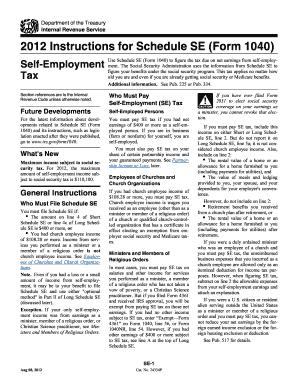
P of Long Schedule SE. SE-1 Aug 08, 2012 Cat. No. 24334P If you have ever filed Form 2031 to elect social security CAUTION coverage on your earnings as a minister, you cannot revoke that elec tion. ! If you must pay SE tax, include this income on either Short or Long Schedule SE, line 2. But do not report it on Long Schedule SE, line 5a; it is not considered church employee income. Also, include on line 2: The rental value of a home or an allowance for a home furnished to you (including p.
Open form follow the instructions
Easily sign the form with your finger
Send filled & signed form or save
How to fill out the IRS Instruction 1040 - Schedule SE online
Filling out the IRS Instruction 1040 - Schedule SE can seem daunting, but this comprehensive guide will help you navigate the process with ease. With clear steps and detailed explanations, you will be equipped to accurately report your self-employment tax obligations.
Follow the steps to effectively complete Schedule SE online.
- Press the ‘Get Form’ button to obtain the form and display it in your editor.
- Start by reviewing the requirements for filing Schedule SE to ensure you meet the necessary criteria, such as net earnings of $400 or more.
- Determine if you will use Short Schedule SE or Long Schedule SE by reading the flowchart provided on the form. Make sure to familiarize yourself with the net earnings from self-employment.
- Input your total net earnings from self-employment on the appropriate line of the form. This may include earnings from business activities or certain partnership incomes.
- If applicable, enter any adjustments or deductions on the form, ensuring to follow the guidelines for reporting church employee income and other relevant categories.
- Once all necessary information is filled out, review the entries for accuracy and completeness to prevent errors.
- After confirming all details are correct, you can save your changes, download a copy of the completed form, print it for your records, or share it with your tax preparer.
Start completing your IRS Instruction 1040 - Schedule SE online today!
Experience a faster way to fill out and sign forms on the web. Access the most extensive library of templates available.
Related content
Schedule SE is used to calculate self-employment tax on net earnings of $400 or more, and...
6 Deduction for employer-equivalent portion of self-employment tax. If the amount on line...
Dec 21, 2011 — Self-employment tax. Schedule SE. File with Form 1040. Estimated tax...
Get answers to your most pressing questions about US Legal Forms API.
How do I calculate my SE tax?
To calculate your self-employment (SE) tax, first determine your net earnings from self-employment using IRS Instruction 1040 - Schedule SE. Multiply this amount by the self-employment tax rate of 15.3%. Keep in mind that you can deduct half of this tax when filing your return, effectively reducing your taxable income.
What is the maximum income for optional methods?
The maximum income for optional methods relates to specific criteria outlined in IRS Instruction 1040 - Schedule SE. Generally, you can use optional methods if your net self-employment earnings are below a set threshold, allowing you to report income using simplified methods. Check the current IRS threshold figures to confirm your eligibility.
How do you enter exempt notary income?
When entering exempt notary income on your tax forms, it’s essential to follow the guidelines provided in IRS Instruction 1040 - Schedule SE. Typically, you do not include this income in your self-employment earnings since it may be exempt from self-employment tax. Be sure to document your notary services and retain any relevant records as proof.
How to fill out Form SE?
To fill out Form SE, begin by downloading the form from the IRS website or using tax software that incorporates IRS Instruction 1040 - Schedule SE. Follow the instructions carefully to report your self-employment earnings, calculate your net profit, and determine your self-employment tax. Ensure you double-check your calculations before submitting to avoid errors.
Who fills out a Schedule SE?
Individuals who receive self-employment income must fill out a Schedule SE as part of their tax return. This includes sole proprietors, partners in a partnership, and members of LLCs that are treated as partnerships. If you earn income without an employer withholding taxes, you need to report it using the IRS Instruction 1040 - Schedule SE.
How do I fill out self-employment income?
To fill out self-employment income on the IRS Instruction 1040 - Schedule SE, start by reporting your total earnings from self-employment on Line 1. You need to maintain accurate records of your income sources, including any Form 1099s received. After calculating your net profit or loss, you will then transfer this information to your personal tax return.
How to file self-employment taxes step by step?
Filing self-employment taxes involves several steps. First, gather your income and expense information, then fill out IRS Instruction 1040 - Schedule SE to calculate your self-employment tax. Follow the filing instructions to complete your tax return accurately, ensuring all relevant deductions are claimed. For a structured approach, consider using uslegalforms to streamline your filing process.
How to calculate the deductible part of self-employment tax?
To calculate the deductible part of self-employment tax, first determine your total self-employment tax. Then, divide that total by two, following the guidelines in IRS Instruction 1040 - Schedule SE. The resulting figure is what you can deduct before calculating your taxable income. If you're unsure, uslegalforms provides resources for clearer understanding and accurate filing.
How is the deductible part of self-employment tax calculated?
The deductible part of self-employment tax is calculated by taking the total self-employment tax amount and dividing it by two. According to IRS Instruction 1040 - Schedule SE, this calculated amount is then deducted from your gross income. This method acknowledges that self-employed individuals contribute to Social Security and Medicare. If you need assistance with this calculation, uslegalforms offers helpful tools and templates.
What is the 20% self-employment deduction?
The 20% self-employment deduction allows eligible self-employed individuals to deduct 20% of their qualified business income. This is a valuable break under the Tax Cuts and Jobs Act, and it can significantly reduce your overall tax liability. It is important to follow IRS Instruction 1040 - Schedule SE to determine your eligibility. Utilizing resources from uslegalforms can help you navigate this deduction effectively.
Use professional pre-built templates to fill in and sign documents online faster. Get access to thousands of forms.
If you believe that this page should be taken down, please follow our DMCA take down process here.
This form is available in several versions. Select the version you need from the drop-down list below.