Open form follow the instructions
Easily sign the form with your finger
Send filled & signed form or save
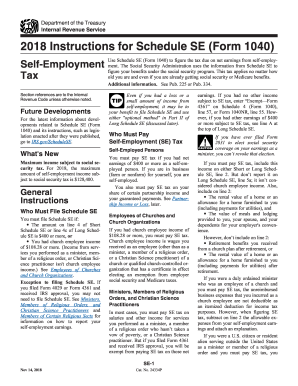
How to fill out the IRS Instruction 1040 - Schedule SE online
Completing the IRS Instruction 1040 - Schedule SE is essential for individuals engaged in self-employment. This guide provides step-by-step instructions to help users easily navigate the online form and ensure accurate submission.
Follow the steps to successfully fill out Schedule SE online.
- Press the ‘Get Form’ button to access the IRS Schedule SE form and open it in the online editor.
- Determine if you must file the Short Schedule SE or Long Schedule SE by reviewing the flowchart provided at the beginning of the form. Choose the appropriate section based on your net earnings from self-employment.
- Calculate your net earnings from self-employment, including any income from partnerships and guaranteed payments. Ensure you understand what constitutes net earnings for accurate reporting.
- Fill in the relevant amounts in lines 1a, 1b, and 2 as instructed, ensuring that your figures reflect all applicable income and deductions.
- Review the line instructions carefully, particularly for line 4, which helps determine if you owe SE tax based on your combined income.
- Complete the rest of the schedule by following the additional instructions for each subsequent line, including income from church employment and various special cases.
- After filling out all necessary fields, save your changes. You can then choose to download, print, or share your completed Schedule SE.
Complete your Schedule SE online to ensure accurate reporting of your self-employment income.
Experience a faster way to fill out and sign forms on the web. Access the most extensive library of templates available.
Related content
Schedule SE is used to calculate self-employment tax on net earnings of $400 or more, and...
6 Deduction for employer-equivalent portion of self-employment tax. If the amount on line...
Dec 21, 2011 — Self-employment tax. Schedule SE. File with Form 1040. Estimated tax...
Get answers to your most pressing questions about US Legal Forms API.
What is the deduction for half of the self-employment tax based on?
The deduction for half of the self-employment tax is based on the total self-employment tax you owe, as calculated with IRS Instruction 1040 - Schedule SE. Specifically, you take your total self-employment tax figure and divide it by two—this amount is then used to reduce your overall taxable income. This provision provides relief for self-employed individuals, easing their tax burden.
How is the deductible part of self-employment tax calculated?
The deductible part of self-employment tax is calculated based on the total self-employment tax you calculated according to IRS Instruction 1040 - Schedule SE. To arrive at the deductible amount, take your total self-employment tax and simply divide it by two. This deduction allows self-employed individuals to reduce their taxable income, making tax filing more advantageous.
How to file self-employment taxes step by step?
Filing self-employment taxes involves several steps, starting with reporting your income and expenses on IRS Instruction 1040 - Schedule SE. First, gather your financial records, then calculate net earnings. Next, complete Schedule SE to determine your self-employment tax, and finally, include this amount when filing your Form 1040. Each step is crucial to ensure accuracy and compliance with tax obligations.
What is the 20% self-employment deduction?
The 20% self-employment deduction refers to a tax benefit that allows eligible self-employed individuals to deduct a portion of their qualified business income. This deduction applies to income reported on IRS Instruction 1040 - Schedule SE and effectively lowers the taxable income amount. Consequently, it can lead to significant savings in your overall tax liability, benefiting small business owners and freelancers.
How do you enter exempt notary income?
Exempt notary income should be reported differently than regular self-employment income according to IRS Instruction 1040 - Schedule SE. You must list any notary income separately and indicate its exempt status under the appropriate line item on your tax forms. It’s important to ensure accurate reporting to avoid complications with your tax filing.
How to calculate the deductible part of self-employment tax?
You can deduct a portion of your self-employment tax when filing your tax return, and this is calculated using IRS Instruction 1040 - Schedule SE. To find the deductible amount, you must calculate your total self-employment tax first, then multiply this figure by 50%. This allowed deduction helps reduce your adjusted gross income and provides tax relief when you file.
How do you calculate self-employment tax?
To calculate self-employment tax, begin by determining your net earnings from self-employment, which you report on IRS Instruction 1040 - Schedule SE. Your self-employment tax rate is currently 15.3%, which consists of Social Security and Medicare taxes. Multiply your net earnings by the tax rate to find your total self-employment tax. Ensure you follow the guidelines provided in IRS Instruction 1040 - Schedule SE for accurate calculations.
How to calculate Social Security tax?
Calculating Social Security tax under IRS Instruction 1040 - Schedule SE involves determining your total self-employment income. After obtaining your net earnings, apply the Social Security tax rate to the applicable portion of your income. Remember to check the income limit, as wages over a certain amount are not subject to additional Social Security tax.
How is self-employment estimated tax calculated?
Self-employment estimated tax is calculated using IRS Instruction 1040 - Schedule SE to project your annual income and expenses. You'll estimate your earnings and expenses for the year, apply the SE tax rate, and then divide the total by four to arrive at your quarterly payment amounts. This method helps you stay compliant and avoid penalties.
How do I calculate my SE tax?
Calculating your self-employment tax is straightforward using IRS Instruction 1040 - Schedule SE. Begin by determining your net earnings from self-employment. Then, follow the outlined steps, which include multiplying your adjusted net earnings by the required tax rates, and assess whether you're subject to any additional health care taxes.
Use professional pre-built templates to fill in and sign documents online faster. Get access to thousands of forms.
If you believe that this page should be taken down, please follow our DMCA take down process here.
This form is available in several versions. Select the version you need from the drop-down list below.