Is allowed because of a bargain sale of property to a charitable organization, the adjusted basis for purposes of determining gain from the sale is the amount that has the same ratio to the adjusted basis as the amount realized has to the fair market value. See Pub. 544 for details. Increase your cost or other basis by any expense of sale, such as broker s fees, commissions, state and local transfer taxes, and option premiums, before making an entry in column (e), unless you reported the net.
Loading

Open form follow the instructions

Easily sign the form with your finger

Send filled & signed form or save
How to use or fill out the IRS Capital Loss Carryover Worksheet online
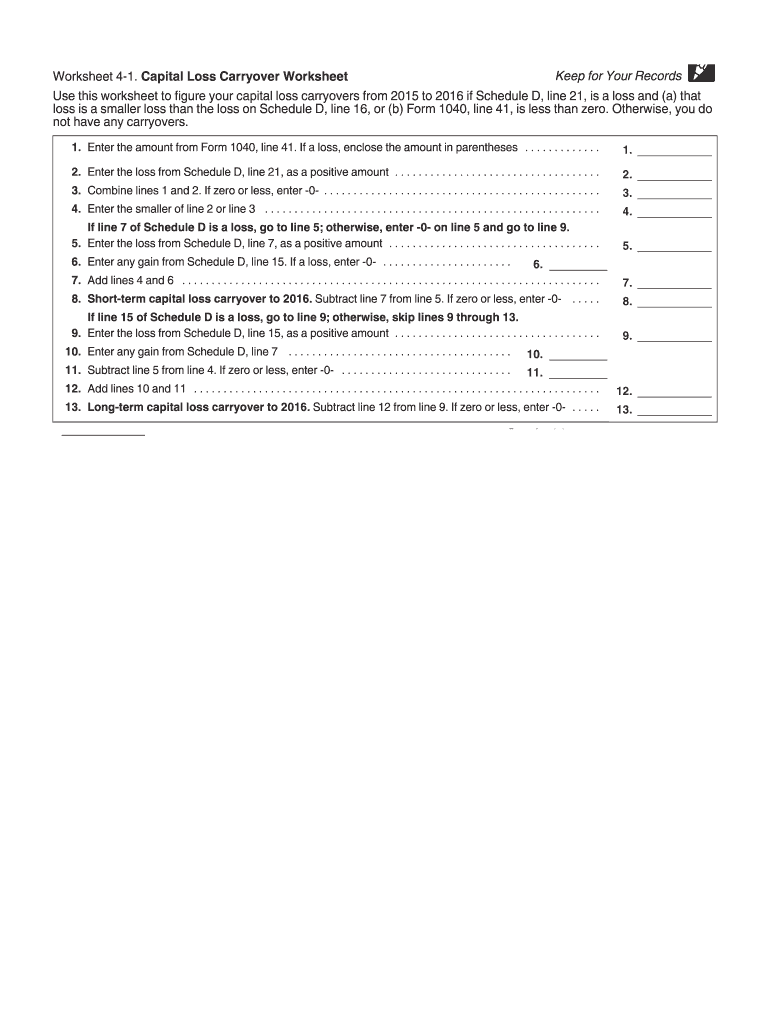
The IRS Capital Loss Carryover Worksheet is a crucial tool for calculating your capital losses that can be carried over to future tax years. This guide will provide clear, step-by-step instructions on how to fill out this worksheet online, ensuring that you have the necessary information at your fingertips.
Follow the steps to accurately complete the IRS Capital Loss Carryover Worksheet.
- Click ‘Get Form’ button to obtain the IRS Capital Loss Carryover Worksheet and open it in your preferred editor.
- In column (d) for Sales Price, enter either the gross sales price or the net sales price from the sale. If you received a Form 1099-B from your broker, use the gross sales price shown unless it indicates a net amount was reported to the IRS.
- In column (e) for Cost or Other Basis, input the total cost of the property, including purchase commissions and any improvements, minus any applicable depreciation, amortization, or depletion.
- If you inherited the property or received it as a gift, be sure to refer to further instructions on how to adjust the basis accordingly. You may need to attach an explanation for the basis used.
- Add all the entries from column (d) on lines 1 and 8, and sum these to the totals on lines 2 and 9. Enter your final totals on lines 3 and 10 respectively.
- Continue filling out lines as instructed, ensuring to subtract or adjust figures as indicated throughout the worksheet.
- Once all entries are complete, you can choose to save the document, download it, print, or share the form as needed.
Start completing your IRS Capital Loss Carryover Worksheet online now for a smooth filing experience.
Experience a faster way to fill out and sign forms on the web. Access the most extensive library of templates available.
Related content
Use this worksheet to figure your capital loss carryovers from 2023 to 2024 if your 2023...
by D SCHEDULE · Cited by 1 — Schedule D (Form 1040) is for reporting capital gains and...
Jan 19, 2017 — You cannot deduct any NOL carryovers or carrybacks from other years...
Get answers to your most pressing questions about US Legal Forms API.
Where on the 1040 is capital loss carryover?
On form 1040, capital loss carryover is typically recorded in the capital gains and losses section. It's essential to refer to the IRS Capital Loss Carryover Worksheet, as this will guide you in accurately reporting any losses carried over from previous years. Correctly positioning this information can positively influence your tax calculation.
What is the federal carryover worksheet?
The federal carryover worksheet helps track tax items that can be carried over into future tax years, such as capital losses and NOLs. It simplifies the process of reporting these items on your tax return. Incorporating the IRS Capital Loss Carryover Worksheet is crucial as it provides the framework for maintaining accurate records of your losses.
Where can I see my capital losses?
Your capital losses can be viewed on your tax documents, specifically within the 'Capital Gains and Losses' section of your tax return. If you use tax software, you can find your capital losses easily through their reporting tools. Remember, the IRS Capital Loss Carryover Worksheet is also essential for tracking any losses you may carry into future years.
Where can I find the capital loss carryover worksheet?
You can find the capital loss carryover worksheet on the IRS website or through tax preparation software like TurboTax. These resources provide the essential forms and guidelines needed for accurate completion. By using the IRS Capital Loss Carryover Worksheet, you can make the process more manageable and straightforward.
Where is capital loss carryover recorded?
Capital loss carryover is recorded on your form 1040, specifically in the capital gains and losses section. Additionally, keeping track of your IRS Capital Loss Carryover Worksheet is important, as it contains the details you need for future returns. This makes it easier to report and utilize your carryover losses in the following tax years.
Where do I enter passive loss carryover TurboTax?
Entering passive loss carryovers in TurboTax is straightforward. Visit the income or rental section, where you can provide details about passive activities. Using the IRS Capital Loss Carryover Worksheet will help you ensure that all losses are properly documented and carried forward to subsequent tax years.
Where do I enter a NOL carryover in TurboTax?
To enter a Net Operating Loss (NOL) carryover in TurboTax, first access the deductions section. Look for the option labeled 'NOL Carryover' where you can input your figures. This section works in concert with the IRS Capital Loss Carryover Worksheet, ensuring that you accurately capture any potential tax benefits.
Where to find capital loss carryover worksheet TurboTax?
You can easily find the capital loss carryover worksheet in TurboTax by navigating to the section that deals with investment income. Look for the 'Capital Gains and Losses' area. Here, you will see options to enter your capital losses, alongside an IRS Capital Loss Carryover Worksheet that you can fill out for accurate reporting.
How to calculate capital loss carryover example?
In a scenario where you have realized $5,000 in capital losses and $2,000 in capital gains, you will first complete the IRS Capital Loss Carryover Worksheet. After offsetting your gains, you would have a $3,000 loss remaining. You can then apply $3,000 against your ordinary income, and if there are any losses left, they can be carried over to the subsequent year. This simple example demonstrates how to effectively use the worksheet for your tax situation.
How to calculate carryover?
To calculate your capital loss carryover, first utilize the IRS Capital Loss Carryover Worksheet for an organized approach. Determine your total capital losses and subtract any capital gains you have for the year. The remaining amount is what you can carry over to future tax years, allowing you to benefit from those losses later. This systematic calculation assists in accurate tax reporting.
Use professional pre-built templates to fill in and sign documents online faster. Get access to thousands of forms.
If you believe that this page should be taken down, please follow our DMCA take down process here.