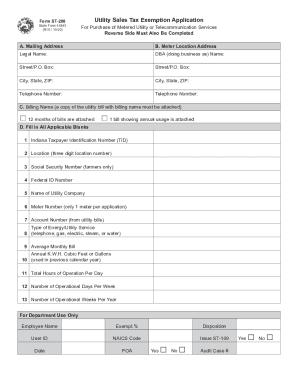
Lity account or something from the utility company on their letterhead with the information needed. Annual utility usages must be documented. Attach either 12 months of billings or one month that has the annual usage documented, typically in a usage graph. Section F: Utility Usage Study: Production (eligible for predominate use exemption) Businesses need to provide the following information detailing production and non-production equipment for the meter. (R&D skip to Section G) 1. List each pi.
Open form follow the instructions
Easily sign the form with your finger
Send filled & signed form or save
How to fill out the IN DoR ST-200 online
The IN DoR ST-200 form is a utility sales tax exemption application for metered utility or telecommunication services. This guide provides step-by-step instructions to help users complete the form accurately and efficiently.
Follow the steps to complete your IN DoR ST-200 application online.
- Click the ‘Get Form’ button to access the ST-200 application and open it in the online editor.
- Provide your legal name and 'doing business as' (DBA) name in Section A, and complete the mailing address details including street, city, state, and ZIP code.
- In Section B, fill in the meter location address, ensuring all required details are accurate.
- For Section C, enter the billing name and attach a copy of the utility bill that includes this information. Indicate whether you are attaching 12 months of bills or one bill showing annual usage.
- Complete Section D by filling in all applicable blanks, including the Indiana Taxpayer Identification Number, location number, federal ID number, name of the utility company, meter number, account number, type of energy utility service, average monthly bill, annual usage, and operational hours.
- In Section E, provide a brief overview of how your operation uses the utility services.
- For Sections F and G, list all production and non-production equipment, detailing their annual energy consumption. Explain how each piece is used and provide the required breakdown.
- In Section H, sign and date the application to certify the information is accurate. If applicable, ensure a Form POA-1 is attached for representatives.
- Once all sections are completed, save your changes, and choose an option to download, print, or share the form for submission.
Complete your IN DoR ST-200 application online today to ensure timely processing.
Experience a faster way to fill out and sign forms on the web. Access the most extensive library of templates available.
Related content
ST-105, 49065, Indiana General Sales Tax Exemption Certificate, fill-in pdf ... ST-200...
Nov 8, 2018 - The Sales Tax Rate Calculator shows the state and local general sales and...
Published on Nov 28, 2018. Usain Bolt is "the world's fastest man" because he has the...
Get answers to your most pressing questions about US Legal Forms API.
How do I get a 501c3 in Indiana?
Choose your Indiana nonprofit filing option. File IN nonprofit articles of incorporation. Get a Federal EIN from the IRS. Adopt your nonprofit's bylaws. Apply for federal and/or state tax exemptions. Register for required state licenses. Open a bank account for your IN nonprofit.
How do I become tax exempt in Indiana?
To receive an Indiana sales tax exemption, the organization must file a Nonprofit Application for Sales Tax Exemption (Form NP-20A) and annually file a Nonprofit Organization's Annual Report (Form NP-20) with the Indiana Department of Revenue.
Is a 501c4 sales tax exempt?
Please note: Being organized and operated as a not-for-profit organization does not, by itself, qualify an organization as a sales tax exempt organization. Religious, charitable, educational, and other organizations must apply to the Tax Department to obtain sales tax exempt status.
Does a 501 C 7 pay sales tax?
Generally, no more than 35 percent of the club's revenues can come from non-member sources. Additionally, a 501(c)(7) club could be subject to taxation or lose its tax exempt status if it engages in business outside of its exempt purpose or if it receives too much income from non-members.
Does a nonprofit pay sales tax?
Nonprofits are also exempt from paying sales tax and property tax. While the income of a nonprofit organization may not be subject to federal taxes, nonprofit organizations do pay employee taxes (Social Security and Medicare) just like any for-profit company.
Do nonprofits pay sales tax in Indiana?
Indiana nonprofit organizations making tax-exempt qualified purchases, but not making retail sales, also must register with the Nonprofit Section of the Indiana Department of Revenue and receive a taxpayer identification number.
Is grocery store food taxed?
Generally, food and food products sold by food stores are exempt from sales tax. However, there are exceptions. This bulletin explains what kinds of food are subject to sales tax and which are exempt when sold by food stores and similar establishments, including supermarkets, grocery stores, convenience stores, etc.
What services are taxable in Indiana?
Although the Indiana sales tax is not aimed at services, certain services are specifically subject to the tax (See below). The rate of the Indiana sales tax is 7%, tying it with Mississippi, New Jersey, Rhode Island, and Tennessee for second highest rate in the U. S., behind California at 7.25%.
Is there sales tax on real estate in Indiana?
Indiana capps property tax rates at 1% of the value for residential property, 2% of the value for rental property and farmland, and 3% of the value for all other types.
What is subject to Indiana sales tax?
Although the Indiana sales tax is not aimed at services, certain services are specifically subject to the tax (See below). The rate of the Indiana sales tax is 7%, tying it with Mississippi, New Jersey, Rhode Island, and Tennessee for second highest rate in the U. S., behind California at 7.25%.
Use professional pre-built templates to fill in and sign documents online faster. Get access to thousands of forms.
If you believe that this page should be taken down, please follow our DMCA take down process here.
This form is available in several versions. Select the version you need from the drop-down list below.