E property used in your trade or D-1 Jan 21, 2020 Cat. No. 24331I business (but see Disposition of Depreciable Property Not Used in Trade or Business in the Form 4797 instructions); c. Oil, gas, geothermal, or other mineral property; and d. Section 126 property. 2. The involuntary conversion (other than from casualty or theft) of property used in a trade or business and capital assets held more than 1 year for business or profit. But see Disposition of Depreciable Property Not Used in Trade o.

How it works
  • Open form

    Open form follow the instructions

  • Easily sign form

    Easily sign the form with your finger

  • Share form

    Send filled & signed form or save

How to fill out the IRS 1040 Schedule D Instructions online

Filling out the IRS 1040 Schedule D Instructions can be straightforward with the right guidance. This guide will provide you with step-by-step instructions on how to complete the form efficiently and accurately online.

Follow the steps to complete the IRS 1040 Schedule D Instructions online.

  1. Press the ‘Get Form’ button to access the form. This will allow you to obtain the IRS 1040 Schedule D Instructions in an interactive format.
  2. Review the purpose of Schedule D. Use this section to determine your overall capital gains or losses from transactions reported on Form 8949 and other relevant forms.
  3. Fill in the details from Form 8949. Ensure you accurately report all short-term and long-term transactions separately, as directed in the form instructions.
  4. Complete lines for any capital gain distributions you received during the year. These will need to be included on the Schedule D.
  5. Gather your documentation for any sales of assets, losses, or other transactions relevant to capital gains and losses.
  6. Finalize your calculations, ensuring all required information is filled in accurately to prevent errors.
  7. Once you have completed the form, you can save your changes, download the form, print it, or share it as needed.

Start filling out your IRS 1040 Schedule D Instructions online today to ensure accurate tax reporting.

Get form

Experience a faster way to fill out and sign forms on the web. Access the most extensive library of templates available.

Related content

About Schedule D (Form 1040), Capital Gains and...

Use Schedule D to report sales, exchanges or some involuntary conversions of capital...

Learn more
Many Tax Forms Are Changing! | Center for...

August 1, 2019 ... The 2018 Form 1040—while created to showcase a new, “simplified”...

Learn more
2004 Instructions For Form 1040 (ALL) P 72 I1040

Attach Schedule SE Other Taxes Payments 37 39 39 55 ? 56 Social security and ..... Form...

Learn more
Questions & Answers

Get answers to your most pressing questions about US Legal Forms API.

Contact support

How are capital gains taxed in 2019?

The current capital gains tax rates under the new 2018 tax law are zero, 15 percent and 20 percent, depending on your income. The 2018 capital gains tax rate is holding steady through 2019, but the income required for each rate has changed.

Capital gains and deductible capital losses are reported on Form 1040, Schedule D, Capital Gains and Losses, and then transferred to line 13 of Form 1040, U.S. Individual Income Tax Return. Capital gains and losses are classified as long-term or short term.

Any year that you have to report a capital asset transaction, you'll need to prepare Form 8949 before filling out Schedule D unless an exception applies. Form 8949 requires the details of each capital asset transaction.

Capital gains and deductible capital losses are reported on Form 1040, Schedule D, Capital Gains and Losses, and then transferred to line 13 of Form 1040, U.S. Individual Income Tax Return.

Schedule D requires taxpayers to report the sales price of their investment or ownership interest, its cost or other basis and any adjustments to the gain or loss. Taxpayers can usually get this information from Form 1099-B, which the payer must file with the IRS for reporting purposes and send a copy to the payee.

Schedule D isn't just used to report capital gains when you sell a home. It's also used to report: The sale or exchange of a capital asset not reported on another form or schedule. Gains from involuntary conversions (other than from casualty or theft) of capital assets not held for business or profit.

Fill out Form 1040. Put your totals from Schedule D on line 13 of form 1040. Attach Schedule D and Form 8949 to your Form 1040 so the IRS can verify your figures. Your long-term gains or losses qualify you for a 15 percent tax rate.

Schedule D requires taxpayers to report the sales price of their investment or ownership interest, its cost or other basis and any adjustments to the gain or loss. Taxpayers can usually get this information from Form 1099-B, which the payer must file with the IRS for reporting purposes and send a copy to the payee.

The Schedule D form is what most people use to report capital gains and losses that result from the sale or trade of certain property during the year. Most people use the Schedule D form to report capital gains and losses that result from the sale or trade of certain property during the year.

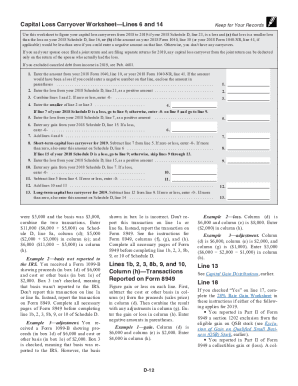
Schedule D contains different worksheets that you may need to complete, including the Capital Loss Carryover Worksheet, 28% Rate Gain Worksheet and Unrecaptured Section 1250 Gain Worksheet. Each of these worksheets helps you compute certain Schedule D line-item amounts, and each also comes with instructions.

Get This Form Now!

Use professional pre-built templates to fill in and sign documents online faster. Get access to thousands of forms.

If you believe that this page should be taken down, please follow our DMCA take down process here.

IRS 1040 Schedule D Instructions Form

This form is available in several versions. Select the version you need from the drop-down list below.

Get IRS 1040 Schedule D Instructions