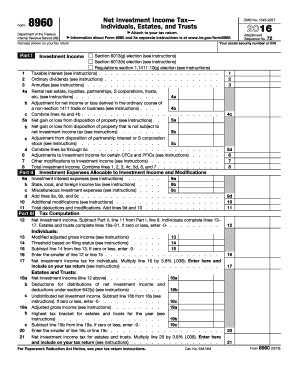
N. about Form 8960 and its separate instructions is at www.irs.gov/form8960. Name(s) shown on your tax return Part I Section 6013(g) election (see instructions) Section 6013(h) election (see instructions) Regulations section 1.1411-10(g) election (see instructions) 1 Taxable interest (see instructions) . . . . . . . . . . . . . . . . . . . . 2 Ordinary dividends (see instructions) . . . . . . . . . . . . . . . . . . . 3 Annuities (see instructions) . . . . . . . . . . . . . . . . . . . . . .
Open form follow the instructions
Easily sign the form with your finger
Send filled & signed form or save
How to fill out the IRS 8960 online
Filling out the IRS Form 8960, which pertains to the net investment income tax for individuals, estates, and trusts, can seem daunting. This guide provides clear steps to help users effectively complete the form online.
Follow the steps to accurately fill out the form 8960 online.
- Click ‘Get Form’ button to obtain the form and open it in the editor.
- Begin by filling in the name(s) shown on your tax return to ensure consistency with your other tax filings.
- In Part I, make elections, if applicable. Review the instructions for Section 6013(g) and (h) elections, as well as the regulations section 1.1411-10(g) election.
- Complete lines 1 through 4c, detailing your taxable interest, ordinary dividends, annuities, and rental real estate income. Follow the instructions carefully for each line to report accurate amounts.
- For net gain or loss from property, fill out lines 5a through 5c, combining them into line 5d.
- Adjust for certain CFCs and PFICs on line 6, and other modifications on line 7, then combine these into line 8 to calculate your total investment income.
- Proceed to Part II, where you will report investment expenses. Fill out lines 9a through 10, ensuring you allocate expenses correctly.
- Calculate total deductions on line 11, which will be used later in your tax computation.
- Move to Part III. For individuals, complete lines 13 through 17, which includes calculating your modified adjusted gross income and net investment income tax.
- Estates and trusts must complete lines 18a through 21, determining their net investment income tax similarly.
- Review all entries for accuracy, then save all changes, download the completed form, print it for your records, or share it as needed.
Take control of your tax obligations and start filling out your IRS 8960 online today.
Experience a faster way to fill out and sign forms on the web. Access the most extensive library of templates available.
Related content
Apr 29, 2025 — Taxpayers use this form to figure the amount of their net investment...
Aug 16, 2013 — The IRS has recently released Draft Form 8960, the Form that will be used...
Jan 4, 2017 — The taxable portion of distributions from nonquali fied plans are subject...
Get answers to your most pressing questions about US Legal Forms API.
How do I avoid 3.8% investment tax?
While it may be challenging to completely avoid the 3.8% investment tax, there are strategies available to reduce your exposure. You might consider tax-efficient investment options, managing your income streams, or isolating investment income to remain under the thresholds. Using services like US Legal Forms can assist you in understanding and preparing the necessary IRS 8960 form to minimize your tax liability.
What triggers the net investment income tax?
The net investment income tax is triggered when your modified adjusted gross income exceeds the defined thresholds, along with reports of net investment income. Factors contributing to this income may include rental income, interest, and capital gains. Understanding how these elements interact with IRS 8960 is crucial for managing your tax responsibilities.
What is the purpose of the IRS form 8960?
IRS form 8960 serves to calculate the net investment income tax owed by taxpayers exceeding the income thresholds. This form captures details about your investment income, such as dividends and capital gains. Completing this form accurately is vital for ensuring compliance with tax regulations.
Who pays the 3.8% net investment tax?
The 3.8% net investment tax is applicable to individuals, estates, and trusts that earn income above specific thresholds. If your modified adjusted gross income exceeds $200,000 or $250,000, you may need to remit this tax on gains from investments. Utilizing the IRS 8960 form helps clarify your tax liability related to investment income.
Who pays the 3.8 investment tax?
The 3.8% investment tax primarily affects individuals with high income levels that surpass the thresholds set by the IRS. Taxpayers who fall within these income brackets are responsible for this additional tax on their net investment income. As you navigate this tax, the IRS 8960 form will be essential for reporting your income accurately.
At what income level does the 3.8 surtax kick in?
The 3.8% surtax on net investment income applies to individuals with modified adjusted gross income (MAGI) exceeding $200,000, or $250,000 for married couples filing jointly. This surtax arises when your investments generate income, contributing to your overall earnings. Understanding your position regarding the IRS 8960 form can help you prepare for this tax.
Who has to file IRS form 8960?
Individuals who have net investment income and whose modified adjusted gross income exceeds the specified limits are required to file IRS Form 8960. This includes higher-income earners with investment income from various sources. If you fall within this category, it is crucial to file this form to determine your tax obligations correctly. Using uSlegalforms can help streamline the filing process by providing easy-to-use resources.
What investments should be reported on taxes?
You should report various types of investments on your taxes, including stocks, bonds, mutual funds, and real estate income. Income generated from these sources is usually subject to taxation and must be included on IRS Form 8960 if applicable. Additionally, you may need to include certain interest and dividend income. Accurate reporting ensures that you remain compliant and avoid potential penalties.
Do I have to declare my investments?
You do have to declare your investments to the IRS when filing your taxes. Specifically, if you earn income from these investments, you must report it. Declaring investments accurately is crucial for compliance and can prevent issues later on. Again, IRS Form 8960 will guide you through the declaration process effectively.
How do you report investments to the IRS?
You report investments to the IRS by listing them on your tax return, usually on IRS Form 8960 if you have net investment income. You will need to gather all relevant documents, such as 1099 forms, that summarize income from investments. It is essential to be thorough in reporting to avoid any discrepancies. Using uSlegalforms can simplify this process by providing templates that guide you through the reporting requirements.
Use professional pre-built templates to fill in and sign documents online faster. Get access to thousands of forms.
If you believe that this page should be taken down, please follow our DMCA take down process here.
This form is available in several versions. Select the version you need from the drop-down list below.