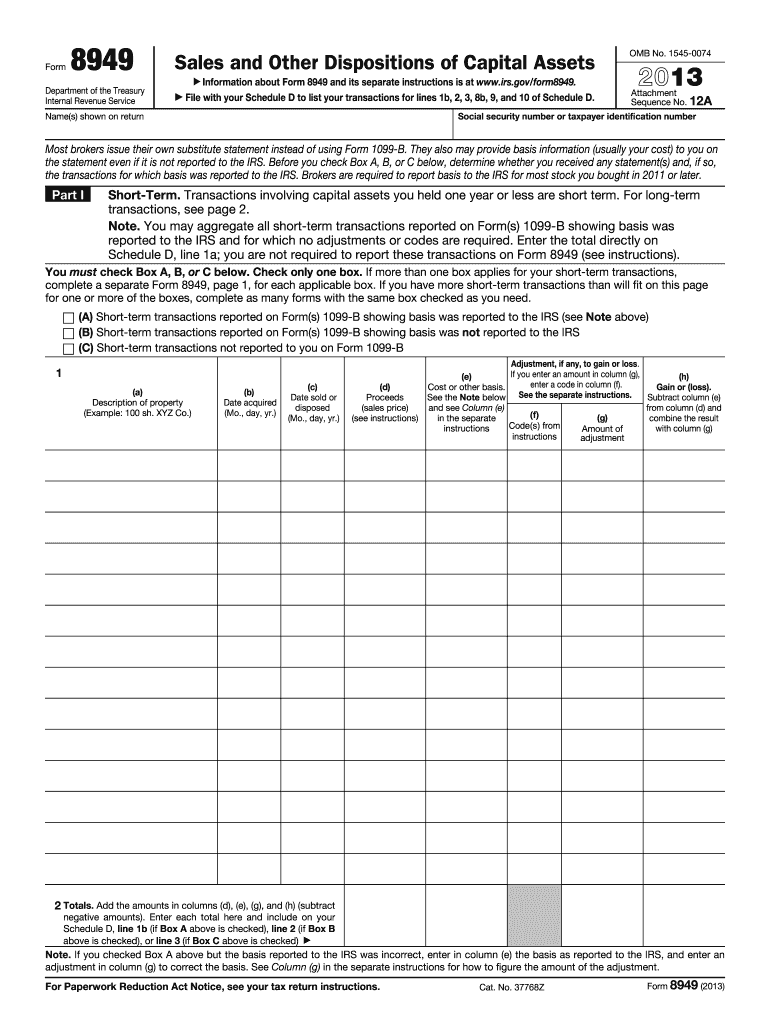
On Act Notice, see your tax return instructions. Cat. No. 37768Z Form 8949 (2013) Attachment Sequence No. 12A Form 8949 (2013) Name(s) shown on return. (Name and SSN or taxpayer identification no. not required if shown on other side.) Page 2 Social security number or taxpayer identification number Most brokers issue their own substitute statement instead of using Form 1099-B. They also may provide basis information (usually your cost) to you on the statement even if it is not reported to.
Loading

Open form follow the instructions

Easily sign the form with your finger

Send filled & signed form or save
How to fill out the IRS 8949 online
Filling out the IRS 8949 form accurately is essential for reporting your sales and dispositions of capital assets. This guide provides clear, step-by-step instructions on completing the form online, ensuring you understand each section and can navigate the process with ease.
Follow the steps to fill out the form effectively.
- Click ‘Get Form’ button to obtain the form and open it in the editor.
- Begin by providing your social security number or taxpayer identification number at the top of the form. This identifies your tax record and associates the form with your filing.
- Enter the name(s) shown on your tax return, ensuring accuracy to match your other filings.
- Determine which section to complete based on whether your transactions were short-term (held for one year or less) or long-term (held for more than one year). Check the appropriate box (A, B, or C for short-term; D, E, or F for long-term).
- For each transaction, fill in the description of the property in column (a), the date acquired in column (b), and the date sold or disposed in column (c).
- Provide the proceeds or sales price in column (d), followed by entering your cost or other basis in column (e).
- If there is an adjustment to your gain or loss, enter it in column (g), and if needed, provide a code in column (f) to specify the type of adjustment.
- Calculate your gain or loss by subtracting column (e) from column (d) and record the result in column (h).
- Add totals for columns (d), (e), (g), and (h) as necessary and enter them at the bottom of the section, corresponding to the appropriate line on your Schedule D.
- Review all entries for accuracy before saving changes, downloading, printing, or sharing your completed form.
Start filling out your IRS 8949 form online today to ensure your capital asset transactions are reported accurately.
Experience a faster way to fill out and sign forms on the web. Access the most extensive library of templates available.
Related content
Jan 23, 2025 — Use Form 8949 to reconcile amounts that were reported to you and the IRS...
Mar 8, 2024 — A taxpayer who sells cryptocurrency owned for more than one year must file...
Form 1099-CAP is sent when a corporation's stock has a change in control or capital...
Get answers to your most pressing questions about US Legal Forms API.
Does TurboTax automatically file the 8949?
While TurboTax does not automatically file IRS 8949 without your input, it does pre-fill the form based on your reported transactions. After reviewing and confirming your information, you can e-file your entire tax return, including the 8949, seamlessly through the platform. This not only saves time but also reduces errors, making your tax filing experience smoother.
Who fills out form 8949?
Individuals who sell or exchange capital assets must fill out IRS 8949. This form applies to all taxpayers who realize capital gains or losses through sales. If you invest in stocks, bonds, or other securities, you will need to complete this form. US Legal Forms can assist you in understanding the requirements and ensure your form is filled out correctly.
Do I need to list all transactions on 8949?
Yes, you should list all sales and exchanges that require reporting on IRS 8949. This includes stock sales, mutual funds, and other capital assets. However, if you have many transactions meeting the same criteria, you may consolidate them using summary reporting. This can save you time, but you must still ensure compliance with IRS regulations.
How do I enter schedule D on TurboTax?
To enter Schedule D in TurboTax, first navigate to the 'Wages & Income' section. From there, locate the investment income section and select 'Stocks, Mutual Funds, Bonds, Other.' You will answer questions about your sales, gains, or losses. TurboTax will guide you through the process, helping ensure your IRS 8949 information flows smoothly to Schedule D.
Does TurboTax fill out form 8949?
Yes, TurboTax can help you complete IRS 8949. When you enter your transactions, TurboTax automatically generates the necessary form based on your input. This feature streamlines your filing process, making it easier to manage your capital gains and losses accurately. Always double-check the information entered to confirm accuracy.
How do I report form 8949 on my taxes?
To report IRS 8949 on your taxes, start by gathering all your sales and transactions related to capital assets. You will need to complete the form and detail each transaction, including dates, amounts, and gains or losses. After filling out the form, transfer the totals to your Schedule D. For additional support, consider using platforms like US Legal Forms to ensure you handle everything correctly.
What is the IRS form 8949 for?
IRS Form 8949 is used to report the sale of capital assets, including stocks and real estate. This form provides the IRS with detailed information about your transactions, helping the agency assess whether you owe taxes on any gains. By accurately filling out Form 8949, you can ensure compliance and potentially minimize your tax liability. For a smooth experience, you might consider resources like US Legal Forms.
Should I use Schedule D or form 8949?
You should use IRS Form 8949 first for detailed reporting of each capital transaction. After that, summarize your results on Schedule D. In essence, Form 8949 offers the necessary transaction details while Schedule D provides an overview of your capital gains and losses. This two-form approach assists you in maintaining accurate records for the IRS.
When to use form 8949 vs schedule D?
Use IRS Form 8949 to report individual sales of capital assets, itemizing each transaction. In contrast, Schedule D summarizes the data from Form 8949 for your tax return. Submit Form 8949 if you have multiple transactions requiring detailed reporting. Knowing when to use each form helps you maintain clarity and compliance in your tax filings.
Do I need form 8949 to file taxes?
Whether you need IRS form 8949 depends on your financial activities throughout the year. If you sold or exchanged any stocks, bonds, or other capital assets, you'll need to fill out the form to report those transactions. Completing form 8949 helps you accurately calculate your capital gains or losses, which is essential for your tax return.
Use professional pre-built templates to fill in and sign documents online faster. Get access to thousands of forms.
If you believe that this page should be taken down, please follow our DMCA take down process here.
This form is available in several versions. Select the version you need from the drop-down list below.