Interest in a nongrantor trust, complete line 3. 1 Complete columns (a), (b), and (c) for all property on which you deferred tax on your 2008, 2009, or 2010 Form 8854. Complete column (d) for any property you disposed of in 2011 and see the instructions for Part III. (a) Description of property (b) Amount of mark-to-market gain or (loss) reported in 2008, 2009, or 2010 (c) Amount of tax deferred in 2008, 2009, or 2010 (d) Date of disposition (if any) 2 Did you receive any distributions of.

Open form follow the instructions

Easily sign the form with your finger

Send filled & signed form or save
How to fill out the IRS 8854 online
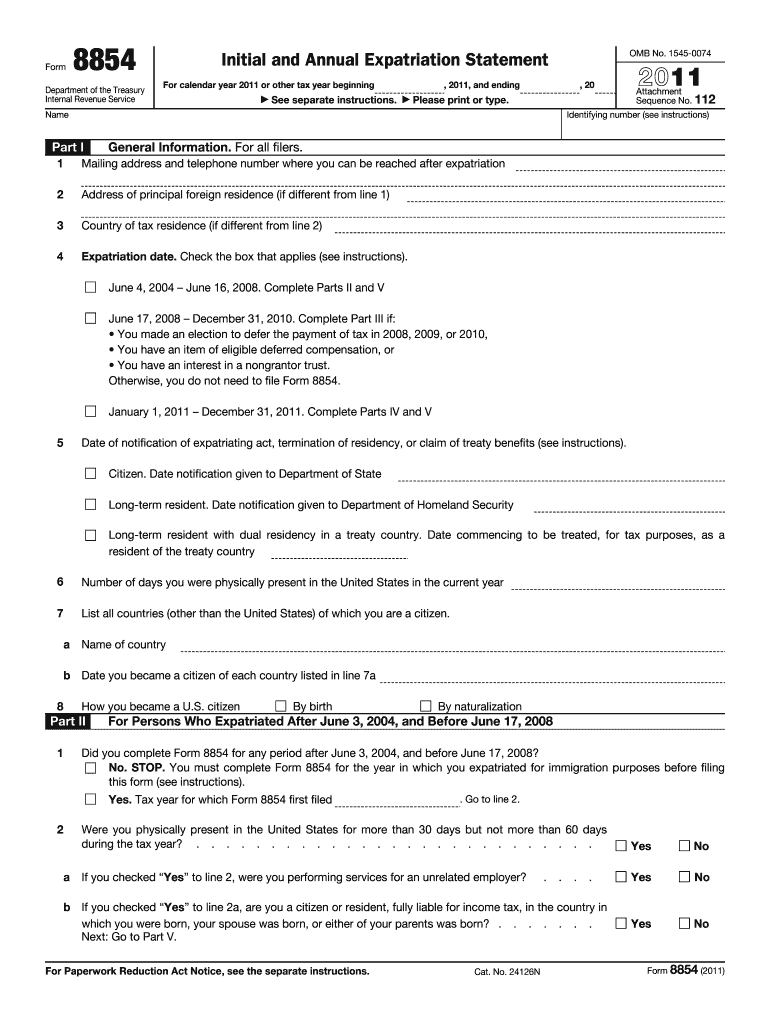
Filling out IRS Form 8854, the Initial and Annual Expatriation Statement, is essential for individuals who have expatriated or terminated their U.S. citizenship. This guide will walk you through each section of the form, providing step-by-step instructions to ensure accurate completion.
Follow the steps to complete the IRS 8854 online successfully.
- Click ‘Get Form’ button to access the IRS Form 8854 online.
- Begin with Part I: General Information. Fill in your mailing address and telephone number where you can be reached after expatriation.
- Complete the address of your principal foreign residence, if different from your mailing address.
- Provide your country of tax residence, noting any differences from the previous address.
- Indicate your expatriation date by checking the appropriate box and completing the relevant parts of the form.
- State the date you notified the Department of State or Department of Homeland Security of your expatriating act or residency termination.
- Enter the number of days you were physically present in the United States during the current year and list all countries of which you are a citizen.
- Continue to the relevant parts for your specific expatriation date and circumstances, completing all applicable questions regarding your U.S. citizenship status.
- Proceed to parts concerning your financial information, including tax liabilities, net worth, and property ownership related to expatriation.
- Finalize the form by reviewing all sections for accuracy. Save changes to your document, and you can download, print, or share it as needed.
Start filling out your IRS Form 8854 online today to ensure compliance with expatriation requirements.
Experience a faster way to fill out and sign forms on the web. Access the most extensive library of templates available.
Related content
Apr 24, 2025 — Form 8854 is used by individuals who have expatriated on or after June 4...
Instructions for Form 8854, expatriation initial information statement. Author: United...
Apr 15, 2015 — What's New. Premium tax credit. You may be eligible to claim the premium...
Get answers to your most pressing questions about US Legal Forms API.
How do I get an IRS tax clearance certificate?
To obtain an IRS tax clearance certificate, you should start by filing the necessary forms, including IRS Form 8854. This form helps the IRS confirm that you have settled your tax obligations. After processing your form, the IRS will issue a closing letter if everything is in order. Using tools provided by US Legal Forms can ensure that you complete this accurately and efficiently.
What happens if you don't file form 8854?
Failing to file IRS Form 8854 can lead to significant consequences, including tax penalties and issues with expatriation. The IRS may assume you retain U.S. residency, complicating your tax situation. Thus, it is crucial to file the form correctly to avoid complications. To facilitate this process, consider accessing resources available through US Legal Forms.
What is an IRS clearance?
An IRS clearance typically refers to any official documentation that verifies an individual’s tax compliance status. This might include letters confirming that all obligations are satisfied. For expatriates, completing Form 8854 is essential to receive confirmation on tax status. By using US Legal Forms, you can ensure accuracy and efficiency in obtaining this documentation.
Does the IRS issue tax clearance certificates?
The IRS does not issue a traditional tax clearance certificate. However, individuals can obtain a Letter 1052 or a closing letter that serves a similar purpose after filing form 8854. This letter confirms that there are no outstanding tax liabilities. Utilizing tools offered by US Legal Forms can streamline this documentation process.
What is the meaning of 8854?
IRS Form 8854 is a crucial document for expatriates who are relinquishing U.S. citizenship or long-term residency. The form helps determine an individual's tax obligations upon departure. Understanding IRS 8854 allows individuals to navigate the tax implications effectively. Consulting resources or professionals can simplify this complex process.
How long does it take to get an IRS estate closing letter?
The timeline for obtaining an IRS estate closing letter can vary. Typically, it can take between six to twelve months once the IRS processes the Form 8854. However, delays can occur depending on the complexity of the estate. To streamline the process, consider using services like US Legal Forms for guidance.
What happens if you forget to report a tax form?
Forgetting to report a tax form like IRS 8854 can lead to audits and penalties from the IRS. It's crucial to file all required forms to avoid legal complications. You can use the resources available on our US Legal Forms platform to streamline your reporting process and ensure accuracy.
How to calculate the exit tax?
To calculate the exit tax for IRS 8854, you need to determine your net worth and any unrealized gains on your assets. Generally, if your net worth exceeds the exemption threshold, you might owe taxes on gains. Using a tax professional can help ensure accurate calculations and compliance.
What is the tax rate for form 8854?
IRS 8854 does not specify a fixed tax rate, but it can lead to exit taxes based on unrealized gains. If classified as a covered expatriate, you may owe taxes on your net worth above a certain threshold. Consulting with a tax professional is wise to evaluate your situation.
What happens if you don't file 8854?
Not filing IRS 8854 puts you at risk of being classified as a covered expatriate. This classification can impose exit taxes on your assets and lead to complications in future tax filings. It's vital to stay informed and maintain your filing responsibilities to avoid these pitfalls.
Use professional pre-built templates to fill in and sign documents online faster. Get access to thousands of forms.
If you believe that this page should be taken down, please follow our DMCA take down process here.
This form is available in several versions. Select the version you need from the drop-down list below.