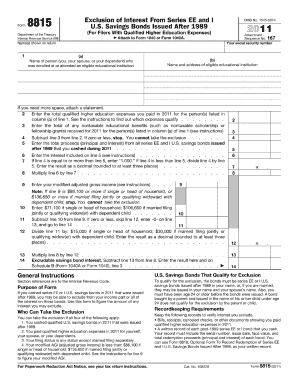
Tentionally Left Blank Page 3 Form 8815 (2012) General Instructions Section references are to the Internal Revenue Code. Future Developments For the latest information about developments related to Form 8815 and its instructions, such as legislation enacted after they were published, go to www.irs.gov/form8815. Purpose of Form If you cashed series EE or I U.S. savings bonds in 2012 that were issued after 1989, you may be able to exclude from your income part or all of the interest on those.
Open form follow the instructions
Easily sign the form with your finger
Send filled & signed form or save
How to fill out the IRS 8815 online
Filing taxes can be a complex process, especially when it comes to claiming exclusions for interest on U.S. savings bonds. This guide will walk you through the steps needed to fill out IRS Form 8815 online, ensuring you can claim any potential benefits confidently.
Follow the steps to complete your Form 8815:
- Click ‘Get Form’ button to obtain the form and open it in the editor.
- In Line 1, enter the name of the person who was enrolled at or attended an eligible educational institution, and in Column (b), provide the name and address of that institution. Remember to list all institutions if there were multiple attended.
- For Line 2, input the total qualified higher education expenses you paid for the person(s) listed. These must include tuition and fees but exclude room and board or expenses related to non-degree courses.
- In Line 3, enter any nontaxable educational benefits received for the individual(s) identified in Line 1. This includes scholarships or grants that are not taxable.
- On Line 5, subtract the amount on Line 3 from Line 2. If the result is zero or less, you cannot take the exclusion and should stop here.
- For Line 6, enter the total proceeds from all series EE and I U.S. savings bonds you cashed during the applicable year.
- In Line 7, provide the interest amount included in your total from Line 6.
- Line 9 requires you to enter your modified adjusted gross income. Make sure to refer to your return and applicable instructions for accurate reporting.
- Complete Lines 10 to 12 based on your modified AGI and your filing status. These lines will guide you on the eligibility for exclusions based on income thresholds.
- On Line 14, calculate and enter the excludable savings bond interest, which should be transferred to Schedule B of your Form 1040 or 1040A.
Start filling out your IRS Form 8815 online to ensure you maximize your potential exclusions.
Experience a faster way to fill out and sign forms on the web. Access the most extensive library of templates available.
Related content
Dec 3, 2024 — If you cashed series EE or I US savings bonds this year that were issued...
5329 Additional Taxes on Qualified Plans and Other. Tax-Favored Accounts. 8815 Exclusion...
Form 8815 is used to figure the amount of interest you can exclude from your income when...
Get answers to your most pressing questions about US Legal Forms API.
Are cashed bonds considered income?
Yes, cashing in bonds generally results in the interest being recognized as income for tax purposes. The IRS requires you to report this interest on your tax return, which could impact your overall liabilities. However, if you utilize the IRS 8815 and meet the income limits, you might exclude some interest from taxable income. Staying informed about these details is vital for effective financial management.
Where to put bonds on a tax return?
When filing your tax return, you report the interest from your savings bonds on Schedule B if it's more than $1,500. If you qualify for the exclusion on Form 8815, cite that on your return as well. Keeping all related documents organized, including the 1099-INT form, helps ensure your filing is accurate. Using platforms like USLegalForms can simplify this process by providing user-friendly templates and guidance.
What is the IRS form 8815 used for?
The IRS form 8815 is specifically designed to allow eligible taxpayers to exclude interest from series EE bonds from their taxable income. This form benefits those who use their bond proceeds for qualified education expenses, thereby reducing their tax liability. It is essential for anyone considering cashing in their EE bonds to assess whether they qualify for this exclusion. Understanding this form can significantly impact your overall tax obligations.
How do I report a cashed savings bond on my taxes?
To report a cashed savings bond, you will include the interest earned on your tax return. Use the 1099-INT form provided to you, as it details the amount of interest that must be reported as income. You may also utilize Form 8815 if you meet the income criteria, which can help you exclude a portion of that interest from taxation. Accurate reporting is crucial for compliance and to maximize your tax benefits.
What is the income limit for Form 8815?
The income limit for Form 8815, which is used to exclude interest from taxable income, is based on your modified adjusted gross income. As of recent guidelines, the limits begin to phase out when your income exceeds $100,000 for single filers and $150,000 for married couples filing jointly. Make sure to review these limits each tax year, as they can change. Meeting these limits can help you take full advantage of the tax benefits associated with your series EE bonds.
How do I avoid paying taxes on series EE bonds?
To avoid paying taxes on series EE bonds, you can use the IRS 8815 form. This form allows you to exclude interest from taxes if you meet certain income requirements. Ensure that your modified adjusted gross income falls below the specified limits, which you can check on the IRS website. Additionally, consider using the bonds for qualified education expenses, which may also help in tax avoidance.
What is the tax exemption form for Series EE savings bonds?
The tax exemption form for Series EE savings bonds is IRS Form 8815, which you file to exclude interest from your taxable income under specific conditions. To qualify, you must use the proceeds for higher education expenses and satisfy income limits. Filing Form 8815 ensures you maximize your savings and minimize tax liabilities. For detailed guidance on this process, you may find US Legal Forms beneficial.
How to avoid paying taxes on inherited savings bonds?
To avoid paying taxes on inherited savings bonds, it’s important to understand the rules governing inherited assets. Generally, beneficiaries do not owe taxes on the bond’s value at the time of inheritance. It is advisable to utilize IRS Form 8815 if the inherited bonds qualify for tax exclusion. Keep in mind that professional assistance from services like US Legal Forms can help clarify your obligations and ensure compliant reporting.
What is the cap for foreign earned income exclusion?
The cap for the foreign earned income exclusion is adjusted annually for inflation. For the tax year 2023, the maximum exclusion is $120,000, allowing qualifying American citizens and residents working abroad to exclude this amount from their taxable income. If you exceed this limit, it's important to understand how Form 8815 may apply to your overall tax situation. Consider consulting with professionals to ensure you utilize tax strategies effectively.
What is the income threshold for Form 8995?
The income threshold for Form 8995 is crucial for determining your eligibility for the Qualified Business Income Deduction. Generally, taxpayers with a taxable income of $163,300 for single filers or $326,600 for joint filers must consider various limitations. It is essential to assess whether your income exceeds these thresholds to utilize Form 8995 effectively. Understanding this threshold ensures you can optimize your tax benefits, including any potential implications of IRS 8815.
Use professional pre-built templates to fill in and sign documents online faster. Get access to thousands of forms.
If you believe that this page should be taken down, please follow our DMCA take down process here.
This form is available in several versions. Select the version you need from the drop-down list below.