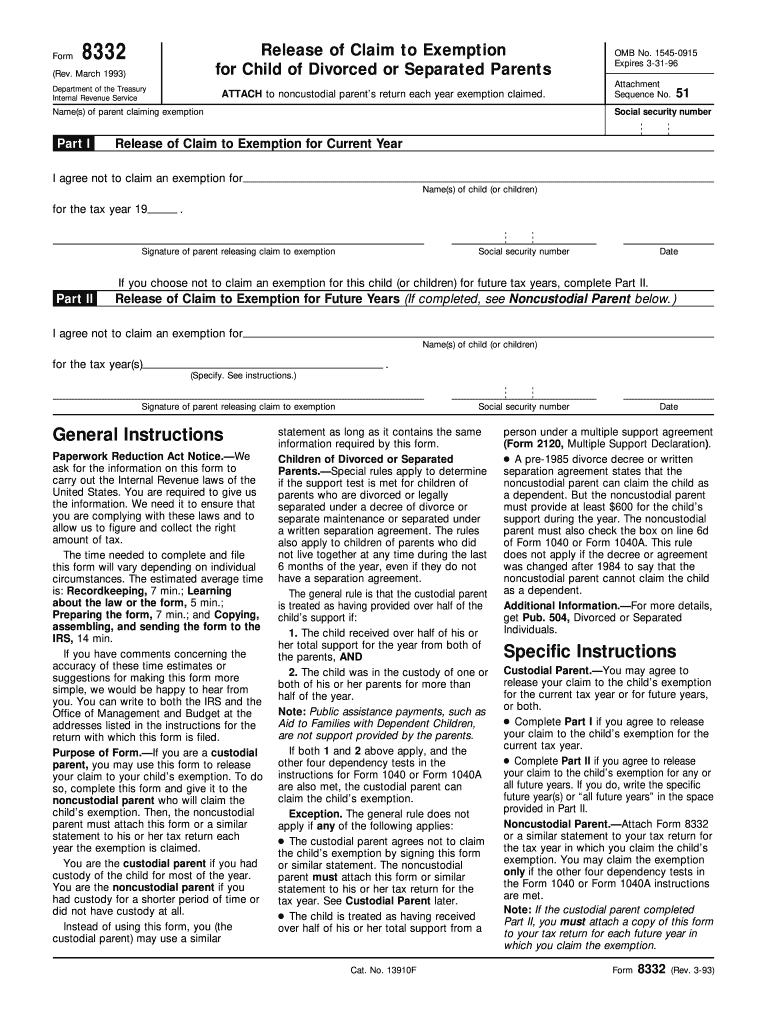
N each year exemption claimed. Name(s) of parent claiming exemption Part I OMB No. 1545-0915 Expires 3-31-96 Attachment Sequence No. 51 Social security number Release of Claim to Exemption for Current Year I agree not to claim an exemption for Name(s) of child (or children) for the tax year 19 . Signature of parent releasing claim to exemption Social security number Date If you choose not to claim an exemption for this child (or children) for future tax years, complete Part II. Par.
Loading

Open form follow the instructions

Easily sign the form with your finger

Send filled & signed form or save
How to fill out the IRS 8332 online
The IRS 8332 form, titled 'Release of Claim to Exemption for Child of Divorced or Separated Parents,' allows a custodial parent to release their claim to a child's tax exemption. This guide will provide you with a clear, step-by-step approach to filling out the form online.
Follow the steps to fill out the form online.
- Click ‘Get Form’ button to obtain the form and open it for editing.
- In Part I, enter the name(s) of the parent who is claiming the exemption. This includes the full names required to identify the claimant accurately.
- Provide the social security number of the parent claiming the exemption to ensure correct identification in tax records.
- In the section labeled 'Release of Claim to Exemption for Current Year,' agree not to claim an exemption for the child or children by providing their names and the tax year.
- Sign the form to confirm your agreement not to claim the exemption and include your social security number and date of signing.
- If you choose to release your claim for future years, complete Part II by entering the names of the child or children and specify the future tax year(s) or indicate 'all future years.'
- Affix your signature, provide your social security number, and date this section to finalize your release for future claims.
- Once all sections are completed, save your changes. You can then download, print, or share the form as needed.
Complete your IRS documents online to ensure a smooth and efficient filing process.
Experience a faster way to fill out and sign forms on the web. Access the most extensive library of templates available.
Related content
Dec 3, 2024 — Release a claim to exemption for your child so that the noncustodial...
Properly Executed IRS Form 8332 is Key to Releasing Dependency Exemption and Trumps State...
Jan 2, 2018 — The custodial parent can use Part III of. Form 8332 for this purpose and...
Get answers to your most pressing questions about US Legal Forms API.
Can IRS Form 8332 be filed electronically?
IRS Form 8332 can be included with electronic tax filings when appropriate. While the IRS allows electronic filing, the form must be attached properly to ensure that the non-custodial parent can claim the dependency exemption. Be sure to follow your tax software's instructions carefully. If you use uslegalforms, it can simplify this process by guiding you through each step.
How do I know who the custodial parent is?
You can determine the custodial parent by evaluating where the child lives more than half the year. If the parents share custody, the arrangement outlined in any custody agreement generally plays a vital role. If there’s still uncertainty, completing IRS Form 8332 can help clarify which parent claims the child. This form also aids in official recognition of the custodial status.
How does the IRS know who the custodial parent is?
The IRS typically knows who the custodial parent is by reviewing the information provided on tax returns. They look at the child’s residency and the parent who claims them as a dependent. Using IRS Form 8332 can provide official documentation in cases of disputes. Therefore, having this form completed helps maintain accurate records.
Does the IRS care about custody agreements?
Yes, the IRS recognizes custody agreements but may not strictly adhere to them. They primarily look at where the child lived for more than half the year. If parents have shared custody, it’s essential to have a clear agreement. Using IRS Form 8332 can help clarify which parent claims the child, ensuring compliance with IRS policies.
Can I claim child tax credit with form 8332?
Yes, Form 8332 allows the non-custodial parent to claim the child tax credit if the custodial parent releases this right. When you submit this form, ensure that you understand all associated tax benefits. It’s important to follow IRS guidelines to maximize your tax return legally. Consulting with a tax professional can also help clarify eligibility.
How does the IRS determine custodial parents?
The IRS determines custodial parents based on the child's residency during the year. Generally, the parent with whom the child lives for the greater part of the year is considered the custodial parent. In cases of shared custody, additional factors may apply. You can clarify your status using IRS 8332 if needed.
How to stop non-custodial parents from claiming their child on taxes?
To prevent non-custodial parents from claiming your child on taxes, you can use IRS Form 8332. This form allows the custodial parent to release the dependency exemption to the non-custodial parent. By completing and signing this form, you establish clear communication about who can legally claim the child. Once filed, it is vital to keep a copy for your records.
Is form 8332 necessary?
IRS Form 8332 is necessary when the custodial parent agrees to let the non-custodial parent claim the child as a dependent. This form prevents confusion and disputes about tax claims, ensuring all parties comply with IRS guidelines. If you find yourself in a situation where the form is relevant, consider using uslegalforms to obtain a proper template and simplify the process.
What happens if the noncustodial parent claims child on taxes?
If a non-custodial parent claims a child on taxes without the custodial parent's consent documented through IRS Form 8332, they may face penalties. The IRS could disallow the claim, leading to tax adjustments and potential fines. This situation highlights the importance of maintaining open communication and using the appropriate forms to avoid misunderstandings.
What happens if I don't file form 8332?
Failing to file IRS Form 8332 when required can lead to a non-custodial parent mistakenly claiming the child as a dependent. This situation may trigger audits or disputes with the IRS, as both parents could end up contesting the deduction. To avoid complications, ensure you submit the form accurately if you choose to allow the other parent to claim your child.
Use professional pre-built templates to fill in and sign documents online faster. Get access to thousands of forms.
If you believe that this page should be taken down, please follow our DMCA take down process here.
This form is available in several versions. Select the version you need from the drop-down list below.