Qualified dividends is more than your investment interest expense. You don't have any other deductible investment expenses. You don't have any carryover of disallowed investment interest expense from 2017. Allocation of Interest Expense Page Exception. A working interest in an oil or gas property that you held directly or through an entity that didn't limit your liability is property held for investment, but only if you didn't materially participate in the activity. Part II Net In.

Open form follow the instructions

Easily sign the form with your finger

Send filled & signed form or save
How to fill out the IRS 4952 online
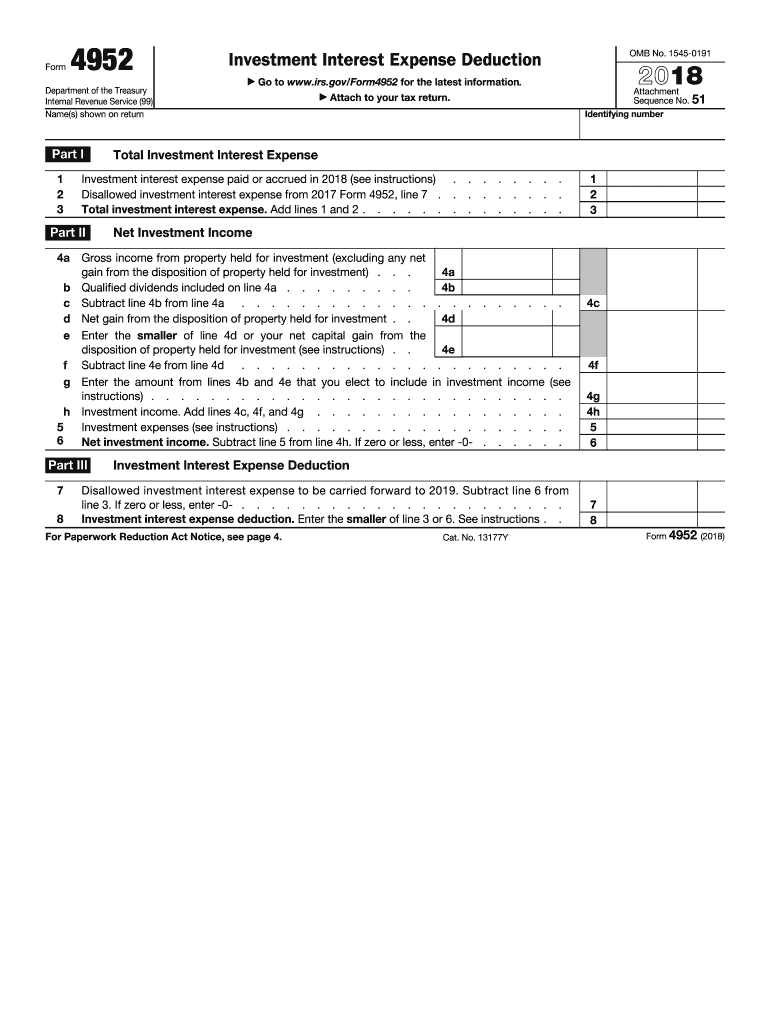
The IRS Form 4952 is used to calculate the amount of investment interest expense that can be deducted for a given tax year, as well as any amounts that can be carried forward to future years. This guide provides a clear and concise step-by-step approach to filling out this form online, making it accessible for users with varying levels of experience in tax matters.
Follow the steps to fill out the IRS 4952 form online.
- Press the ‘Get Form’ button to obtain the document and open it in your browser.
- Enter the names shown on your tax return in the corresponding field of the form.
- In Part I, input the total investment interest expense for the year. This is the interest expense you paid or accrued related to investment activities.
- Add any disallowed investment interest expense from your 2017 Form 4952 in the specified line to compute the total investment interest expense.
- In Part II, calculate your net investment income by first entering your gross income from property held for investment, excluding any net gain from the disposal of property.
- Include any qualified dividends in the appropriate line and subtract it from the gross income to find your net income.
- If applicable, enter any gains from the disposition of property held for investment and calculate the net capital gain.
- Sum the investment income calculated and input any related expenses.
- Subtract the investment expenses from the total net investment income.
- In Part III, enter the disallowed investment interest expense you wish to carry forward.
- Finally, calculate the investment interest expense deduction and ensure to specify if it is less than the calculated amounts and transition it to the applicable form or schedule.
- Review your completed form for accuracy and completeness before saving changes, downloading, printing, or sharing the form.
Complete your forms online efficiently and ensure accurate filing.
Experience a faster way to fill out and sign forms on the web. Access the most extensive library of templates available.
Related content
Feb 19, 2025 — Use this form to figure the amount of investment interest expense you can...
Section 4952 contains provisions that generally correspond to provisions of section 4945...
Mar 1, 2017 — Publication 505 covers tax withholding and estimated tax, including how to...
Get answers to your most pressing questions about US Legal Forms API.
What is the IRS form 4972 used for?
IRS Form 4972 is used to calculate tax on lump-sum distributions from retirement plans, including certain employer-sponsored plans. Although not directly related to IRS 4952, understanding various IRS forms is key to navigating your tax obligations effectively. Consulting resources on platforms like US Legal Forms can provide valuable insights into all pertinent tax forms and their uses.
Can unused investment interest expense be carried forward?
Yes, unused investment interest expense can indeed be carried forward to offset future taxable income. By using Form 4952, you can accurately track and report these amounts in subsequent tax years. This carryforward provision enables you to maximize your tax benefits as your investment income grows. Being aware of these options is important for effective tax planning.
What happens to unused investment interest expense?
Unused investment interest expenses can be carried forward to future tax years. By filing Form 4952, you will correctly report these amounts and track them over time. This can provide a significant tax advantage as you can deduct these expenses against future investment income. Professional platforms like US Legal Forms can assist you in managing this process effectively.
Can you write off investment interest expenses?
Yes, you can write off investment interest expenses, but only to the extent of your investment income. If you choose to use IRS 4952, it will help you calculate the amount you can deduct accurately. If your investment interest expenses exceed your investment income, you can carry these amounts forward to future years. Thus, keeping thorough records is vital for maximizing your deductions.
What happens to excess business interest expense?
Excess business interest expenses may be deducted in future tax years, provided you file Form 4952. The IRS allows you to carry this interest expense forward to offset future income, which can help you minimize your tax bill. It's crucial to track these amounts carefully to take advantage of potential deductions when the time comes. Using tools available on the US Legal Forms platform can simplify this process.
Who is required to file form 4952?
Form 4952 is required for taxpayers who have interest expenses related to investments. If your investment interest expenses exceed your investment income, you must file this form to properly report these amounts. Additionally, if you plan to carry forward any unused investment interest expense to the next year, filing Form 4952 is essential. Understanding this requirement can make managing your taxes easier.
Can I deduct interest expense from an investment property?
Yes, you can generally deduct interest expenses related to an investment property. When using IRS 4952, you can determine how much of your investment interest expenses are deductible. This deduction can lower your taxable income, which benefits your overall tax situation. However, ensure you meet the necessary requirements outlined by the IRS.
How to claim margin interest on tax return?
Claiming margin interest on your tax return involves filling out IRS 4952 to identify and deduct this expense from your investment income. Ensure you keep accurate records of your margin interest payments, as these will support your claims. By claiming your margin interest correctly, you can effectively lower your taxable income and benefit financially.
How do you write off investment income?
To write off investment income, you can use IRS 4952 to deduct related investment interest expenses against your taxable investment income. Additionally, if your total investment expenses exceed your investment income, you may carry forward the unused portion to future tax years. This practice can significantly enhance your tax strategy.
Does margin interest show on 1099?
Yes, margin interest typically appears on your 1099 form, specifically in the section listing investment income. Financial institutions are required to report this information to the IRS, and you will receive a copy for your records. It's crucial to reference this form when filling out IRS 4952 to claim any applicable deductions.
Use professional pre-built templates to fill in and sign documents online faster. Get access to thousands of forms.
If you believe that this page should be taken down, please follow our DMCA take down process here.
This form is available in several versions. Select the version you need from the drop-down list below.