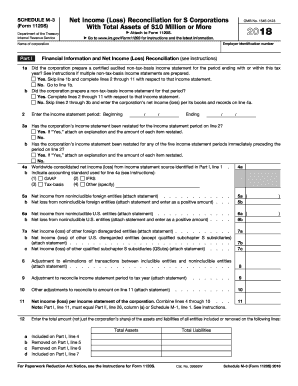
E) of the assets and liabilities of all entities included or removed on the following lines: Total Assets a b c d . . . Total Liabilities Included on Part I, line 4 Removed on Part I, line 5 Removed on Part I, line 6 Included on Part I, line 7 For Paperwork Reduction Act Notice, see the Instructions for Form 1120S. Cat. No. 39666W Schedule M-3 (Form 1120S) 2018 Schedule M-3 (Form 1120S) 2018 Page Part II Reconciliation of Net Income (Loss) per Income Statement of the Corporation Wit.
Open form follow the instructions
Easily sign the form with your finger
Send filled & signed form or save
How to fill out the IRS 1120S - Schedule M-3 online
Filling out the IRS 1120S - Schedule M-3 is essential for S corporations with total assets of $10 million or more. This guide provides a clear and structured approach to completing this form online, ensuring compliance with IRS requirements while making the process as straightforward as possible.
Follow the steps to effectively complete the IRS 1120S - Schedule M-3 online.
- Click ‘Get Form’ button to obtain the form and open it in the editor.
- Begin with Part I, where you will provide financial information and net income (loss) reconciliation. Start by indicating if the corporation prepared a certified audited non-tax-basis income statement for the period. If so, skip to lines 2 through 11 for completion.
- If a non-tax-basis income statement was not prepared, proceed to line 1b. If applicable, complete lines 2 through 11 based on the prepared income statement.
- Enter the income statement period's beginning and ending dates on line 2. Follow up by reflecting any restatements in financial statements in lines 3a and 3b, if necessary.
- On lines 4a and 4b, report the worldwide consolidated net income (loss) and the accounting standard used. Be sure to attach relevant statements for items such as net income from foreign entities and adjustments.
- Continue through lines 5 to 10, which require detailed reporting of net income or losses related to various entities and adjustments. Ensure to provide attached statements as needed.
- Finally, on line 11, calculate the total net income (loss) based on the results from lines 4 through 10. This number must align with figures reported in Part II.
- In Part II, provide a reconciliation of net income (loss) per the income statement with total income (loss) per return. Document any differences and adjustments in the associated lines.
- In Part III, perform a similar reconciliation for expense and deduction items, ensuring that all calculated totals are correctly reported to maintain alignment between the financial statements and tax return.
- Once all sections are completed, review the form for accuracy and completeness. Save changes, download the finished document, and print or share as necessary.
Take the initiative to complete your IRS 1120S - Schedule M-3 online today for a smooth filing experience.
Experience a faster way to fill out and sign forms on the web. Access the most extensive library of templates available.
Related content
Part I. Financial Information and Net Income (Loss) Reconciliation (see instructions). 1a...
Dec 12, 2012 — No Schedule M-3 is required for taxpayers filing Form 1120-REIT, U.S...
Jan 31, 2012 — (Form 1120S) instead of Schedule M-1. Taxed. Return. See the separate...
Get answers to your most pressing questions about US Legal Forms API.
What is the difference between Schedule M-1 and M-3?
The primary difference between Schedule M-1 and Schedule M-3 lies in the level of detail provided. Schedule M-1 offers a simpler overview of reconciliation between book and taxable income, while Schedule M-3 demands a more in-depth breakdown tailored for larger businesses. For those using IRS 1120S - Schedule M-3, this greater detail can help in correctly aligning tax filings with financial statements.
Is Schedule M-3 required for 1120S?
Schedule M-3 is required for Form 1120S only if the S corporation exceeds the asset threshold of $10 million by the end of the tax year. For smaller corporations, filing the M-1 schedule may suffice, as it provides less detail. However, if you qualify, using IRS 1120S - Schedule M-3 can strengthen your tax reporting by ensuring detailed financial data is communicated to the IRS.
What is IRS Schedule M-3?
IRS Schedule M-3 is a supplementary form that provides essential details for corporations and partnerships to report differences between book and tax income. This form plays a critical role in enhancing compliance and reducing discrepancies in corporate tax filings. By utilizing IRS 1120S - Schedule M-3, businesses can improve clarity and transparency in their financial reporting.
What is the schedule M-3 on form 1065?
Schedule M-3 on Form 1065 is similar to that of Form 1120S, serving partnerships that need to reconcile financial and taxable income. It also addresses the same issues of reporting comprehensive financial information to the IRS. If you are managing a partnership, understanding IRS 1120S - Schedule M-3 can foster accurate reporting and compliance.
When did Schedule M-3 start?
The IRS introduced Schedule M-3 in 2004 as part of ongoing efforts to enhance transparency and compliance in corporate tax filings. Initially voluntary for certain entities, it became mandatory for large corporations in 2006. This change aimed to simplify the reconciliation process and create a clearer connection between financial statements and tax returns under IRS 1120S - Schedule M-3.
Is Schedule M-3 required?
Yes, Schedule M-3 is required for certain S corporations that have total assets exceeding $10 million at the end of the tax year. This schedule ensures that the IRS receives a consistent and thorough view of corporate financial statements and tax returns. If your S corporation meets this threshold, you must include IRS 1120S - Schedule M-3 with your filing to ensure compliance.
What is Schedule M-3 on 1120 S?
Schedule M-3 for Form 1120S is a comprehensive report that helps S corporations reconcile financial income with taxable income. This schedule provides a detailed breakdown of permanent and temporary differences. It is essential for the IRS to understand how a corporation's financial reporting aligns with its tax reporting, specifically under IRS 1120S - Schedule M-3.
What is Schedule M on a tax return?
Schedule M refers to various forms that help reconcile differences between IRS tax reporting and a corporation's financial records. In the context of the IRS 1120S - Schedule M-3, it specifically addresses larger corporations’ need for detailed reporting on income and expenses. Understanding Schedule M can help business owners achieve compliance while accurately reflecting their financial status.
Who must file Schedule M-3 Part II?
Part II of Schedule M-3 must be filed by any S corporation required to complete the entire schedule. This section demands a deeper review of income and expenses, ensuring full disclosure. Thus, it's essential for larger corporations to comply with these reporting standards to maintain transparency with the IRS.
Who is required to file M-3 1120S?
Any S corporation with total assets over $10 million must file the IRS 1120S - Schedule M-3. This requirement ensures that larger entities provide comprehensive details about their financial adjustments. If you find yourself needing assistance with this complicated process, consider using platforms like UsLegalForms, which can simplify your filing experience.
Use professional pre-built templates to fill in and sign documents online faster. Get access to thousands of forms.
If you believe that this page should be taken down, please follow our DMCA take down process here.
This form is available in several versions. Select the version you need from the drop-down list below.