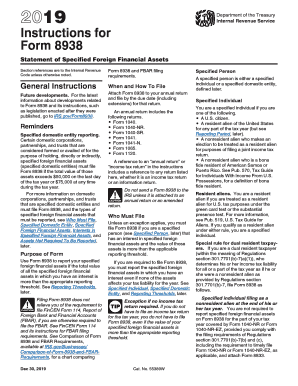
(within the meaning of Regulations section 301.7701(b)-7(a)(1)), who determines his or her income tax liability for all or a part of the tax year as if he or she were a nonresident alien as provided by Regulations section 301.7701(b)-7, file Form 8938 as follows: Specified individual filing as a nonresident alien at the end of his or her tax year. You are not required to report specified foreign financial assets on Form 8938 for the part of your tax year covered by Form 1040NR or Form 1040NR-EZ,.
Open form follow the instructions
Easily sign the form with your finger
Send filled & signed form or save
How to fill out the IRS Instruction 8938 online
Filling out the IRS Instruction 8938, which reports specified foreign financial assets, requires careful attention to detail. This comprehensive guide provides step-by-step instructions tailored to users, ensuring that both experienced and inexperienced individuals can complete the form accurately.
Follow the steps to complete the IRS Instruction 8938 online efficiently.
- Click the ‘Get Form’ button to obtain the IRS Instruction 8938 form and open it in your preferred editor.
- Begin by entering your identifying information at the top of the form, including your name and taxpayer identification number (TIN). Make sure this matches the information on your income tax return.
- Indicate your filing status by checking the appropriate box that reflects whether you are a specified individual or a specified domestic entity.
- In Part I, summarize any foreign deposit and custodial accounts. Report the total maximum value of these accounts, specifying the number of accounts you are reporting.
- In Part II, summarize details of other foreign assets not covered in Part I. Report the total maximum value and the number of such assets.
- Proceed to Part III to provide a summary of tax items attributable to specified foreign financial assets. This includes reporting any interest, dividends, or other types of income.
- In Part IV, note any specified foreign financial assets that you reported on other forms and indicate which forms you filed.
- Use Parts V and VI to provide detailed information for each foreign deposit and custodial account, as well as any other foreign financial assets you've summarized.
- Ensure to report the maximum value of each asset you are including according to the specified reporting rules. Use the correct currency exchange rates if applicable.
- Review your entries for accuracy. Once all sections are completed, save your changes, print, or share the form as necessary.
Complete your IRS Instruction 8938 online today!
Experience a faster way to fill out and sign forms on the web. Access the most extensive library of templates available.
Related content
Use Form 8938 to report your specified foreign financial assets if the total value of all...
Jul 2, 2015 — Who must File? • Unless an exception applies, your client must file...
See the Form 8938 instructions for details. Change of address. If your child filed a...
Get answers to your most pressing questions about US Legal Forms API.
Is it illegal for a US citizen to have a foreign bank account?
No, it is not illegal for a U.S. citizen to have a foreign bank account; however, you must report it according to IRS Instruction 8938. Maintaining transparency and compliance with reporting rules is crucial to avoid penalties. Many people use foreign accounts for various legitimate reasons, such as travel or investment. Understanding your reporting responsibilities is essential for managing your finances effectively.
Are foreign bank accounts reported to the IRS?
Yes, foreign bank accounts are reported to the IRS under IRS Instruction 8938 and other regulations. U.S. taxpayers must disclose their foreign accounts to ensure transparency and compliance with tax laws. The IRS uses this information to monitor foreign financial activities closely. It is essential to stay informed and report accurately to avoid potential issues.
Can form 8938 be filed electronically?
Yes, Form 8938 can be filed electronically through the IRS e-filing system. This option simplifies the filing process, allowing you to submit your information quickly and securely. Ensure that your details are accurate and complete to avoid delays. Using tools like USLegalForms can also offer guidance and support during the electronic filing process.
Do I have to file both form 8938 and FBAR?
Yes, you may need to file both Form 8938 and the FBAR (FinCEN Form 114). While both forms serve to report foreign financial assets, they have distinct requirements and thresholds. Form 8938 falls under IRS Instruction 8938, focusing on specified foreign assets, while the FBAR pertains specifically to foreign bank accounts. Understanding these differences ensures you meet all your reporting obligations.
What happens if you don't declare a foreign bank account?
Not declaring a foreign bank account can lead to severe repercussions, such as hefty fines and possible criminal charges. The IRS actively targets noncompliance, and a failure to report under IRS Instruction 8938 can trigger audits and investigations. It's crucial to proactively disclose all your foreign accounts to remain compliant and protect your financial future. Consulting resources like USLegalForms can help you navigate these requirements.
How do I report foreign property to the IRS?
To report foreign property to the IRS, file Form 8938 along with your annual tax return. This form is designed to disclose specified foreign financial assets, which include bank accounts and property. Ensure that you accurately report all relevant details and maintain records, as the IRS may request documentation. Using platforms like USLegalForms can simplify the process, ensuring you meet all reporting requirements.
What happens if I have more than $100,000 in a foreign bank account?
If you maintain more than $100,000 in a foreign bank account, you must report it to the IRS under IRS Instruction 8938. Failure to do so may result in significant penalties, including fines and interest. Moreover, the IRS could investigate your financial activities, potentially leading to serious legal issues. It's essential to stay informed and compliant to avoid complications.
What happens if you don't file form 8938?
Not filing form 8938 when required can lead to substantial penalties, which can accumulate over time. The IRS takes non-compliance seriously, and you may face fines or additional scrutiny on your tax returns. It’s best to stay compliant with IRS Instruction 8938 to avoid these consequences. Platforms like US Legal Forms can help you ensure that you meet all your filing obligations.
What is the total maximum value for form 8938?
The maximum value for form 8938 reporting is set at $5 million for individuals living abroad and $300,000 for those living in the United States. This figure includes the total value of specified foreign financial assets. Understanding these limits helps you determine whether or not you need to report your assets under IRS Instruction 8938. US Legal Forms can guide you through this essential reporting process.
Do you have to file both FBAR and form 8938?
Yes, in many situations, you are required to file both the FBAR and form 8938 if you exceed the reporting thresholds. IRS Instruction 8938 and FBAR serve different purposes but have some overlapping criteria. Not filing can result in serious penalties, so it is advisable to keep informed about your obligations. Our platform can assist you in managing these filings correctly.
Use professional pre-built templates to fill in and sign documents online faster. Get access to thousands of forms.
If you believe that this page should be taken down, please follow our DMCA take down process here.
This form is available in several versions. Select the version you need from the drop-down list below.