Loading
Form preview
  • US Legal Forms
  • Other Templates
  • Tax Forms
  • Executive Department Treasury IRS Forms
  • Irs 1040 - Schedule D 2019

Get Irs 1040 - Schedule D 2019

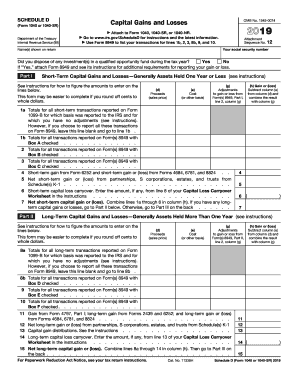
. . 10 Totals for all transactions reported on Form(s) 8949 with Box F checked . . . . . . . . . . . . . . 11 Gain from Form 4797, Part I; long-term gain from Forms 2439 and 6252; and long-term gain or (loss) from Forms 4684, 6781, and 8824 . . . . . . . . . . . . . . . . . . . . . . . 11 12 Net long-term gain or (loss) from partnerships, S corporations, estates, and trusts from Schedule(s) K-1 12 13 Capital gain distributions. See the instructions . . . . . . . . . . . . . . . . . . . 14.

This website is not affiliated with IRS

How it works

  1. Open form

    Open form follow the instructions

  2. Easily sign form

    Easily sign the form with your finger

  3. Share form

    Send filled & signed form or save

How to fill out the IRS 1040 - Schedule D online

This guide provides clear and straightforward instructions on how to complete the IRS 1040 - Schedule D online. Schedule D is used to report capital gains and losses, making it an essential part of your tax return.

Follow the steps to successfully complete your Schedule D.

  1. Click the ‘Get Form’ button to access the IRS 1040 - Schedule D document and open it in your preferred editor.
  2. Begin by entering your social security number at the top of the form, along with the names shown on your tax return. Indicate whether you disposed of any investments in a qualified opportunity fund during the tax year by selecting ‘Yes’ or ‘No.’ If 'Yes,' ensure to attach Form 8949.
  3. In Part I, report your short-term capital gains and losses. Enter totals as applicable based on transactions reported on Form 1099-B. The form will guide you on whether to leave certain lines blank if reporting elsewhere.
  4. For each section in Part I, accurately enter the proceeds (sales price), cost, adjustments to gain or loss, and calculate the gain or loss by subtracting the cost from the proceeds.
  5. Proceed to Part II to report long-term capital gains and losses in a similar manner as in Part I. Follow the same process for entering totals and calculating gains or losses.
  6. In Part III, summarize your short-term and long-term net amounts. If the total results in a gain, record this on the appropriate line of Form 1040 or 1040-SR. If it's a loss, take the necessary steps detailed on the form.
  7. Finally, once all sections of Schedule D are completed, review your entries for accuracy. Save your changes, and you can then download, print, or share your completed form as needed.

Complete your IRS 1040 - Schedule D online confidently and ensure you have all necessary documents ready for filing.

Get form

Experience a faster way to fill out and sign forms on the web. Access the most extensive library of templates available.

Related content

About Schedule D (Form 1040), Capital Gains and...
Mar 25, 2025 — Use Schedule D (Form 1040) to report the following: The sale or exchange...
Learn more
2001 Form 1040 (Schedule D)
䊳 Use Schedule D-1 to list additional transactions for lines 1 and 8. Your social...
Learn more
f1045--2017.pdf
19. Enter the loss, if any, from line 21 of your 2017 Schedule D (Form 1040). (Estates and...
Learn more

Related links form

WI Form 1952 2017 SBA 5C 2018 SSA-1-BK 2018 CA LIC 9182 2015

Questions & Answers

Get answers to your most pressing questions about US Legal Forms API.

Contact support

The new 1040 form for seniors is the 1040SR, which was introduced to cater specifically to taxpayers aged 65 and older. This form offers a simplified layout and larger text, making it easier for seniors to navigate their tax information. Utilizing 1040SR can help seniors take advantage of deductions and credits they may qualify for without feeling overwhelmed.

The IRS 1040 form is used for filing annual tax returns, while the 1040 ES is used for estimating and paying quarterly taxes. Self-employed individuals or those with other sources of income may need to use 1040 ES to avoid underpayment penalties. Understanding when to use each form is important for effective tax planning and compliance.

The IRS 1040 and 1040SR are similar forms, but the 1040SR is specifically designed for seniors aged 65 and older. The 1040SR features larger print for easier reading and provides a streamlined layout to help seniors report income and claim deductions. Choosing the right form can enhance your filing experience and ensure that you claim all eligible benefits.

For the tax year, seniors aged 65 and older can benefit from an increased standard deduction. This amount is higher than the regular standard deduction, allowing for greater tax relief. It is essential to stay informed about these updates, as they can significantly affect your overall tax liability.

In TurboTax, you can find Schedule D by navigating to the 'Wages & Income' section, then selecting 'Investment Income.' This section guides you through reporting your investments and will lead you to Schedule D automatically if needed. Utilizing TurboTax simplifies the process and ensures you capture all relevant capital gains and losses accurately.

You can obtain the IRS Schedule D tax form from the official IRS website or through tax preparation software. Many online platforms, like uslegalforms, provide easy access to downloadable tax forms, including Schedule D. It’s important to ensure that you are using the most current version of the form for accurate tax reporting.

IRS Schedule D is a tax form used to report capital gains and losses from the sale of assets, while Form 8949 is used to detail each transaction that results in a capital gain or loss. After listing your individual transactions on Form 8949, you transfer the totals to Schedule D for your overall capital gains or losses. Together, these forms help taxpayers accurately report and manage investment-related income.

The IRS 1040 is the standard form used for individual income tax returns, while the 1040X is used to amend a previous tax return. If you discover an error or need to change information on your original return, the 1040X allows you to correct that. Understanding this difference is crucial for accurate tax filing and compliance.

Anyone who has sold capital assets, like stocks, must file IRS 1040 - Schedule D. This includes individuals who have generated short-term or long-term capital gains and losses. If you meet these criteria, ensure you report your transactions accurately to comply with tax laws.

Exceptions to filing Form 8949 include situations where you have short-term capital gains that simply aggregate with other income, or if you sold assets for a total of less than $200. Certain transactions, such as those subject to special treatment, may also bypass this requirement. Nevertheless, you still need to report your total on IRS 1040 - Schedule D.

Get This Form Now!

Use professional pre-built templates to fill in and sign documents online faster. Get access to thousands of forms.
If you believe that this page should be taken down, please follow our DMCA take down processhere.
Get IRS 1040 - Schedule D
  • Adoption
  • Bankruptcy
  • Contractors
  • Divorce
  • Home Sales
  • Employment
  • Identity Theft
  • Incorporation
  • Landlord Tenant
  • Living Trust
  • Name Change
  • Personal Planning
  • Small Business
  • Wills & Estates
  • Packages A-Z
  • Affidavits
  • Bankruptcy
  • Bill of Sale
  • Corporate - LLC
  • Divorce
  • Employment
  • Identity Theft
  • Internet Technology
  • Landlord Tenant
  • Living Wills
  • Name Change
  • Power of Attorney
  • Real Estate
  • Small Estates
  • Wills
  • All Forms
  • Forms A-Z
  • Other Templates
  • Legal Hub
  • About Us
  • Help Portal
  • Legal Resources
  • Blog
  • Affiliates
  • Contact Us
  • Delete My Account
  • Site Map
  • Industries
  • Forms in Spanish
  • Localized Forms
  • State-specific Forms
  • Forms Kit
  • Real Estate Handbook
  • All Guides
  • Notarize
  • Incorporation services
  • For Consumers
  • For Small Business
  • For Attorneys
  • USLegal
  • FormsPass
  • pdfFiller
  • signNow
  • altaFlow
  • DocHub
  • Instapage
Form Packages
  • Adoption
  • Bankruptcy
  • Contractors
  • Divorce
  • Home Sales
  • Employment
  • Identity Theft
  • Incorporation
  • Landlord Tenant
  • Living Trust
  • Name Change
  • Personal Planning
  • Small Business
  • Wills & Estates
  • Packages A-Z
Form Categories
  • Affidavits
  • Bankruptcy
  • Bill of Sale
  • Corporate - LLC
  • Divorce
  • Employment
  • Identity Theft
  • Internet Technology
  • Landlord Tenant
  • Living Wills
  • Name Change
  • Power of Attorney
  • Real Estate
  • Small Estates
  • Wills
  • All Forms
  • Forms A-Z
  • Other Templates
Customer Service
  • Legal Hub
  • About Us
  • Help Portal
  • Legal Resources
  • Blog
  • Affiliates
  • Contact Us
  • Delete My Account
  • Site Map
  • Industries
  • Forms in Spanish
  • Localized Forms
  • State-specific Forms
  • Forms Kit
Legal Guides
  • Real Estate Handbook
  • All Guides
Prepared for you
  • Notarize
  • Incorporation services
Our Customers
  • For Consumers
  • For Small Business
  • For Attorneys
Our Sites
  • USLegal
  • FormsPass
  • pdfFiller
  • signNow
  • altaFlow
  • DocHub
  • Instapage
Social Media
Call us now toll free:
+1 833 426 79 33
As seen in:
© Copyright 1999-2026 airSlate Legal Forms, Inc. 17 Station Street, Ste. 203, Brookline, MA 02445
  • Your Privacy Choices
  • Terms of Service
  • Privacy Notice
  • Content Takedown Policy
  • Bug Bounty Program
IRS 1040 - Schedule D
This form is available in several versions.
Select the version you need from the drop-down list below.
2021 IRS 1040 - Schedule D
Select form
  • 2021 IRS 1040 - Schedule D
  • 2020 IRS 1040 - Schedule D
  • 2019 IRS 1040 - Schedule D
  • 2018 IRS 1040 - Schedule D
  • 2017 IRS 1040 - Schedule D
  • 2016 IRS 1040 - Schedule D
  • 2015 IRS 1040 - Schedule D
  • 2014 IRS 1040 - Schedule D
  • 2013 IRS 1040 - Schedule D
  • 2012 IRS 1040 - Schedule D
  • 2011 IRS 1040 - Schedule D
  • 2010 IRS 1040 - Schedule D
  • 1997 IRS 1040 - Schedule D
Select form