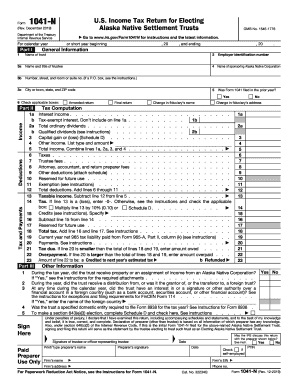
1041NU.S. Income Tax Return for Electing Alaska Native Settlement TrustsForm (Rev. December 2018)Department of the Treasury Internal Revenue ServiceFor calendar yearPart IOMB No. 15451776Go to www.irs.gov/Form1041N.

How it works
  • Open form

    Open form follow the instructions

  • Easily sign form

    Easily sign the form with your finger

  • Share form

    Send filled & signed form or save

How to fill out the IRS 1041-N online

Filling out the IRS 1041-N form is essential for electing Alaska Native settlement trusts. This guide provides a clear and detailed overview to help users complete the form online, ensuring compliance with tax regulations.

Follow the steps to complete the IRS 1041-N effectively.

  1. Press the ‘Get Form’ button to access the IRS 1041-N form and open it in your preferred online editor.
  2. In Part I, provide the name of the trust, contact details of the trustee, and the name of the sponsoring Alaska Native corporation. Ensure that all information is accurate.
  3. Fill in the employer identification number for the trust, and indicate whether Form 1041 was filed in the prior year by checking 'Yes' or 'No.'
  4. Complete Part II, which includes sections on income, deductions, and taxes. Enter all relevant financial information, like interest income, dividends, capital gains, and any deductions.
  5. Move to Part III to answer questions regarding any foreign properties or accounts. This section includes important checks to ensure all necessary requirements are met.
  6. In the signature section, ensure that the trustee or an authorized officer signs the document. Include any necessary preparer's information, if applicable.
  7. Review all sections to verify that all information is complete and accurate before finishing. Once confirmed, you can save your changes, download, print, or share the form.

Start completing your IRS 1041-N form online today for a smooth filing experience.

Get form

Experience a faster way to fill out and sign forms on the web. Access the most extensive library of templates available.

Related content

About Form 1041-N, U.S. Income Tax Return for...

Jan 28, 2025 — This one-time election is made by filing Form 1041-N and the form is used...

Learn more
26 CFR § 1.6081-6 - Automatic extension of time...

This section applies to applications for an automatic extension of time to file an estate...

Learn more
Instructions for Form 7004 (Rev. December 2017)

Feb 1, 2018 — An estate (other than a bankruptcy estate) and a trust filing Form 1041...

Learn more
Questions & Answers

Get answers to your most pressing questions about US Legal Forms API.

Contact support

Can an IRS form 1041 be filed electronically?

Yes, you can file Form 1041-N electronically, which streamlines the submission process. Electronic filing often results in faster processing times and reduced paperwork. Utilizing online platforms like uslegalforms can help make this process more efficient.

An estate does not have to file Form 1041 if there is no income during the tax year. In such cases, filing Form 1041-N is a suitable option for communicating with the IRS. It is important to align your filings according to the income status of the estate.

You typically do not need to file an estate tax return if there is no income generated by the estate. However, it is wise to file Form 1041-N to officially indicate the estate's zero income. Taking this step ensures clarity in your tax filings.

If your trust has no income, you should file Form 1041-N instead of the standard Form 1041. This specialized form serves to inform the IRS about your trust's status without the complexities of income reporting. Choosing the right form simplifies your filing process.

The exemption for Form 1041 varies depending on the type of entity filing the form. Generally, if the trust or estate has no income, as indicated by using Form 1041-N, you may not face any tax liabilities. Understanding exemptions helps you navigate your tax obligations effectively.

You do not need to file a Form 1041 for an estate without any income. Instead, you can opt to file Form 1041-N to formally close the estate's tax responsibilities. Filing the appropriate form keeps your records clear and compliant with IRS guidelines.

The IRS Form 1041-N is specifically designed for trusts and estates that have no income during the tax year. This form simplifies the process of filing when there are no financial activities to report. By using Form 1041-N, you can effectively communicate your trust’s financial status to the IRS.

To close a trust with the IRS, you need to file Form 1041-N, the return for trusts that have no income. This form allows you to report the income, deductions, and credits related to the trust. Additionally, ensure all necessary final distributions and tax payments are addressed before submitting the form.

A final 1041 is required when an estate or trust has income to report, even if it is the last return. However, if there is no income, the necessity to file may change. It is always wise to ensure compliance with IRS regulations, so confirming your situation with a tax expert or using resources like uslegalforms can help you understand your obligations.

The exemption amount for estates reported on Form 1041 can vary, often linked to the current estate tax exemption limit set by the IRS. It’s crucial to stay updated with these limits as they can change. Understanding these exemptions can help minimize tax liability. For personalized insights, consulting uslegalforms or a tax specialist can be particularly beneficial.

Get This Form Now!

Use professional pre-built templates to fill in and sign documents online faster. Get access to thousands of forms.

If you believe that this page should be taken down, please follow our DMCA take down process here.

Get IRS 1041-N