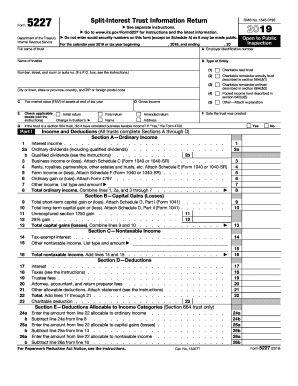
Form5227SplitInterest Trust Information ReturnOMB No. 15450196 See separate instructions. Go to www.irs.gov/Form5227 for instructions and the latest information. Do not enter social security numbers.
Open form follow the instructions
Easily sign the form with your finger
Send filled & signed form or save
How to fill out the IRS 5227 online
The IRS 5227 form is used to report information regarding split-interest trusts, including income and deductions. Completing this form accurately is essential for compliance with tax regulations. This guide will provide clear, step-by-step instructions for filling out the IRS 5227 online.
Follow the steps to accurately complete the IRS 5227 form.
- Click ‘Get Form’ button to obtain the form and open it in your editor.
- In the top section, fill in the full name of the trust and the employer identification number. Be sure to also include the name of the trustee, the type of entity, and the trust's address.
- Indicate the fair market value of the trust assets at the end of the tax year and check any applicable boxes, including whether this is an initial, final, or amended return.
- Complete Part I, which includes Sections A through D for income and deductions. Report interest income, dividends, business income, and any other income applicable.
- In Sections B and C, report total capital gains, nontaxable income, and other deductions that might apply to your trust.
- If applicable, fill out Part II with information regarding distributable income and any prior year's undistributed income.
- Proceed to Part III and provide details about distributions made during the tax year, including both principal and income distributions.
- Complete the balance sheet in Part IV. Report the categories of assets and liabilities, ensuring that the total liabilities match the total assets.
- In Parts V and VI, provide any necessary information pertinent to charitable remainder trusts or other specific classifications.
- After filling out all sections, review all information for accuracy. You can then save your changes, download, print, or share the completed form as needed.
Complete your IRS 5227 form online today to ensure compliance and accurate reporting.
Experience a faster way to fill out and sign forms on the web. Access the most extensive library of templates available.
Related content
Jan 23, 2025 — Use Form 5227 to: Report the financial activities of a split-interest...
If Part II-A, Total, column (i) does not agree with line 61b of Form 5227 for a CRAT or...
IRS can assist with preparing your amended tax returns. For additional information and...
Get answers to your most pressing questions about US Legal Forms API.
What is the IRS form for a charitable trust?
The primary IRS form for a charitable trust is Form 5227. This form is essential for reporting the financial activities of non-exempt charitable trusts to the IRS. Understanding how to properly complete Form 5227 is critical for maintaining your trust’s tax-exempt status. If you need assistance with this process, consider using platforms like USLegalForms to streamline your filing.
Can you file form 5227 electronically?
Absolutely, Form 5227 can be filed electronically through specific tax software that supports IRS submissions. Electronic filing is beneficial as it offers immediate confirmation of receipt, ensuring you stay on track with deadlines. Utilizing a reliable e-filing platform, like USLegalForms, can provide you with step-by-step guidance on completing and submitting your form. This modern approach makes it easier for charitable trusts to remain compliant.
Can you electronically file form 5227?
Yes, you can electronically file Form 5227, which streamlines the submission process. By utilizing IRS-approved e-filing services, you can submit your form quickly and securely. This method reduces paperwork and minimizes the chances of errors that can occur with traditional paper filing. E-filing is an efficient way to ensure your Form 5227 is processed on time.
What is IRS Form 5227 used for?
IRS Form 5227 is used to report financial information from non-exempt charitable trusts. This form assists the IRS in reviewing the activities of the trust, ensuring it operates within the legal framework required for tax-exempt status. It details the income, expenses, and distributions made by the trust. Using Form 5227 is crucial for maintaining proper oversight and compliance.
How do I generate Form 5227 for a charitable trust?
Generating Form 5227 for a charitable trust can be done easily by utilizing tax preparation software or services like USLegalForms. You will need to gather the necessary financial information about the trust, including income, assets, and distributions. Once you have this data, you can complete the form accurately to meet IRS requirements. This process simplifies compliance and helps avoid penalties.
Who must file form 5471 IRS?
Form 5471 is required for U.S. citizens or residents who are involved with certain foreign corporations. This includes individuals who own a significant share of a foreign corporation, have control over such an entity, or are officers in certain foreign corporations. Failure to file Form 5471 can lead to hefty penalties, so it's essential to understand the obligations tied to this form. If you are managing international assets, consult with a tax professional to ensure compliance.
Does a charitable trust have to file a tax return?
Yes, a charitable trust typically must file a tax return, specifically IRS Form 5227. This form outlines the trust's financial activities for the year and ensures transparency with the IRS. Filing Form 5227 is essential because it provides a comprehensive overview of income, distributions, and assets, helping maintain the trust's tax-exempt status. Therefore, it's important to stay on top of these filing requirements.
Who needs to file form 5227?
Individuals and entities that create charitable trusts governed by the IRS need to file Form 5227. This form is specifically designed for non-exempt charitable trusts to report their activities. If you manage a charitable trust, you are required to submit this form annually to ensure compliance with IRS regulations. Understanding the need for Form 5227 is crucial for maintaining your trust's tax status.
How do I find my AGI from last year?
To find your AGI from last year, locate your previous year’s tax return. It is usually listed on the first page of your Form 1040. If you cannot find it, you may also obtain a transcript online from the IRS, which will contain your AGI for the last filed year.
Can I call the IRS and get my AGI?
Yes, you can call the IRS to request your AGI, but doing so might be less convenient than online options. When you call, be ready to provide identification details and perhaps even answer security questions. Keep in mind that wait times may vary, so consider using the online methods first for quicker access.
Use professional pre-built templates to fill in and sign documents online faster. Get access to thousands of forms.
If you believe that this page should be taken down, please follow our DMCA take down process here.
This form is available in several versions. Select the version you need from the drop-down list below.