Loading
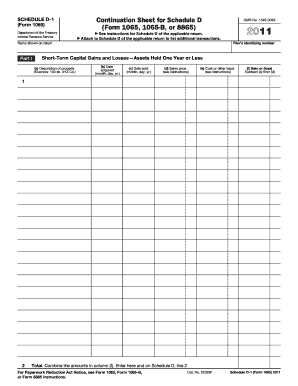
Get Irs 1065 - Schedule D-1 2010
How it works
-

Open form follow the instructions
-

Easily sign the form with your finger
-

Send filled & signed form or save
How to fill out the IRS 1065 - Schedule D-1 online
Filling out the IRS 1065 - Schedule D-1 is an essential process for reporting capital gains and losses from partnerships. This guide provides clear, step-by-step instructions to assist users in completing the form accurately and efficiently.
Follow the steps to fill out the IRS 1065 - Schedule D-1 online.
- Press the ‘Get Form’ button to obtain the form and open it in your editing tool.
- Provide your filer’s identifying number and the name as shown on your return in the designated fields.
- In Part I, titled ‘Short-Term Capital Gains and Losses—Assets Held One Year or Less’, list each asset by filling in the description under column (a), the acquisition date under column (b), and the date sold under column (c).
- Enter the sales price in column (d) and the cost or other basis in column (e). For both columns, refer to the instructions for clarity on what to enter.
- Calculate the gain or loss by subtracting the amount in column (e) from the amount in column (d), and record this in column (f).
- At the bottom of Part I, combine the amounts listed in column (f) and enter the total on the provided line designated for Schedule D, line 2.
- In Part II, titled ‘Long-Term Capital Gains and Losses—Assets Held More Than One Year’, repeat the process as outlined in steps 3 through 6 for your long-term assets.
- After listing the assets and calculating totals, ensure the total for column (f) in Part II is entered on the respective line for Schedule D—either line 7 for Form 1065-B or line 8 for Form 1065 or 8865.
- Review the completed form for accuracy. Once satisfied, you can save your changes, download the completed form, print it, or share it as needed.
Complete your IRS document filings online to ensure accuracy and efficiency.
Get form
Experience a faster way to fill out and sign forms on the web. Access the most extensive library of templates available.
Related links form
Yes, you must report the sale of inherited property to the IRS. This involves completing IRS Schedule D as part of your tax filings. By reporting accurately, you ensure compliance, especially when you deal with IRS 1065 - Schedule D-1 to capture any gains or losses from the sale.
Get This Form Now!
Use professional pre-built templates to fill in and sign documents online faster. Get access to thousands of forms.