Er of proceeding City or town, state, and ZIP code Date Time a.m. Place of other proceedings p.m. Part IV I certify that I have the authority to execute this notice concerning fiduciary relationship on behalf of the taxpayer. Please Sign Here Signature Fiduciary s signature Title, if applicable Date Form 56 (Rev. 11-2017).

Open form follow the instructions

Easily sign the form with your finger

Send filled & signed form or save
How to fill out the IRS 56 online
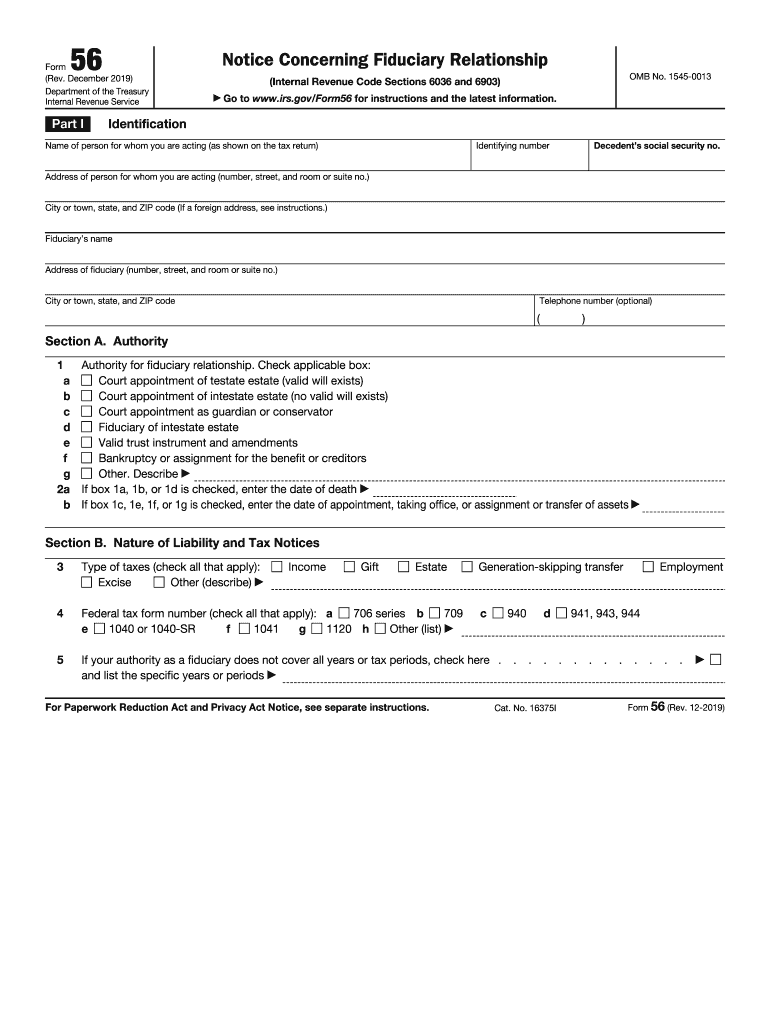
Filling out the IRS 56, also known as the notice concerning fiduciary relationship, is an important process for anyone acting on behalf of another individual regarding tax responsibilities. This guide provides clear, step-by-step instructions to ensure that you can complete the form accurately and efficiently online.
Follow the steps to fill out the IRS 56 with ease.
- Click ‘Get Form’ button to obtain the form and open it in the editor.
- In Part I, identify the person for whom you are acting. Fill in their name, social security number, and identifying number accurately. Provide their complete address as well.
- Below the identification section, enter the fiduciary's name and address as required. Optional: include a telephone number.
- In Section A, specify the authority for the fiduciary relationship by checking the applicable box(es) that match your situation, and provide the relevant dates as instructed.
- In Section B, indicate the type of taxes that apply by checking all relevant boxes. Further, check the corresponding federal tax form numbers for reporting.
- If your fiduciary authority is limited to specific years or tax periods, indicate this by checking the designated box and listing those periods.
- In Part II, specify any revocation or termination of prior fiduciary notices by checking the appropriate box and providing reasons if applicable.
- If any substitutions for fiduciaries are being made, check the relevant box and provide the names and addresses of the new fiduciaries.
- In Part III, provide details regarding any court or administrative proceedings related to the fiduciary relationship, including dates and addresses.
- Finally, review the entire document, sign where indicated, and include the date. Ensure accuracy to fulfill perjury declarations.
- Once completed, you can save changes, download, print, or share the form as needed.
Prepare your documents and complete the IRS 56 online for efficient tax management.
Experience a faster way to fill out and sign forms on the web. Access the most extensive library of templates available.
Related content
Jan 21, 2025 — You may use Form 56 to: Provide notification to the IRS of the creation...
26 U.S. Code § 56 - Adjustments in computing alternative minimum taxable income · (i)...
Don't file Form 2210. You aren't required to figure your penalty because the IRS will...
Get answers to your most pressing questions about US Legal Forms API.
What is the purpose of IRS form 56?
The purpose of IRS Form 56 is to inform the IRS of a fiduciary's appointment and authority. This ensures that the IRS knows who is responsible for tax obligations on behalf of another party. It plays a vital role in maintaining clear and accurate tax records. Filing this form helps protect your interests and ensure compliance.
What happens if I don't file form 56?
Failing to file IRS Form 56 may lead to confusion regarding your status as a fiduciary. This could result in the IRS not recognizing your authority to manage tax matters, leading to potential penalties. Properly filing the form is crucial for avoiding complications. Always consider reaching out to resources like US Legal Forms to help navigate these requirements.
Does a personal representative have to file form 56?
Yes, a personal representative typically needs to file IRS Form 56. This form notifies the IRS that the representative has authority to act on behalf of the estate. Filing it simplifies tax matters during the administration process. It's important to confirm your obligations to maintain compliance during these situations.
Where can I get IRS form 56?
You can obtain IRS Form 56 directly from the IRS website or through various tax preparation software. Additionally, platforms like US Legal Forms offer easy access to this form and related guidance. This convenience makes it simple to obtain and complete the form accurately. Ensure you always have the correct version for your needs.
Is there a penalty for not filing form 56 after?
Yes, there can be penalties for not filing IRS Form 56 when required. The IRS may impose fines for failure to comply with notifying them of fiduciary roles. This can complicate tax responsibilities and lead to further issues down the line. Filing on time helps you avoid any unnecessary complications.
Is IRS form 56 mandatory?
IRS Form 56 is mandatory in certain situations. If you act as a fiduciary, such as a trustee or an executor, you must file this form to notify the IRS of your role. This keeps your tax filings clear and in order. Be mindful to assess your situation to determine if it is necessary.
What happens if you don't report a tax form?
If you fail to report a tax form like IRS Form 56, you risk incurring penalties from the IRS. The agency may treat the lack of reporting as an attempt to evade tax responsibilities. Clear communication regarding fiduciary status protects you and ensures compliance. It is best to stay on top of your filings to avoid complications.
Is form 56 required for final 1040?
Yes, IRS Form 56 is often required for final 1040 returns, especially if there is a change in a fiduciary relationship. This form informs the IRS that a person or entity is acting as a fiduciary on behalf of another. Filing it ensures that all tax responsibilities are properly managed. You can easily find assistance for this on the US Legal Forms platform.
How do I get my IRS form 5329?
To obtain IRS form 5329, you can download it directly from the IRS website. This form is essential for reporting additional taxes on certain distributions from retirement accounts. If you are managing a deceased taxpayer's affairs, make sure to have all relevant forms, including IRS form 56, to facilitate accurate filings.
What is the difference between form 56 and 2848?
IRS form 56 serves as official notice of a personal representative's authority for tax matters, while form 2848, Power of Attorney and Declaration of Representative, allows a designated individual to represent a taxpayer before the IRS. Both forms are essential for their specific purposes, and understanding their differences can facilitate proper representation. When working with estates, you might need to file both forms depending on the situation.
Use professional pre-built templates to fill in and sign documents online faster. Get access to thousands of forms.
If you believe that this page should be taken down, please follow our DMCA take down process here.