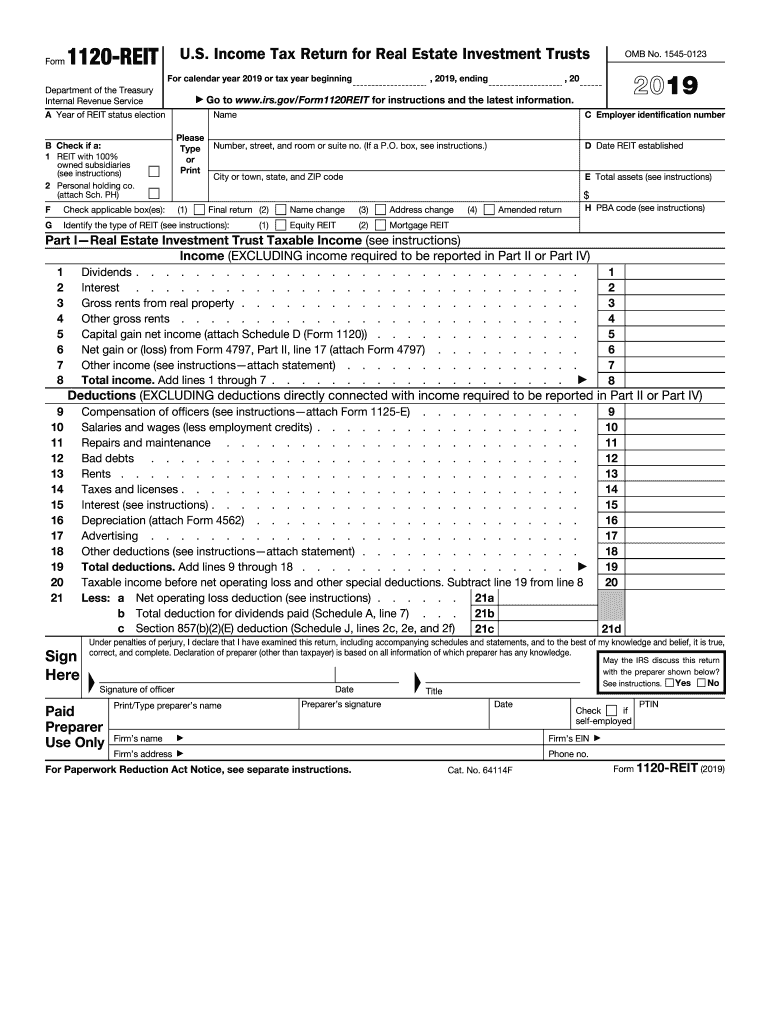
Ction B Check if a: 1 REIT with 100% owned subsidiaries (see instructions) 2 Personal holding co. (attach Sch. PH) Please Type or Print , 2018, ending OMB No. 1545-0123 2018 , 20 Go to www.irs.gov/Form1120REIT for instructions and the latest information. Name C Employer identification number Number, street, and room or suite no. (If a P.O. box, see instructions.) D Date REIT established City or town, state, and ZIP code E Total assets (see instructions) $ F Check applicable bo.
Loading

Open form follow the instructions

Easily sign the form with your finger

Send filled & signed form or save
How to fill out the IRS 1120-REIT online
Filling out the IRS 1120-REIT form is an essential task for real estate investment trusts to report their income, deductions, and tax liabilities. This guide provides comprehensive, step-by-step instructions to help you navigate and complete the form online with confidence.
Follow the steps to fill out the IRS 1120-REIT form correctly.
- Click ‘Get Form’ button to access the IRS 1120-REIT form in an editable format.
- Begin by entering your organization’s name, employer identification number, and address in the designated areas. Ensure that all information is accurate and up to date.
- Indicate the date your REIT was established and report the total assets in the respective fields, adhering to instructions for accurate calculation.
- Check the appropriate boxes to indicate your REIT type and selection. This includes options for final returns or personal holding companies, among others.
- Proceed to Part I and carefully report your taxable income. Include various income sources such as dividends, interest, and gross rents while ensuring that you follow the specified formats and calculations properly.
- Document your deductions in the next section. Be sure to categorize expenses accurately based on the guidelines, and attach any necessary supporting schedules.
- Continue to Part II, where you will report any tax obligations related to net income from foreclosure property, ensuring to detail each calculation as instructed.
- Complete Part III reporting tax related to income source requirements, and Part IV should be filled out for any prohibited transaction income.
- In Schedule A, record the total dividends paid and ensure the correct deduction calculation is made. Verify that totals reconcile with previous entries.
- Lastly, review all provided information for any errors. After confirming accuracy, you can choose to save, download, or print your completed form for submission.
Complete your IRS 1120-REIT form online today to ensure timely and accurate filing.
Experience a faster way to fill out and sign forms on the web. Access the most extensive library of templates available.
Related content
Mar 28, 2025 — Information about Form 1120-REIT, U.S. Income Tax Return for Real Estate...
Form 1120-REIT, U.S. income tax return for real estate investment trusts.-journal.
Form 1125-E must be completed and attached to Form. 1120, 1120-C, 1120-F, 1120-RIC...
Get answers to your most pressing questions about US Legal Forms API.
What is the tax classification of a REIT?
REITs are classified as either publicly traded or non-traded, affecting their tax obligations and reporting. Most are structured as corporations but can elect to be treated differently if they meet specific Internal Revenue Service guidelines. Proper filing with IRS Form 1120-REIT supports this classification and helps ensure they qualify for tax benefits.
Are REITs taxed as pass-through entities?
REITs are not classified as pass-through entities in the same way that partnerships are. However, they do pass much of their income through to investors, who report it on their tax returns, avoiding double taxation at the corporate level. This unique structure is why it's important to utilize the IRS 1120-REIT to comply with tax requirements.
Do you file IRS Form 1120-REIT?
Yes, if you operate a REIT, you need to file IRS Form 1120-REIT annually. This form is essential for reporting income, expenses, and distributions to shareholders. Completing this form correctly helps maintain favorable tax treatment under REIT regulations.
Are REITs taxed as corporations?
Yes, Real Estate Investment Trusts (REITs) are generally taxed as corporations under the IRS tax rules. However, if they meet certain criteria, they can elect to be taxed differently, allowing them to avoid double taxation. Using the IRS 1120-REIT form is key for compliance and ensures that the REIT can maintain its special tax status.
Where are qualified REIT dividends reported?
Qualified REIT dividends are reported on your individual tax return, specifically using Schedule B on Form 1040. This ensures the IRS receives accurate information about your dividend income. Additionally, your REIT should provide you with Form 1099-DIV, which summarizes your dividend activity for the tax year.
How are REIT dividends reported to the IRS?
REIT dividends are reported to the IRS using Form 1099-DIV, which is provided by the REIT to shareholders. This form outlines the dividends you've received throughout the year, including the portion classified as qualified dividends. Review the information on the 1099-DIV carefully when preparing your IRS 1120-REIT filing.
How do I report REIT dividends on my taxes?
To report your REIT dividends on your taxes, include them on your IRS Form 1040. Use Schedule B for reporting interest and dividends; each qualified REIT dividend should be listed there. Keeping clear records of your dividends will simplify this process and enhance your tax reporting accuracy.
How are qualified REIT dividends taxed?
Qualified REIT dividends are generally taxed at a lower rate compared to ordinary income. According to IRS guidelines, these dividends typically qualify for the 20% deduction, significantly reducing your taxable income. It's crucial to understand how this taxation affects your overall tax liability when filing your IRS 1120-REIT.
Does a REIT have to be registered as a corporation?
Yes, a Real Estate Investment Trust, or REIT, must be structured as a corporation or a business trust. This structure allows REITs to meet the legal requirements set forth by the IRS. It ensures that the REIT can provide shareholders with a steady income stream through dividends derived from real estate investments.
Where do I report qualified REIT dividends?
You report qualified REIT dividends on your individual tax return, typically using IRS Form 1040. Specifically, you will enter these dividends on Schedule B to show your interest and dividend income. It's essential to accurately report this income to ensure compliance with IRS regulations and to effectively manage your tax obligations.
Use professional pre-built templates to fill in and sign documents online faster. Get access to thousands of forms.
If you believe that this page should be taken down, please follow our DMCA take down process here.
This form is available in several versions. Select the version you need from the drop-down list below.