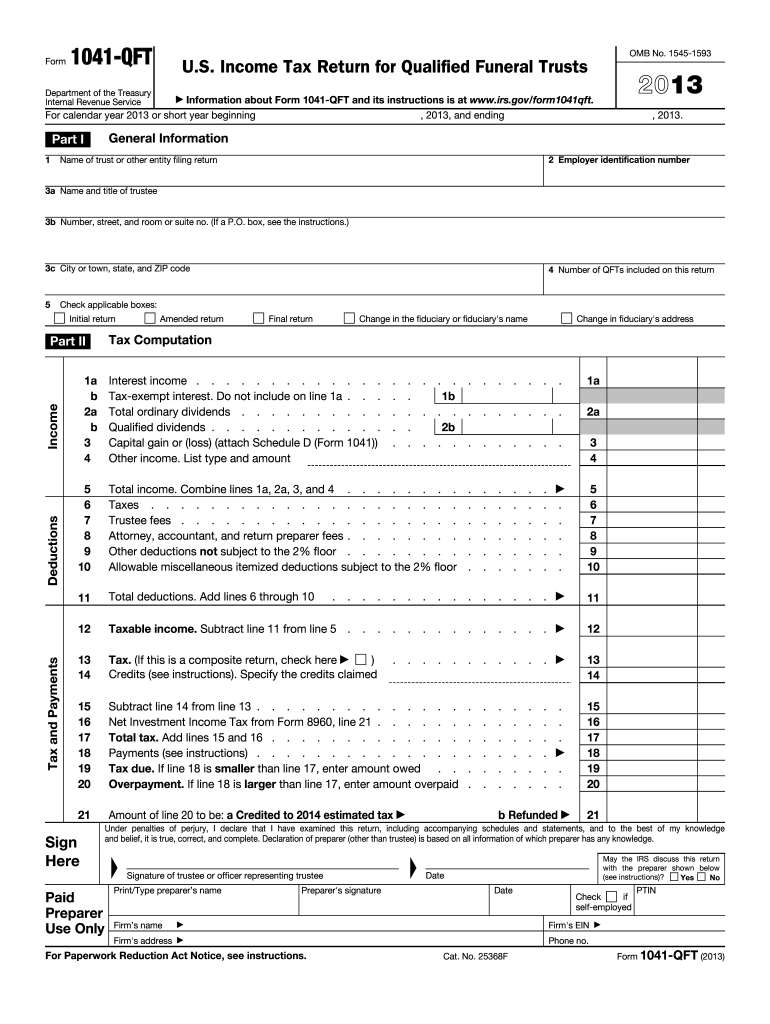
Ons is at www.irs.gov/form1041qft. For calendar year 2013 or short year beginning , 2013, and ending , 2013. General Information Part I 1 2 Employer identification number Name of trust or other entity filing return 3a Name and title of trustee 3b Number, street, and room or suite no. (If a P.O. box, see the instructions.) 3c City or town, state, and ZIP code 5 4 Number of QFTs included on this return Check applicable boxes: Initial return Part II Final return Change in the fidu.
Loading

Open form follow the instructions

Easily sign the form with your finger

Send filled & signed form or save
How to fill out the IRS 1041-QFT online
Filing the IRS 1041-QFT form is essential for trustees managing a qualified funeral trust. This guide provides a comprehensive, user-friendly approach to assist you in completing the form accurately online, ensuring compliance with IRS regulations.
Follow the steps to complete the IRS 1041-QFT form online effectively.
- Click the ‘Get Form’ button to obtain the IRS 1041-QFT form and open it in your editor.
- In Part I, fill out the general information by entering the name of the trust, the employer identification number, and the address of the trust.
- Provide details regarding the trustee including their name, title, address, and the applicable boxes for whether this is the initial or final return.
- In Part II, report the tax computation by entering all applicable income and deductions, ensuring to list them correctly in the designated lines.
- Calculate the taxable income by subtracting total deductions from total income and complete the necessary calculations to determine your total tax.
- Finalize your form by reviewing all entries for accuracy, ensuring all required signatures are included, and either save changes, download, print, or share your completed form.
Begin filling out your IRS 1041-QFT form online today.
Experience a faster way to fill out and sign forms on the web. Access the most extensive library of templates available.
Related content
Feb 20, 2025 — The trustee of a trust that has elected to be taxed as a qualified...
A trustee may file a single, composite. Form 1041-QFT for some or all QFTs of which he or...
Feb 1, 2018 — Form 7004 is used to request an automatic extension of time to file...
Get answers to your most pressing questions about US Legal Forms API.
How do I get an IRS transcript for a trust?
To obtain an IRS transcript for a trust, you can request it using Form 4506-T or through the IRS online tool. Ensure you specify the type of transcript you need for the trust, such as the IRS 1041-QFT information. This step is important for managing records and staying compliant with IRS regulations.
Who has to file a 1041 tax return?
Trusts and estates that have generated income generally must file a 1041 tax return. This includes income exceeding the applicable thresholds, which may vary based on circumstances. If you are concerned about meeting IRS requirements, using resources like uslegalforms can guide you through the filing process.
Can I file the IRS form 1041 electronically?
Yes, you can file the IRS form 1041 electronically, which often simplifies the process. Many tax preparation software programs support this form, allowing you to submit the IRS 1041-QFT efficiently. E-filing can also expedite the processing time for your return.
How do I get a copy of my estate tax return from the IRS?
To obtain a copy of your estate tax return, you can request it directly from the IRS. Use Form 4506 to order a transcript or copy of the return. This process is essential if you need to review details or verify information related to the IRS 1041-QFT.
How do I know if I need to file a 1041?
If you manage an estate or trust that earns income, you may need to file a 1041. Look for events such as interest or dividends that exceed the $600 filing threshold, as these indicate the necessity of submitting the IRS 1041-QFT. It's wise to consult a tax professional if unsure about your specific situation.
What is a 1041 QFT?
A 1041 QFT refers to a specific type of tax return for qualified disability trusts. This form allows for the income generated by the trust to be reported to the IRS while providing benefits to disabled individuals. Filing the IRS 1041-QFT is crucial for maintaining eligibility for certain benefits and meeting tax obligations.
What is a 1041 tax form used for?
The IRS 1041 tax form is primarily used to report income, deductions, gains, and losses of estates and trusts. When an estate generates income or a trust distributes income, the IRS 1041-QFT allows for accurate reporting of these financial activities. Understanding its purpose helps ensure compliance with federal tax regulations.
Do I have to file a 1041 as a beneficiary?
As a beneficiary, you may need to file a 1041 tax return if you receive income from the estate or trust. This obligation arises because the IRS 1041-QFT is designed for reporting income earned by a qualified disability trust. It is essential to evaluate the trust's income and your role to determine if you should file.
Where do I report beneficiary distributions on 1041?
You report beneficiary distributions on IRS Form 1041, specifically on Schedule K-1. Each beneficiary will receive a K-1, detailing the amount distributed and their share of the estate’s income. This ensures that beneficiaries can accurately report their distributions on their personal tax returns.
How to elect fiscal year for estate 1041?
To elect a fiscal year for your estate when filing IRS Form 1041, you must indicate your choice on the form and make sure to use the proper form instructions. This election allows you to choose a tax year that best fits the estate’s needs, but you need IRS approval to make this change. It's a good idea to consult financial experts to navigate this decision.
Use professional pre-built templates to fill in and sign documents online faster. Get access to thousands of forms.
If you believe that this page should be taken down, please follow our DMCA take down process here.
This form is available in several versions. Select the version you need from the drop-down list below.