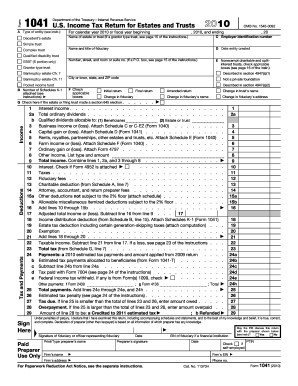
Tax payments and amount applied from 2009 return . . . Estimated tax payments allocated to beneficiaries (from Form 1041-T) . . . . . . . Subtract line 24b from line 24a . . . . . . . . . . . . . . . . . . . . Tax paid with Form 7004 (see page 24 of the instructions) . . . . . . . . . . . . . . . . . . Federal income tax withheld. If any is from Form(s) 1099, check Other payments: f Form 2439 25 26 27 28 29 ; g Form 4136 . . 1 2a . . . . . 3 4 5 6 7 8 9 10 11 12 13 14 15a 15b 16.
Open form follow the instructions
Easily sign the form with your finger
Send filled & signed form or save
How to fill out the IRS 1041 online
The IRS 1041 form is used for reporting income, deductions, gains, and losses for estates and trusts. Filling it out online can simplify the filing process and ensure accuracy in financial reporting.
Follow the steps to accurately complete the IRS 1041 online.
- Click ‘Get Form’ button to obtain the IRS 1041 and access it in your preferred digital format.
- Begin by entering the type of entity, such as 'Decedent's estate' or 'Trust'. Provide the name of the estate or trust in the designated field.
- Fill in the employer identification number (EIN) and the name and title of the fiduciary managing the estate or trust.
- Indicate the creation date of the entity and provide the full address, including city, state, and ZIP code.
- Check the appropriate box regarding the nature of the estate or trust, based on the provided categories such as 'Simple trust' or 'Complex trust'.
- Document the number of Schedules K-1 attached to the IRS 1041 form.
- Complete the income section by reporting various types of income, including interest income, dividends, capital gains, and other relevant sources. Attach any necessary schedules as indicated.
- Proceed to the deductions section. Enter all applicable deductions such as fiduciary fees, charitable deductions, and any other allowable expenses.
- Calculate the total income and total deductions. Then, calculate the taxable income by subtracting total deductions from total income.
- In the payments section, document any estimated tax payments made, federal tax withheld, and any other payments or credits received.
- Finally, review your completed IRS 1041 for accuracy. Save your changes, download a copy for your records, and print or share the form as needed.
Complete your IRS 1041 online today to ensure a smooth filing process.
Experience a faster way to fill out and sign forms on the web. Access the most extensive library of templates available.
Related content
Feb 19, 2025 — Use Schedule D (Form 1041) to report gains and losses from the sale or...
26 U.S. Code § 1041 - Transfers of property between spouses or incident to divorce ; (a)...
Jan 4, 2017 — Otherwise, include the amount from line 7 in the total on Form 1040, line...
Get answers to your most pressing questions about US Legal Forms API.
Can I file IRS Form 1041 electronically?
Yes, you can file IRS Form 1041 electronically through approved tax software. This option often leads to faster processing and the potential for quicker refunds. Ensure that your chosen software is compatible with IRS guidelines and trust requirements. If you're unsure about which software to use, USLegal Forms can provide valuable resources to guide your decision.
What income is required for a 1041 filing?
To file IRS Form 1041, a trust or estate must have gross income of $600 or more for the year. Additionally, the income must be from sources that include interest, dividends, or rental income. For estates of deceased individuals, other factors such as the number of beneficiaries may also come into play. Utilizing platforms like USLegal Forms can clarify these requirements and assist you in filing.
What is the IRS form 1041 for dummies?
IRS Form 1041 is a tax return for estates and trusts, designed to report income, deductions, gains, and losses. It also calculates the income tax due for the estate or trust, as well as the distributions made to beneficiaries. If you're new to filing or find tax jargon confusing, consider using USLegal Forms to simplify the process and make it easier to understand.
How do you calculate tentative tax on estate tax base?
Calculating tentative tax on the estate tax base requires understanding the gross estate value and applicable deductions. For IRS Form 1041, factor in both the taxable estate and the debt obligations of the estate. The IRS provides guidelines for calculating these figures, which can be intricate. Leveraging resources such as USLegal Forms can provide detailed assistance in ensuring accuracy.
How do you calculate total tax due?
Calculating total tax due on IRS Form 1041 requires summing your trust's taxable income and any other sources of income. After determining your total income, apply the correct tax rate based on your filing status and the income brackets for trusts. Don’t forget to account for available deductions or credits to arrive at your total tax due. Tools like USLegal Forms can help you organize this information effectively.
How to calculate tax due on Form 1041?
To calculate the tax due on IRS Form 1041, begin with your taxable income figure. Next, apply the current tax rates based on the income brackets relevant for trusts. Add any applicable credits or adjustments to finalize your tax obligation. If needed, using platforms such as USLegal Forms simplifies this process.
How to calculate tax on trust income?
Calculating tax on trust income reported on IRS Form 1041 involves first determining the total income earned by the trust. Then, you need to subtract any allowable deductions to arrive at the taxable income. After this, apply the appropriate tax rate to determine the estimated tax owed. Resources like USLegal Forms can offer guidance on these calculations.
What is the tax rate on form 1041?
The tax rate on IRS Form 1041 varies based on the income brackets set by the IRS. Trusts typically use the same rates as individual income tax rates, meaning they can face higher rates at lower income levels. Understanding these rates is crucial to accurately calculating your trust's tax obligations. Utilizing platforms like USLegal Forms can help you navigate these details more easily.
How do I know if I need to file a 1041?
You will need to file IRS Form 1041 if you are managing an estate or trust that has generated income above a certain threshold. Additionally, if you are an executor of a deceased person's estate that meets income requirements, filing is necessary. If you want help determining your need to file, resources on US Legal Forms can clarify your situation and provide guidance tailored to your circumstances. Consulting a professional can also offer assurance.
What IRS forms cannot be filed electronically?
Several IRS forms cannot be filed electronically, including specific complex returns and certain informational returns. Forms like IRS Form 1040-X, which is used for amended returns, are among those that require paper filing. If you're unsure which forms are eligible for e-filing, check the IRS website or consult resources from US Legal Forms. Staying informed will ensure you follow the correct filing procedures.
Use professional pre-built templates to fill in and sign documents online faster. Get access to thousands of forms.
If you believe that this page should be taken down, please follow our DMCA take down process here.
This form is available in several versions. Select the version you need from the drop-down list below.