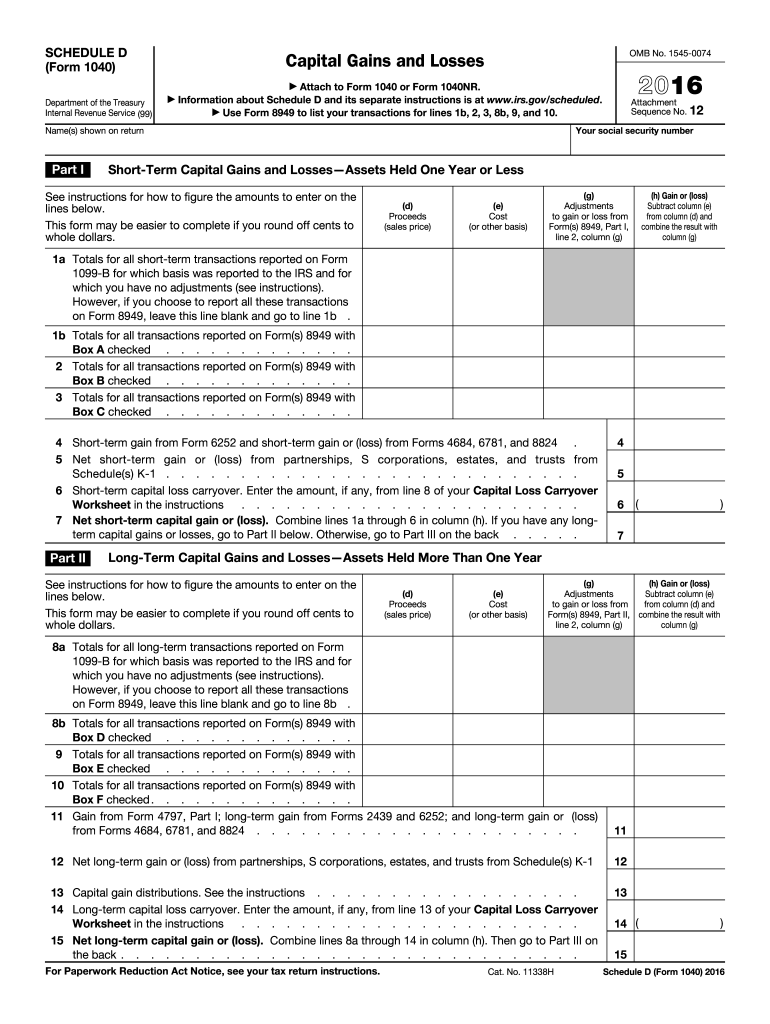
Box F checked . . . . . . . . . . . . . . 11 Gain from Form 4797, Part I; long-term gain from Forms 2439 and 6252; and long-term gain or (loss) from Forms 4684, 6781, and 8824 . . . . . . . . . . . . . . . . . . . . . . 11 12 Net long-term gain or (loss) from partnerships, S corporations, estates, and trusts from Schedule(s) K-1 12 13 Capital gain distributions. See the instructions . . . . . . . . . . . . . . . . . . 14 Long-term capital loss carryover. Enter the amount, if any, from line.
Loading

Open form follow the instructions

Easily sign the form with your finger

Send filled & signed form or save
How to fill out the IRS 1040 - Schedule D online
This guide provides clear and detailed instructions on how to complete the IRS 1040 - Schedule D form online, focusing on capital gains and losses. By following this step-by-step process, users can navigate the form with ease and accuracy.
Follow the steps to complete the IRS 1040 - Schedule D online.
- Click the ‘Get Form’ button to obtain the form and open it in your preferred editing tool.
- Begin by entering your social security number and the name(s) as shown on your tax return. This information is essential for identification purposes.
- In Part I, list short-term capital gains and losses for assets held for one year or less. Use Form 8949 to detail transactions for lines 1b, 2, 3, 8b, 9, and 10.
- For each transaction, enter the proceeds (sales price) in column (d) and the cost (or other basis) in column (e). If there are any adjustments to gain or loss, include them in column (g).
- Calculate the gain or loss by subtracting column (e) from column (d) and adding any adjustments from column (g) to column (h).
- Continue through Part II to report long-term capital gains and losses for assets held for more than one year. Follow the same entry format as in Part I.
- After completing Parts I and II, move to Part III. Combine lines 7 and 15 to determine your overall gain or loss.
- Follow the prompts in Part III to determine how to report your net gain or loss on Form 1040. Pay attention to specific questions about additional gains or qualified dividends.
- Once all sections are filled out accurately, you can save your changes, download the form, print it, or share it as needed.
Complete your IRS 1040 - Schedule D online today for a smooth filing experience!
Experience a faster way to fill out and sign forms on the web. Access the most extensive library of templates available.
Related content
Mar 25, 2025 — Use Schedule D (Form 1040) to report the following: The sale or exchange...
by D SCHEDULE · Cited by 1 — Complete the Qualified Dividends and Capital Gain Tax...
19. Enter the loss, if any, from line 21 of your 2017 Schedule D (Form 1040). (Estates and...
Get answers to your most pressing questions about US Legal Forms API.
How do you report the sale of inherited property to the IRS?
To report the sale of inherited property, first calculate the capital gain or loss based on the stepped-up basis. Then, complete Form 8949 to list the sale transaction and its details. Finally, summarize this information on IRS 1040 - Schedule D, ensuring accurate reporting of your capital gains and losses.
Do I have to report the sale of inherited property to the IRS?
Yes, you must report the sale of inherited property to the IRS, regardless of whether or not you realize a gain. Use IRS 1040 - Schedule D to report this sale. It helps the IRS understand your overall tax situation and ensures compliance with tax laws.
What is the Schedule D on the 1040 form?
The Schedule D is a form used to report capital gains and losses on your IRS 1040 tax return. It details your sales of stock, real estate, and other assets, allowing you to calculate your overall gains or losses. Understanding how to use IRS 1040 - Schedule D is vital for accurately reporting your financial situation to the IRS.
Who does not need to file Schedule D?
Individuals who do not have any capital gains or losses do not need to file IRS 1040 - Schedule D. Additionally, if your only capital transactions involve tax-exempt securities or investments, you may also skip this form. Always verify your tax situation or consult a tax professional for accurate guidance.
Should I file form 8949 or schedule D?
You will typically use both Form 8949 and IRS 1040 - Schedule D when reporting capital gains or losses. Form 8949 is specifically for listing each individual transaction, while Schedule D summarizes your total gains and losses. Ensure you account for any inherited property sales accurately on these forms to comply with IRS regulations.
Do you get a 1099 when you sell an inherited house?
When you sell an inherited house, you generally do not receive a 1099 form. However, you will still need to report the sale on IRS 1040 - Schedule D. It is crucial to keep records of the sale, including any expenses related to the transaction, as they may affect your overall tax obligation.
What is the difference between Schedule D and form 4797?
Schedule D is used for reporting capital gains and losses from the sale of investment assets, while Form 4797 pertains to sales of business property and other non-capital assets. If you have investment income, use IRS 1040 - Schedule D; for business-related asset sales, Form 4797 is the appropriate choice. Understanding which form to use helps ensure accurate tax reporting.
Where is Schedule D on the Tax Act?
In the Tax Act software, IRS 1040 - Schedule D can usually be found in the section dedicated to capital gains and losses. Simply navigate to the tax forms section, and look for Schedule D among the options provided. This functionality streamlines the process of reporting your capital transactions.
Where do I get my Schedule D?
You can obtain IRS 1040 - Schedule D from the IRS website, where all tax forms are available for download. Additionally, tax software programs often provide access to this form as part of their filing process. If you prefer, you can also order a paper version of the Schedule D through the IRS.
Who must file Schedule D Form 1040?
Generally, any taxpayer who has capital gains, losses, or transactions related to capital assets must file IRS 1040 - Schedule D. This includes individual taxpayers, partnerships, and even corporations that sell stocks or other investment properties. If you sold any of these assets during the year, it's essential to report them using Schedule D.
Use professional pre-built templates to fill in and sign documents online faster. Get access to thousands of forms.
If you believe that this page should be taken down, please follow our DMCA take down process here.
This form is available in several versions. Select the version you need from the drop-down list below.