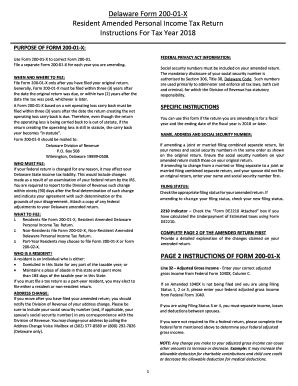
-01. File a separate Form 200-01-X for each year you are amending. Social security numbers must be included on your amended return. The mandatory disclosure of your social security number is authorized by Section 306, Title 30, Delaware Code. Such numbers are used primarily to administer and enforce all tax laws, both civil and criminal, for which the Division of Revenue has statutory responsibility. WHEN AND WHERE TO FILE: File Form 200-01-X only after you have filed your original return. Gen.

How it works
  • Open form

    Open form follow the instructions

  • Easily sign form

    Easily sign the form with your finger

  • Share form

    Send filled & signed form or save

How to fill out the DE DoR 200-01-X-I online

The DE DoR 200-01-X-I form is an essential document for individuals seeking to amend their Delaware Resident Personal Income Tax Return for the tax year 2018. This guide provides straightforward and detailed instructions to help users complete the form accurately and efficiently online.

Follow the steps to complete your DE DoR 200-01-X-I online.

  1. Use the ‘Get Form’ button to access the DE DoR 200-01-X-I form online.
  2. Begin by filling in your name, address, and social security number. If you are amending a joint return, ensure to enter the names and social security numbers in the same order as previously submitted.
  3. Indicate your filing status by checking the appropriate box. If you are changing your filing status from the original return, be sure to select the new status.
  4. Proceed to complete Page 2 first, providing a detailed explanation of the changes you are claiming on your amended return.
  5. Input your adjusted gross income on Line 32, ensuring you are using the correct figures from your Federal Form 1040X or original return if applicable.
  6. Ensure to include any necessary additional documentation such as corrected W-2 forms if you are correcting wages.
  7. As you move through the form, complete all required lines, ensuring you follow the specific instructions for deductions and credits that apply to your situation.
  8. Once all information is entered correctly, review the form for accuracy before submitting.
  9. After finalizing your entries, save the changes to your document. At this point, you can download, print, or share your completed DE DoR 200-01-X-I form accordingly.

Complete your DE DoR 200-01-X-I online today to ensure a smooth amendment process.

Get form

Experience a faster way to fill out and sign forms on the web. Access the most extensive library of templates available.

Related content

2020-2021 Personal Income Tax Forms - Division of...

Personal Income Tax · Form 200EX Extension Request Voucher – 2020 – Request For...

Learn more
Sedação Paliativa, Bioética e Terminalidade da...

by ACVSA Soeiro · 2022 · Cited by 3 — Os achados demonstram que a sedação paliativa...

Learn more
Manual de Instalação, Operação e Manutenção

IMPORTANTE: O Grau de Proteção deste equipamento é IPX0 para as unidades evaporadoras e...

Learn more
Questions & Answers

Get answers to your most pressing questions about US Legal Forms API.

Contact support

How do I file a tax adjustment?

To file a tax adjustment, submit Form 1040X, which allows you to amend your tax return. The DE DoR 200-01-X-I provides additional instructions for Delaware residents making adjustments. Be sure to explain the reasons for your adjustments clearly. Filing this form promptly can help rectify any issues and ensure compliance with state tax laws.

Claiming hardship on your taxes involves demonstrating your inability to meet tax obligations due to financial issues. Use the DE DoR 200-01-X-I as a guideline for understanding the process. Collect all relevant documentation to support your claim, such as income statements and bills. Submitting this information accurately helps the IRS evaluate your hardship status more effectively.

To file for tax hardship, you need to complete Form 433-A or Form 433-F, providing details about your financial condition. Reference the DE DoR 200-01-X-I to understand what documentation may be required. This includes your income, expenses, and assets. It is essential to be honest and precise in your reporting to facilitate your application.

Individuals who earn income in Delaware or are residents of the state must file a Delaware tax return. This includes those working remotely for a Delaware employer. Refer to the DE DoR 200-01-X-I for detailed guidance on residency and income requirements. Even if you had only a small amount of income, filing may benefit you, especially for potential credits or refunds.

To prove a hardship to the IRS, you must provide documentation showing your financial situation, such as income statements, unpaid bills, or any medical expenses. The DE DoR 200-01-X-I can serve as a valuable resource for understanding how to properly present your case. Be clear and thorough in your explanations, as this will help the IRS assess your situation accurately. Consulting with a tax expert may enhance your chances of successfully proving hardship.

To qualify for the IRS forgiveness program, you typically need to demonstrate financial hardship, meet certain income thresholds, and have unpaid taxes. The DE DoR 200-01-X-I outlines specific requirements for eligibility. It is advisable to gather your financial documents beforehand to ensure you meet the criteria. Consulting a tax professional can provide guidance tailored to your situation.

Delaware offers a modest standard deduction for individual filers. The current rate is subject to changes, but it's quite beneficial for reducing taxable income. Stay updated with DE DoR 200-01-X-I guidelines to maximize your deductions and ensure compliance when filing your tax return.

Delaware's transfer tax rates can be higher than those in other states, mainly to fund various public services and infrastructure. This tax is applied to real estate transactions, which can impact buyers and sellers alike. Hence, being familiar with the DE DoR 200-01-X-I can help individuals better prepare for these costs when engaging in real estate in Delaware.

Many states, including Delaware, tax Required Minimum Distributions from retirement accounts. Each state has different rules regarding the taxation of RMDs, which can impact retirees significantly. Thus, understanding state-specific regulations like those outlined in DE DoR 200-01-X-I is crucial for retirees looking to manage their income effectively.

Required Minimum Distributions (RMDs) from retirement accounts are generally subject to Delaware state income tax. However, this taxation may vary based on specific circumstances or types of accounts. Staying informed about RMDs within the framework of DE DoR 200-01-X-I is essential for effective tax planning.

Get This Form Now!

Use professional pre-built templates to fill in and sign documents online faster. Get access to thousands of forms.

If you believe that this page should be taken down, please follow our DMCA take down process here.

DE DoR 200-01-X-I Form

This form is available in several versions. Select the version you need from the drop-down list below.

Get DE DoR 200-01-X-I