Of the District of Columbia Office of Tax and Revenue Recorder of Deeds 515 D Street, NW Washington, DC 20001 Phone (202)727-5374 PART K: Computation of Tax If the residential deed transfer is for a total consideration of less than $400,000 use Lines 1, 2 and 3. All other deed transfers, security instruments and commercial transactions use Lines 4, 5 and 6. 1. 2. 3. 4. 5. 6. 7. Recordation Tax 1.1% of Line 2 or Line 3, Part J Transfer Tax 1.1% of Line 2 or Line 3, Part J Recordation Tax 1.1%.
Loading

Open form follow the instructions

Easily sign the form with your finger

Send filled & signed form or save
How to fill out the DC ROD FP 7/C online
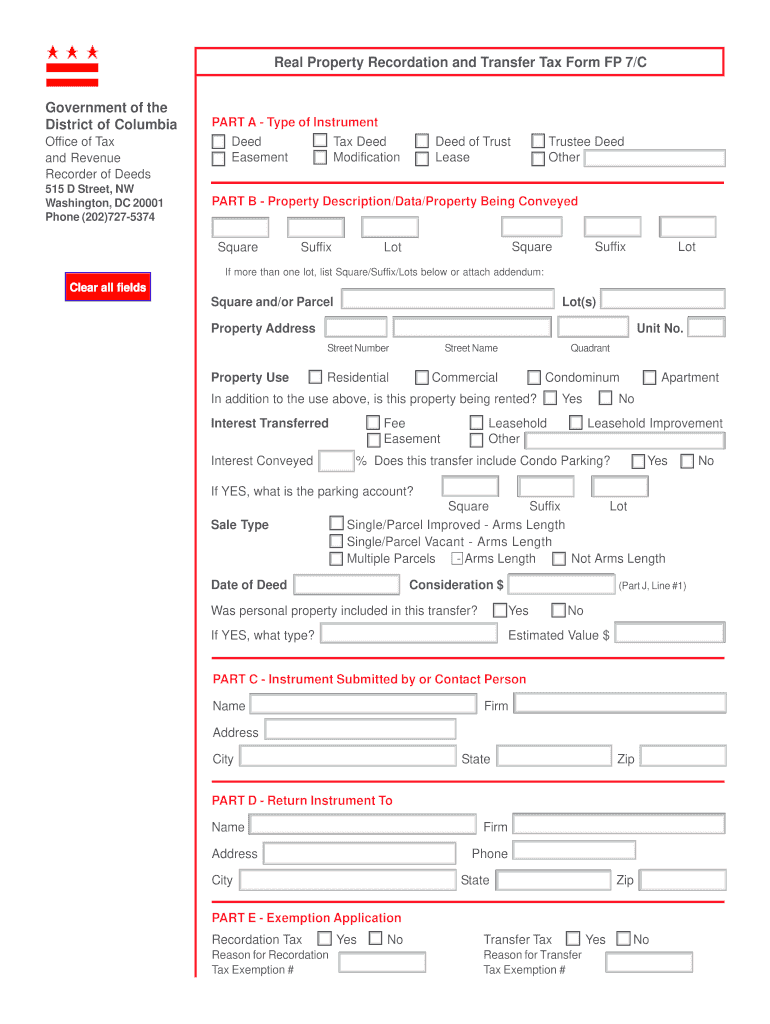
The DC ROD FP 7/C is an important form used for recording real property transactions in the District of Columbia. This guide provides clear, step-by-step instructions on how to complete this form online, ensuring accurate and efficient processing of your real estate documentation.
Follow the steps to fill out the DC ROD FP 7/C form online effectively.
- Press the ‘Get Form’ button to access the DC ROD FP 7/C form and open it in your preferred editor.
- In Part A, select the type of instrument from the options provided, such as Deed, Tax Deed, or Lease. Ensure you choose the instrument that correctly reflects your transaction.
- Proceed to Part B to describe the property being conveyed. Enter the Square, Lot, and any Suffixes, along with the full property address, including the unit number if applicable. Specify the property use (Residential, Commercial, Condominium) and if the property is being rented.
- In Part C, provide the name and contact information of the person or firm submitting the instrument, including their address, city, state, and zip code.
- Complete Part D with the return information. Enter the name and address of the individual to whom the instrument should be returned after processing.
- In Part E, answer the exemption application questions for both recordation and transfer taxes. Provide reasons and exemption numbers if applicable.
- Part F will require answering notifications regarding Homestead or Senior Deduction eligibility. Indicate whether the property will be used as an owner-occupied residence.
- Provide information on the Grantor(s) and Grantee(s) in Parts G and H respectively. Enter names, addresses, and tenancy details for all parties involved.
- In Part I, enter the mailing address for the Grantee if it differs from the Grantee information provided earlier.
- Complete Part J by detailing the consideration and financing. Fill in the cash amounts and other financial details necessary for the transaction.
- In Part K, compute the applicable taxes based on the consideration provided. Follow the instructions for calculating recordation and transfer taxes.
- Finally, in Part L, sign and date the affidavit, affirming the truthfulness of the information provided. Ensure that all Grantor(s) and Grantee(s) complete this step.
- After reviewing all entries for accuracy, save your changes, download a copy of the form, print it for records, or share it as required.
Complete your real estate documentation online today by following these detailed instructions for the DC ROD FP 7/C form.
Experience a faster way to fill out and sign forms on the web. Access the most extensive library of templates available.
Related content
Sep 30, 2024 — ROD 1 - Real Property Recordation and Transfer Tax (Form FP 7C) FY2025 ·...
A completed Tax Return (FP-7/C) is required to record any Deed, Deed of Trust...
Get answers to your most pressing questions about US Legal Forms API.
What is the first time home buyer tax credit in DC?
The first time home buyer tax credit in DC offers financial incentives for those purchasing their first home, designed to ease financial constraints. This credit can be found in various forms, often under initiatives like DC ROD FP 7/C. Understanding how this credit works is essential, so consider consulting resources that specialize in home buying in Washington, DC.
How to get a copy of a deed in DC?
To get a copy of a deed in DC, you need to visit the DC Office of the Recorder of Deeds. There, you can request the document in person or check if it’s available online. Programs like DC ROD FP 7/C can assist you with navigating ownership records, ensuring you have access to important property documents.
Where can I get DC tax forms?
You can obtain DC tax forms online through the DC Office of Tax and Revenue's website. Additionally, resources related to the DC ROD FP 7/C can provide guidance on which forms you might need for first time home buyer benefits. For convenience, you may also find some forms at local government offices or libraries.
Did Biden's first time home buyer tax credit pass?
Biden's administration has proposed several initiatives to support first time home buyers, but specific details about tax credits can change frequently. As of now, the focus remains on making homeownership attainable, particularly through plans like the DC ROD FP 7/C. It's essential to stay updated on these developments to understand how they might benefit you.
How long does it take to record a deed?
Typically, it takes about 10 to 15 business days to record a deed in DC, depending on the volume of submissions and other administrative factors. Once the deed is recorded, it becomes a matter of public record, enhancing its security. If you're navigating the DC ROD FP 7/C, be sure to factor in this timeline when planning your property transactions. For quicker insights and form preparations, uslegalforms can be a valuable tool.
Do you qualify for DC's first time homebuyer recordation tax reduction?
DC offers a recordation tax reduction for qualified first-time homebuyers aiming to make homeownership more accessible. To qualify, you must meet specific income and residency requirements outlined by the city. Exploring the benefits of the DC ROD FP 7/C can simplify your understanding of eligibility criteria. For tailored assistance, consider using resources like uslegalforms to guide you through this process.
Who pays transfer tax in Washington County?
In Washington County, the seller is generally responsible for paying the transfer tax. However, similar to many jurisdictions, this obligation can be negotiated in the sale contract. Understanding who pays these taxes assists you in making well-informed decisions during your property transaction, particularly when involved with DC ROD FP 7/C.
Is recordation tax the same as transfer tax?
No, recordation tax and transfer tax are not the same. Recordation tax is related to the official recording of property documents, while transfer tax applies to the financial aspect of selling property. It’s important to recognize these distinctions to navigate the housing market effectively, especially in relation to DC ROD FP 7/C.
What is another name for transfer tax?
Transfer tax is often referred to as a 'conveyance tax'. This term highlights its role in the transfer of property ownership. Each jurisdiction may have its own terminology, but understanding these terms is beneficial, particularly when you are looking into DC ROD FP 7/C.
Who pays state recordation tax in Maryland?
In Maryland, the seller typically pays the state recordation tax during a real estate transaction. However, this responsibility can also be negotiated between the buyer and seller. Knowing who is liable for this tax helps you plan your finances effectively, especially when considering options like DC ROD FP 7/C.
Use professional pre-built templates to fill in and sign documents online faster. Get access to thousands of forms.
If you believe that this page should be taken down, please follow our DMCA take down process here.
This form is available in several versions. Select the version you need from the drop-down list below.