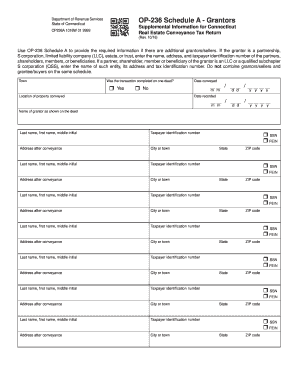
Department of Revenue Services State of Connecticut OP-236 Schedule A - Grantors Supplemental Information for Connecticut Real Estate Conveyance Tax Return OP236A 1016W 01 9999 Rev. 10/16 Clear Fields Go Back to OP-236 Use OP-236 Schedule A to provide the required information if there are additional grantors/sellers. If the grantor is a partnership S corporation limited liability company LLC estate or trust enter the name address and taxpayer identification number of the partners shareholders me.
Open form follow the instructions
Easily sign the form with your finger
Send filled & signed form or save
How to fill out the CT OP-236 Schedule A online
The CT OP-236 Schedule A is an essential document required for providing supplemental information concerning additional grantors or sellers in real estate transactions in Connecticut. This guide will walk you through the steps necessary to complete the form accurately and efficiently, ensuring that all necessary details are included for compliance with state regulations.
Follow the steps to fill out the CT OP-236 Schedule A online:
- Click the ‘Get Form’ button to obtain the online version of the CT OP-236 Schedule A. This will open the form for you to begin filling it out.
- Indicate whether the transaction was completed on one deed by selecting either 'Yes' or 'No' in the designated box.
- Fill in the date the property was conveyed. Use the format mm/dd/yyyy.
- Provide the location of the property conveyed, ensuring you include the full address.
- Enter the date the conveyance was recorded in the appropriate format.
- List the name of the grantor as shown on the deed, including the last name, first name, and middle initial.
- Fill in the taxpayer identification number of the grantor, noting whether it is a Social Security Number (SSN) or Federal Employer Identification Number (FEIN) as applicable.
- Enter the address after the conveyance, including city or town, state, and ZIP code.
- Repeat steps 6 to 8 for each additional grantor or seller, ensuring that all necessary individuals are accounted for.
- Once all relevant fields are completed, review the form for accuracy and save your changes. You may also choose to download, print, or share the completed form as needed.
Complete your CT OP-236 Schedule A online today to ensure compliance with real estate conveyance requirements.
Experience a faster way to fill out and sign forms on the web. Access the most extensive library of templates available.
Related content
OP-236 Schedule A is used for additional grantors/sellers, especially for partnerships, S...
Jan 15, 2022 — The 2021 Form CT-1040, Connecticut Resident Income Tax Return...
To access the Schedule menu screen, press on the Configura- tion menu screen. Select Local...
Get answers to your most pressing questions about US Legal Forms API.
What are the new CT tax rates?
Connecticut's tax rates can change periodically, impacting individual and corporate taxpayers differently. To stay updated, refer to the Connecticut Department of Revenue Services for the most current information on tax brackets and rates. The CT OP-236 Schedule A can help to navigate these changes, especially in relation to capital gains and property sales.
What corporations are required to file Form CT 1120?
Corporations operating within Connecticut that earn income must file Form CT-1120. This requirement applies to both domestic and foreign corporations conducting business in the state. It is vital for these corporations to also assess potential capital gains impacts using the CT OP-236 Schedule A as part of their overall filings.
Who pays the local transfer tax?
Typically, in Connecticut, the seller pays the local transfer tax associated with the sale of the property. However, this can vary based on negotiated terms between the buyer and seller. Understanding these responsibilities is crucial, and consulting the CT OP-236 Schedule A can guide you through the process.
What is a 1040 ES form CT?
The 1040 ES form is used in Connecticut for estimated income tax payments. Taxpayers, including individuals and self-employed workers, need to file it if they expect to owe $1,000 or more in taxes for the year. If you're working with complex transactions, such as real estate sales, the CT OP-236 Schedule A can be integrated into your overall tax strategy.
Is a non-resident required to file an income tax return?
Yes, non-residents of Connecticut who earn income sourced from within the state must file an income tax return. This includes various income types, such as wages, rental income, and certain capital gains. Utilizing Form CT-1040NR and potentially the CT OP-236 Schedule A can simplify this process.
What is CT form OP 236?
CT Form OP-236 is a schedule used to report certain capital gains or losses associated with the sale of real estate properties in Connecticut. This form helps taxpayers detail their financial gains and calculate any due taxes. By accurately completing the CT OP-236 Schedule A, you can ensure compliance while also optimizing your tax position.
How to avoid Connecticut capital gains tax on the sale of a home?
To potentially avoid capital gains tax when selling your home in Connecticut, you may qualify for the homeowner tax exclusion, which typically applies if you have used the home as your primary residence for at least two of the last five years. Additionally, proper documentation through the CT OP-236 Schedule A can help you strategize your tax planning effectively.
Which forms are part-year residents and nonresidents required to file in Connecticut?
Part-year residents must file Form CT-1040 for the period they were residents in Connecticut. Non-residents, as mentioned, should use Form CT-1040NR. Both forms require careful attention to detail, and the CT OP-236 Schedule A may be beneficial for those with specific real estate transactions.
What is the tax form for a non-resident?
Non-residents in Connecticut typically need to use Form CT-1040NR to file their state income tax. This form allows non-residents to report income earned in Connecticut. If you are involved in real estate transactions, including taxable sales, incorporating the CT OP-236 Schedule A may assist you in calculating your obligations.
What is the capital gains tax on real estate in CT?
In Connecticut, the capital gains tax on real estate sales depends on your income level and the duration of ownership. Generally, if you sell your property for a profit, you may be subject to capital gains tax. Additionally, completing the CT OP-236 Schedule A can help you determine your tax liability and potential deductions related to the sale.
Use professional pre-built templates to fill in and sign documents online faster. Get access to thousands of forms.
If you believe that this page should be taken down, please follow our DMCA take down process here.