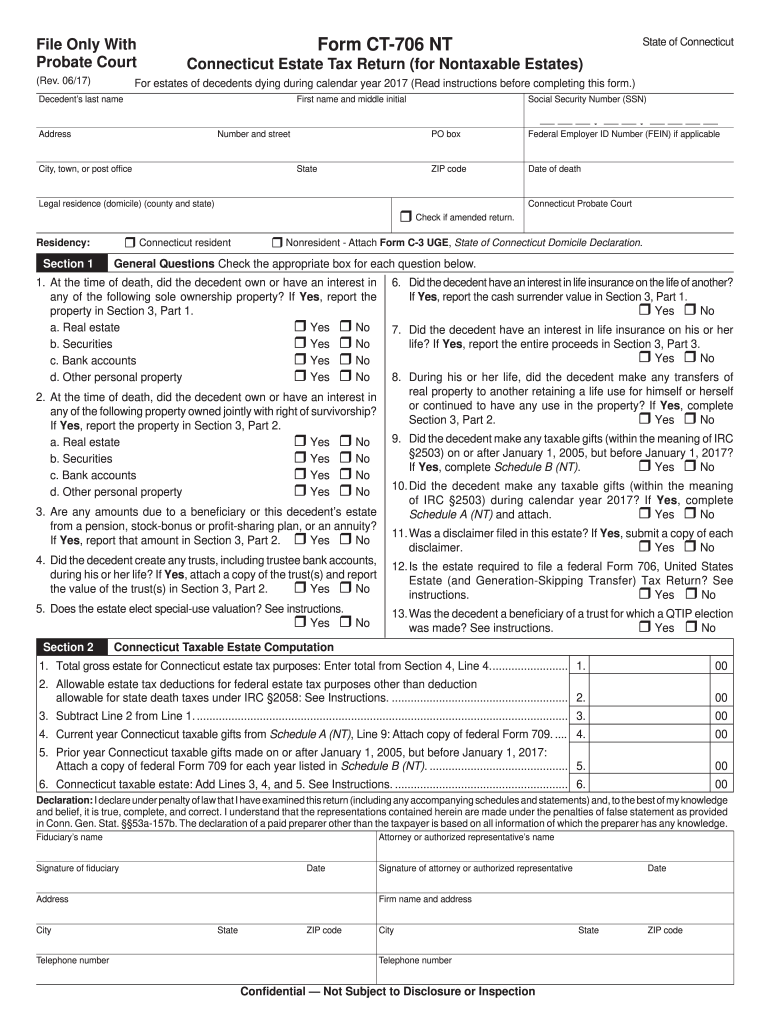
Deral Form 706, United States Estate (and Generation-Skipping Transfer) Tax Return? See instructions. Yes No 13. Was the decedent a beneficiary of a trust for which a QTIP election was made? See instructions. Yes No Connecticut Taxable Estate Computation 1. Total gross estate for Connecticut estate tax purposes: Enter total from Section 4, Line 4. ........................ 1. 00 2. Allowable estate tax deductions for federal estate tax purposes other than deduction allowable f.

Open form follow the instructions

Easily sign the form with your finger

Send filled & signed form or save
How to fill out the CT DRS CT-706 NT online
The CT DRS CT-706 NT is an essential form for reporting the Connecticut estate tax for nontaxable estates. This guide provides clear instructions to help users fill out the form accurately, ensuring compliance with state requirements.
Follow the steps to complete your CT DRS CT-706 NT online.
- Press the ‘Get Form’ button to access the CT DRS CT-706 NT form. This will open the document in your chosen online editor.
- Start by entering the decedent's first name and middle initial, along with their full address, including number, street, city, and state. Also, include their social security number.
- Indicate whether the return is amended by checking the appropriate box and select the residency status of the decedent (Connecticut resident or Nonresident). For nonresidents, be sure to attach Form C-3 UGE.
- Proceed to answer the general questions presented in Section 1. These questions help determine the estate's assets and associated tax implications. Select 'Yes' or 'No' for each applicable question.
- In Section 3, Part 1, report all solely-owned property under the decedent's name. Provide a detailed description, fair market value at the time of death, and other relevant information as required.
- Continue to Section 3, Part 2 to declare any jointly-owned property. Again, include a thorough description and corresponding values.
- In Section 4, calculate the total gross estate for Connecticut estate tax purposes. This involves summing up the values reported in previous sections.
- Review all information entered for accuracy. Once finalized, proceed to save your changes, download the form, or print it as needed. Ensure that all required attachments are included for submission.
Complete your CT DRS CT-706 NT online today to ensure compliance with Connecticut estate tax regulations.
Experience a faster way to fill out and sign forms on the web. Access the most extensive library of templates available.
Related content
Form CT-706 NT (Rev. 06/22). Page 2 of 5. Part 1 - Solely-Owned Property. A. Item. No. B...
2021 Form CT-706 NT Instructions: Connecticut Estate Tax Return (for Nontaxable Estates)...
KEY PART NUMBER. U/M DESCRIPTION. 135420-09-000. EA RADIO-AM/FM/CASS/CD COMBO-AUX/CD...
Get answers to your most pressing questions about US Legal Forms API.
What is the estate tax exemption in CT 2025?
As of 2025, the estate tax exemption in Connecticut is projected to remain at $12.92 million. This exemption allows many estates to transfer wealth without incurring tax. It's beneficial to stay updated, as tax laws can change. For comprehensive information on how this exemption impacts estate planning, refer to the CT DRS CT-706 NT for guidance.
What is a CT-706 NT?
The CT-706 NT is a form used in Connecticut for reporting the estate tax for non-taxable estates. It serves to clarify that your estate falls below the tax exemption threshold. This form is essential for maintaining compliance with state tax requirements, even if your estate owes no tax. Utilize the CT DRS CT-706 NT to ensure proper documentation.
How to avoid estate tax in Connecticut?
To avoid estate tax in Connecticut, employ careful estate planning techniques. You may consider establishing irrevocable trusts or gifting assets before your death. Additionally, exploring strategies such as life insurance policies or charitable donations can help minimize your estate's tax burden. For personalized advice, reach out to a professional well- in Connecticut's tax laws, including the CT DRS CT-706 NT.
Does Connecticut have an estate tax exemption?
Yes, Connecticut has an estate tax exemption of $12.92 million. This means that estates valued under this amount do not owe any estate tax. However, if the estate's value surpasses this limit, a tax will be assessed on the entire estate value. Utilizing resources like the CT DRS CT-706 NT can provide clarity on the intricacies of estate tax in Connecticut.
How can I legally avoid estate tax?
You can legally avoid estate tax through various strategies, such as estate planning and setting up trusts. Consider gifting assets during your lifetime or utilizing marital deductions effectively. These methods can help reduce your taxable estate and ensure a smoother transition for heirs. Consulting a financial advisor or legal professional can provide tailored strategies specific to your circumstances.
How do I get a CT tax registration number?
To obtain a CT tax registration number, you must visit the Connecticut Department of Revenue Services website. There, you can complete the registration process online or download the necessary forms. Completing the process online can save time and simplify your tax management. If you have questions, the CT DRS provides resources to assist you.
How much can you inherit in CT without paying taxes?
In Connecticut, you can inherit up to $12.92 million without incurring estate tax. This exemption applies to estates valued below this threshold, offering relief to many heirs. It's important to consider that if the estate exceeds this value, the estate tax could apply. To better understand your situation, consult the CT DRS CT-706 NT for specific details.
Where do I file my CT 706?
You can file your CT 706 form with the Connecticut Department of Revenue Services (CT DRS). Make sure to submit your completed form either by mail or electronically through the CT DRS online portal. It's crucial to check for any additional documentation requirements that may accompany your filing. Ensure you keep copies of all submitted forms for your records.
What is the most you can inherit without paying taxes?
Currently, the maximum amount that can be inherited without incurring estate taxes in Connecticut stands at $12.92 million. This figure may change, so it's wise to remain informed about any updates. Utilizing the CT DRS CT-706 NT form allows you to correctly navigate the thresholds for tax obligations related to significant inheritances.
What is CT 706 709 Connecticut estate and gift tax return?
The CT 706 709 is a dual-purpose form in Connecticut that addresses both estate and gift taxes. This form allows you to report gifts made during your lifetime in addition to the estate taxes due after death. Understanding how to fill out this form correctly, such as the CT DRS CT-706 NT for non-taxable estates, is essential for compliance with Connecticut tax laws.
Use professional pre-built templates to fill in and sign documents online faster. Get access to thousands of forms.
If you believe that this page should be taken down, please follow our DMCA take down process here.
This form is available in several versions. Select the version you need from the drop-down list below.