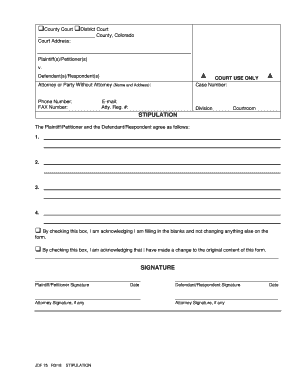
COURT USE ONLY Case Number: Phone Number: FAX Number: Division E-mail: Atty. Reg. #: Courtroom STIPULATION The Plaintiff/Petitioner and the Defendant/Respondent agree as follows: 1. 2. 3. 4. By checking this box, I am acknowledging I am filling in the blanks and not changing anything else on the form. By checking this box, I am acknowledging that I have made a change to the original content of this form.
Open form follow the instructions
Easily sign the form with your finger
Send filled & signed form or save
How to fill out the CO JDF 75 online
The CO JDF 75 form is essential for filing stipulations in legal cases within Colorado. This guide will provide you with a clear, step-by-step approach to completing this form online.
Follow the steps to effectively fill out the CO JDF 75 form
- Click 'Get Form' button to obtain the form and open it in the editing interface.
- Begin by filling in the court information. Indicate whether the case is in County Court or District Court, and provide the name of the relevant county along with the court's address.
- In the top section, identify the parties involved in the case. Fill in the names of the Plaintiff(s)/Petitioner(s) and Defendant(s)/Respondent(s).
- If applicable, include the name and address of the attorney or party without an attorney representing either side.
- Leave space for court use only. Enter the case number, phone number, fax number, division, email address, attorney registration number, and courtroom details as per your case needs.
- Move to the stipulation section. Clearly list the agreements made between Plaintiff/Petitioner and Defendant/Respondent in the provided numbered fields.
- Indicate whether you are making any changes to the form by checking the appropriate box for acknowledgment of filling in the blanks or making changes.
- Finally, ensure each party signs the form in the signature section, including the date. If there is legal representation, the attorney's signature should also be included.
- Once all sections are completed and reviewed for accuracy, save the changes, and choose to download, print, or share the completed form appropriately.
Complete your CO JDF 75 form online today for a smoother legal process.
Experience a faster way to fill out and sign forms on the web. Access the most extensive library of templates available.
Related content
Plaintiff(s)/Petitioner(s) v. Defendant(s)/Respondent(s). COURT USE ONLY. Attorney or...
For example, statistics for fiscal year 2015 from the Colorado judicial branch indicate...
The BQ270V has a book thickness caliper for on-demand production, is easy to use, produces...
Get answers to your most pressing questions about US Legal Forms API.
How to file in small claims court in Colorado?
Filing in small claims court in Colorado involves completing necessary forms, including the CO JDF 75, and submitting them to the court. You need to collect relevant evidence and prepare your arguments clearly. The court will designate a hearing date upon acceptance of your filing. It's a straightforward process, but using a reliable platform like US Legal Forms can simplify your experience, making sure you get everything right.
Do divorce papers need to be notarized in Colorado?
In Colorado, divorce papers do not typically need notarization, but it is beneficial to check state requirements. Whenever possible, utilize the CO JDF 75 form, which helps facilitate your divorce process by ensuring proper filing and service. While notarization is not mandatory, some court documents may require it, so always verify your specific needs. This approach can smooth your path through the legal system.
What happens if a spouse refuses to be served divorce papers?
If your spouse refuses to accept divorce papers, you have several options. You can request a special service method, such as posting the notice in a public place or applying for a divorce by publication. Completing the CO JDF 75 form becomes crucial here as it helps you document your attempts at service. It is advisable to consult a legal expert to understand the best course of action.
How to serve divorce papers in Colorado?
To serve divorce papers in Colorado, you will need to deliver the documents to your spouse following state rules. You may hire a licensed process server or send the papers through certified mail, ensuring that the CO JDF 75 form is completed and filed. This documentation shows the court that your spouse was officially notified. Remember, understanding the rules of service can simplify your process significantly.
How are divorce papers served in Colorado?
In Colorado, divorce papers are commonly served through a process server or via certified mail. The serving person must complete the CO JDF 75 form to confirm delivery. It is essential to adhere to these steps to avoid any complications that may delay your divorce process. If you have any concerns, consider using a legal service to guide you through these steps.
How to serve someone in Colorado?
Serving someone in Colorado requires following specific legal procedures. You may need to use a registered process server, or someone over 18 who is not involved in the case. Ensure you complete the necessary forms like the CO JDF 75 to document the service properly. This step is crucial to ensure that the recipient receives actual notice of the legal action.
What is the emergency guardianship statute in Colorado?
The emergency guardianship statute in Colorado allows a court to appoint a guardian on a temporary basis to protect a person's well-being when immediate action is necessary. This typically occurs when the individual is incapacitated or unable to make safe decisions. The statute outlines the criteria for such appointments and the duration they can last. For more comprehensive details, you may want to refer to CO JDF 75 to ensure compliance with all legal requirements.
How to file an answer to a Summons in Colorado?
Filing an answer to a Summons in Colorado involves submitting a written document to the court, addressing the claims made against you. It is important to do this within the specified time frame, usually 20 to 30 days after receiving the Summons. Your response should include any defenses or counterclaims you have against the plaintiff's allegations. Utilizing CO JDF 75 can help you access the necessary forms and ensure you're meeting all deadlines.
How to file a judgment lien in Colorado?
To file a judgment lien in Colorado, you need to record your judgment in the county where the debtor owns property. This involves submitting a form to the county clerk, with details about the judgment and the debtor. A judgment lien secures your financial interests and can be vital for debt recovery. Ensure to check CO JDF 75 for the required forms and filing process to facilitate your claims.
What is the difference between guardianship and conservatorship in Colorado?
In Colorado, guardianship typically refers to the care and well-being of a person, while conservatorship involves managing financial matters and property on behalf of an individual. Guardians are responsible for decisions related to health and personal affairs, whereas conservators handle monetary assets and financial obligations. Understanding this distinction is vital, especially when considering the use of resources like CO JDF 75 for legal proceedings.
Use professional pre-built templates to fill in and sign documents online faster. Get access to thousands of forms.
If you believe that this page should be taken down, please follow our DMCA take down process here.