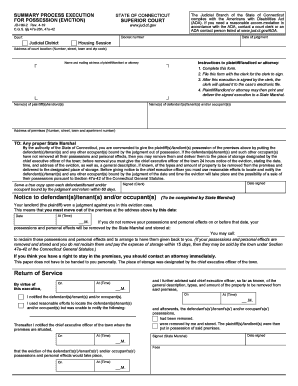
On in accordance with the ADA, contact a court clerk or an ADA contact person listed at www.jud.ct.gov/ADA. STATE OF CONNECTICUT SUPERIOR COURT www.jud.ct.gov JD-HM-2 Rev. 4-19 C.G.S. 47a-26h, 47a-42 Docket number Court Judicial District Date of judgment Housing Session Address of court location (Number, street, town and zip code) Instructions to plaintiff/landlord or attorney: 1. Complete this form. 2. File this form with the clerk for the clerk to sign. 3. After this execution i.

How it works
  • Open form

    Open form follow the instructions

  • Easily sign form

    Easily sign the form with your finger

  • Share form

    Send filled & signed form or save

How to fill out the CT JD-HM-2 online

Filling out the CT JD-HM-2 form is a crucial step in the eviction process in Connecticut. This guide provides detailed instructions to help users complete the form accurately and efficiently, ensuring compliance with legal requirements.

Follow the steps to complete the CT JD-HM-2 form online.

  1. Click ‘Get Form’ button to obtain the CT JD-HM-2 form and open it in the online editing tool.
  2. Begin by filling in the docket number, which is required to identify the specific legal case. Ensure that this number is accurate to avoid any complications.
  3. Next, indicate the courthouse by selecting the appropriate option for the court location, specifying both the judicial district and the address (number, street, town, and zip code).
  4. Provide the date of judgment, which is essential for the official record. This date informs all parties involved when the court made a decision regarding the eviction.
  5. List the name and mailing address of the plaintiff or landlord, as well as their attorney if applicable. This information is necessary for legal notifications and correspondence.
  6. Identify the names of all plaintiffs or landlords, followed by the names of the defendants, tenants, and/or occupants. Accurate names ensure proper service of the eviction notice.
  7. Include the address of the premises to which the eviction applies. Be thorough, making sure to provide the complete address along with any relevant details, like apartment numbers.
  8. Before submitting, review the completed form to ensure all information is accurate and complete. Save your changes, and once satisfied, download or print the filled form.
  9. After finalizing the form, file it with the clerk for their signature. The clerk will upload it to the case's electronic file.
  10. Once the execution is signed by the clerk, the plaintiff or attorney may print and deliver the signed execution to a State Marshal.

Ensure your eviction process is handled correctly by completing the CT JD-HM-2 form online today.

Get form

Experience a faster way to fill out and sign forms on the web. Access the most extensive library of templates available.

Related content

Official Court Forms of the Connecticut Judicial...

Official Court Webforms. Forms are ... JD-AP-048PT, Affidavit of Indigency — Fee Waiver...

Learn more
Pediatric Radiology Normal Measurements | OHSU

2. Siegel MJ. Pediatric Body CT. Lippincott Williams & Wilkins: Philadelphia. 1999. p...

Learn more
HP2011 HM Hinge Operated Safety Interlock Switch...

May 24, 2016 - Only use solvent-free cleaning agents to clean the. safety switch!...

Learn more
Questions & Answers

Get answers to your most pressing questions about US Legal Forms API.

Contact support

What happens if you don't go to court for eviction?

If you don't file an answer or go to court, your landlord can ask the judge to find you in default. Then the judge may let your landlord show there is reason for you to be evicted. ... An eviction judgment can also be for damages, meaning you'll have to pay money to the landlord.

In many cases, an eviction notice is issued for failure to pay rent. If that's your situation, you can stop the landlord from going through with the eviction by paying the rent you owe. ... Once the matter goes to court, the landlord still must win the case and obtain a court order to legally evict you.

Unfortunately your employer can refuse your retracted resignation, so prepare yourself for that scenario if you can. If your employer refuses to accept your retraction, then you will be legally obliged to work your notice and then leave.

In almost all cases, this Notice must be served a minimum of three days before you are able to file for an eviction. Some reasons could require as much as a year's notice. Often, you must first serve a tenant with a Notice to Cease before you can even serve them with a Notice to Quit.

A notice to quit is the notice often referred to as "eviction", given by a landlord to a tenant to leave the premises either by a certain date (usually 30 days) or to pay overdue rent or correct some other default ( pets, damage to premises, too many roommates, using the property for illegal purposes, etc.) within a ...

A notice to quit is the notice often referred to as "eviction", given by a landlord to a tenant to leave the premises either by a certain date (usually 30 days) or to pay overdue rent or correct some other default ( pets, damage to premises, too many roommates, using the property for illegal purposes, etc.) within a ...

1a) Fourteen Day Pay or Vacate Notice. In order to win in court against an eviction for non-payment of rent, the tenant must be able to establish that they do not owe the rent the landlord is trying to collect. A 14-day pay or vacate notice does not mean that you have to vacate the premises within fourteen days.

Summary process refers to an immediate process, issuing and taking effect without intermediate applications or delays. ... The term summary process is also used to refer to the legal documents used to achieve an expeditious resolution of the controversy. For example, court order.

Summary eviction refers to eviction accomplished through a simplified legal procedure, without the formalities of a full trial. Summary eviction proceeding is the quickest way to legally evict a tenant. Generally, a landlord can petition for summary eviction in a civil court.

An eviction is the process of getting a court order to remove a tenant and other occupants from a rental property. ... The court case that a landlord files to get a court order is called summary process (the legal term for an eviction). The court order that allows a landlord to evict a tenant is called an execution.

Get This Form Now!

Use professional pre-built templates to fill in and sign documents online faster. Get access to thousands of forms.

If you believe that this page should be taken down, please follow our DMCA take down process here.

Get CT JD-HM-2