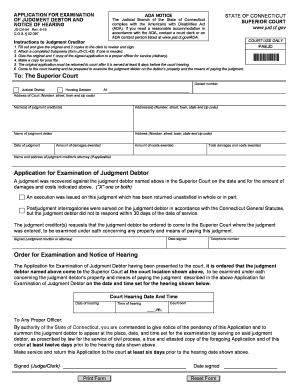
APPLICATION FOR EXAMINATION OF JUDGMENT DEBTOR AND NOTICE OF HEARINGADA NOTICESTATE OF CONNECTICUT SUPERIOR COURT www.jud.ct.govThe Judicial Branch of the State of Connecticut complies with the Americans.
Loading
Open form follow the instructions
Easily sign the form with your finger
Send filled & signed form or save
How to fill out the CT JD-CV-54 online
Filling out the CT JD-CV-54 form online can simplify the process of applying for an examination of a judgment debtor. This guide will help you navigate each step in completing the form effectively, ensuring you meet all necessary requirements.
Follow the steps to complete the CT JD-CV-54 online.
- Press the 'Get Form' button to access the CT JD-CV-54 document and open it in your preferred online format.
- Begin by entering the docket number and the judicial district where your case is filed. It is important to ensure this information is accurate and corresponds with your case records.
- Proceed to input the name and address of the judgment creditor or creditors. Ensure that all details, such as street addresses and zip codes, are correct for effective communication.
- Next, provide the name and address of the judgment debtor, including all relevant details to avoid confusion during the service process.
- Indicate the date of judgment and the amounts awarded in damages and costs. Make sure to double-check these figures for accuracy.
- If applicable, enter the name and address of the attorney representing the judgment creditor. Include accurate contact information to facilitate correspondence.
- Select the appropriate options regarding the execution status and postjudgment interrogatories by marking the corresponding checkboxes.
- Sign and date the application, ensuring that your contact number is included for any necessary follow-up.
- Once all fields are completed, review the entire form for accuracy and completeness. Adjust any errors as needed.
- Save your changes. You may download, print, or share the form as necessary. Ensure you follow all court requirements for submission.
Start filling out the CT JD-CV-54 online today to streamline your application process.
Experience a faster way to fill out and sign forms on the web. Access the most extensive library of templates available.
Related content
APPLICATION FOR EXAMINATION. OF JUDGMENT DEBTOR AND. NOTICE OF HEARING. JD-CV-54 Rev...
54-86e. (The asterisk appears at the end of the caption line of the opinion.) ... court...
Clarence Thomas (born June 23, 1948) is an American lawyer who serves as an associate...
Get answers to your most pressing questions about US Legal Forms API.
How much is small claims fee in CT?
No.ItemFee12.If complaint amended to show demand is not less than $2,500$7513.Small claims Small claims counterclaim$95 $9514.Motion to transfer small claims case to regular docket - from moving party$12515.Jury fee$44041 more rows
How do I collect on a small claims Judgement in CT?
24. How do I collect money if I win my case? The court does not collect the money for you, but you can request that the clerk issue an execution. An execution authorizes you to hire a state marshal to attach a judgment debtor's (defendant's) wages, nonexempt personal property or financial institution (bank) account.
What are interrogatories in aid of execution?
Interrogatories in aid of execution are an important discovery tool to: Get a full picture of a judgment debtor's financial condition. Locate income and assets available to satisfy the judgment. Identify any improperly transferred assets that may provide grounds for a voidable transactions or fraudulent transfer claim.
What is the statute of limitations on a Judgement lien in CT?
How long does a judgment lien last in Connecticut? A judgment lien in Connecticut will remain attached to the debtor's property (even if the property changes hands) for 20 years (for liens on real estate) or five years (liens on personal property).
What is the small claims limit in CT?
What is “Small Claims Court”? The “Small Claims Court” is a part of Connecticut's court system where a person may sue for up to $5,000.00 in money damages only. This amount is set by state law and may change from time to time.
How long do you have to file small claims in CT?
For example, the Connecticut statute of limitations is three years for oral contracts, six years for written contracts, and two years for personal injury and personal property damage cases. If you don't file within the proper period, you lose your right to sue.
What is the lowest amount for small claims court?
If you are an individual and want to file a lawsuit for $10,000 or less, you have the option of filing a small claims case or a limited civil case. If you are a business, you can file in small claims court for $5,000 or less.
How long do you have to file a lawsuit in CT?
Generally, you have two years to file a case but there are circumstances where you have much less time to notify the parties that you are intending to sue. For a quasi-governmental agency, you might have notice periods as short as 90 days.
Use professional pre-built templates to fill in and sign documents online faster. Get access to thousands of forms.
If you believe that this page should be taken down, please follow our DMCA take down process here.