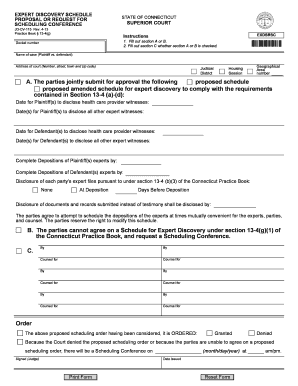
A or B. 2. Fill out section C whether section A or B is checked. Docket number *EXDSRSC* Name of case (Plaintiff vs. defendant) Address of court (Number, street, town and zip code) Judicial District Housing Session Geographical Area number A. The parties jointly submit for approval the following proposed schedule proposed amended schedule for expert discovery to comply with the requirements contained in Section 13-4 (a)-(d): Date for Plaintiff(s) to disclose health care provider witnesses.

How it works
  • Open form

    Open form follow the instructions

  • Easily sign form

    Easily sign the form with your finger

  • Share form

    Send filled & signed form or save

How to fill out the CT JD-CV-115 online

Filling out the CT JD-CV-115 form online is a straightforward process that helps parties outline a schedule for expert discovery in legal matters. This guide will walk you through each section of the form to ensure all necessary information is provided accurately.

Follow the steps to effectively complete the form

  1. Press the ‘Get Form’ button to access the CT JD-CV-115 form and open it in the online editor.
  2. Start by filling out either Section A or Section B as appropriate for your situation. Section A is used if the parties jointly submit a proposed schedule for approval. Section B is for when the parties cannot agree on a schedule and request a scheduling conference.
  3. If you chose Section A, provide the required dates for the disclosure of expert witnesses for both the plaintiff and defendant. Ensure all relevant dates are entered accurately.
  4. In Section A, complete the deposition deadlines for both parties’ experts, including any deadlines for the disclosure of expert files.
  5. If you selected Section B, indicate that the parties cannot agree on a schedule and provide the names and signatures of the counsel involved.
  6. Next, move to Section C and fill out any necessary information related to counsel for each party and any orders from the court.
  7. Once all sections are completed, review the form to ensure accuracy and completeness before finalizing your submission.
  8. You can then save your changes, download, print, or share the completed form as needed.

Complete your CT JD-CV-115 form online today for an efficient scheduling process.

Get form

Experience a faster way to fill out and sign forms on the web. Access the most extensive library of templates available.

Related content

Official Court Forms of the Connecticut Judicial...

JD-CV-115, Schedule For Expert Discovery Proposal Or Request For Scheduling ... CT.gov |...

Learn more
Diversity of Chromobacterium violaceum isolates...

by LT Dall’Agnol · 2008 · Cited by 28 — Strains CV6, CV29 and CV83 lost the ability...

Learn more
O Novo Padrão

Design Circumaural Supra-auricular de Costas. Fechadas • Curva de EQ para Música e...

Learn more
Questions & Answers

Get answers to your most pressing questions about US Legal Forms API.

Contact support

Do I need to wear a suit to small claims court?

Wearing a suit to small claims court is not a requirement, but dressing appropriately is essential. You want to show respect for the court and present yourself professionally. Business casual attire is generally acceptable, following the guidelines of decorum in court. Remember, the focus should be on the details of your case rather than fashion.

You should file a certificate of closed pleadings in Connecticut after all parties have submitted their pleadings and there are no further amendments or motions pending. This certificate signals to the court that the matter is ready for trial. It is crucial to file this document in accordance with the CT JD-CV-115 rules to avoid any delays in your case.

A motion to compel in Connecticut is a request made to the court for an order to compel a party to comply with a discovery request. This can occur during the small claims process when one party does not provide necessary documents or information. Understanding how to file such a motion is vital for ensuring your case proceeds efficiently. Utilize the CT JD-CV-115 guidelines for proper motion procedures.

In Connecticut, the statute of limitations for small claims court is typically six years. This timeframe applies to most contract claims and certain types of debts. However, some cases might have different limitations, so it’s essential to check specific circumstances. Always refer to CT JD-CV-115 for guidance on filing your claims on time.

To serve a small claims writ and notice of suit in Connecticut, you must follow the CT JD-CV-115 procedures. First, ensure that the document is filled out correctly and signed. Then, you can serve it through a state marshal or an individual over the age of 18. Following the rules ensures that your service is valid and recognized by the court.

Disclosure of expert witness refers to the requirement of informing the other party about any expert you plan to use in your case. In Connecticut, you must disclose this information prior to trial, including the expert's qualifications and the opinions they will present. Understanding this aspect is essential for effectively preparing your case involving CT JD-CV-115.

To file a small claims suit in Connecticut, you will need to complete the form CT JD-CV-115. First, determine the exact amount you are claiming and ensure it falls within the state's limit for small claims. Next, gather all necessary documents and evidence to support your claim. Once you have everything ready, you can file the form at your local court, and our platform, uslegalforms, can assist you with additional resources and guidance.

When pleadings are closed, it means that all parties involved have completed their submissions of claims and defenses. This marks a significant milestone in the litigation process, indicating that the details of the case are established and ready for adjudication. Filing the CT JD-CV-115 may be necessary at this stage to confirm that nothing further will be added. To make this process easier, consider utilizing the services available on the USLegalForms platform.

A certificate of closed pleadings signifies that all parties have finalized their statements of their case, which includes claims and defenses. This document, often represented by the CT JD-CV-115, allows the court to understand that no further pleadings will be submitted on those claims. Filing this certificate is a critical step towards moving your case into the next phase of litigation. Use the resources on the USLegalForms platform to guide you through this process.

Section 10-35 of the CT practice book outlines the rules regarding the completion of pleadings. This section helps ensure that all parties have adequately presented their claims and defenses. Understanding this section is vital for properly closing your case, and filing the CT JD-CV-115 is often a necessary step. You can refer to legal resources for a detailed explanation of its implications.

Get This Form Now!

Use professional pre-built templates to fill in and sign documents online faster. Get access to thousands of forms.

If you believe that this page should be taken down, please follow our DMCA take down process here.

CT JD-CV-115 Form

This form is available in several versions. Select the version you need from the drop-down list below.

Get CT JD-CV-115