Rt to verify assets. I have examined all securities, evidences of deposit and investments; and such assets correspond with the account, except as indicated. Signature (Not Trustee) Date of verification: Name Printed or Typed and Title Telephone Number Date PR-1937, 10/10 Trustee's Account (Informal Administration and Formal Administration) 701.16(4) and (5), Wisconsin Statutes This form shall not be modified. It may be supplemented with additional material. Page 3 of 3.
Loading

Open form follow the instructions

Easily sign the form with your finger

Send filled & signed form or save
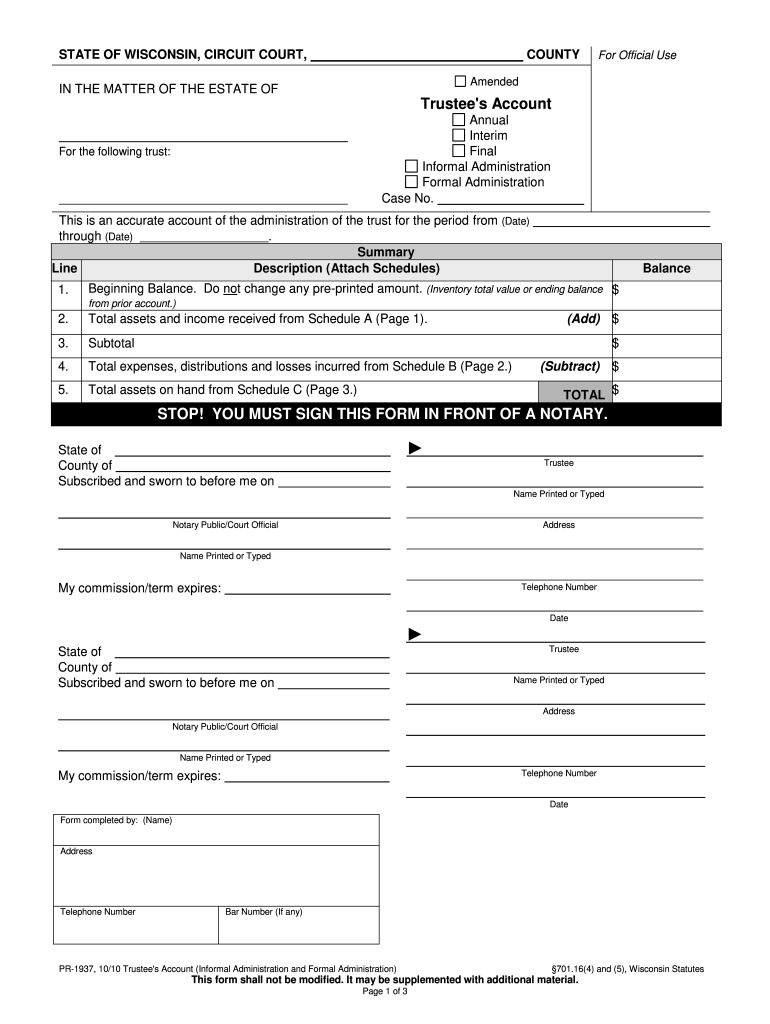
How to fill out the WI PR-1937 online
Filling out the WI PR-1937 form online can seem daunting, but with clear guidance, you can navigate the process smoothly. This form is essential for reporting the trustee's account for estates undergoing informal or formal administration.
Follow the steps to complete the WI PR-1937 form online.
- Click the ‘Get Form’ button to obtain the form and open it in the online editor.
- Begin by entering the case number at the top of the form, which identifies your specific estate matter.
- Indicate the type of account you are reporting: annual, interim, or final. This is often a checkbox option.
- In the section that specifies the period of administration, fill in the dates you are reporting on — specifically, from the start date through the end date.
- For the summary lines that follow, start with line 1 where you enter the beginning balance. Be sure not to modify any pre-printed amounts.
- In line 2, input the total assets and income received from Schedule A. Make sure to have this detailed in the corresponding schedule.
- Calculate and enter the subtotal in line 3, which is the total of the beginning balance and line 2.
- On line 4, list the total expenses, distributions, and losses incurred from Schedule B.
- In line 5, enter the total assets on hand from Schedule C by referencing the values entered in that schedule.
- Finally, verify all sums in the 'TOTAL' line and ensure the entire summary is accurate before signing.
- Sign the form in front of a notary, ensuring to fill in the notary's information and commission expiration date.
- Once completed, save any changes made, then download, print, or share the form as needed.
Start filling out your WI PR-1937 form online today for a smoother process.
Experience a faster way to fill out and sign forms on the web. Access the most extensive library of templates available.
Related content
Trusts: Trust Termination Packet. Trust Inventory (PR-1932). Trustee's Annual Account...
QUIPMENT is subject to corrosive tion, Abrasion by steam, water, or solids. |... a. I...
Classificação geral. editar. Desde 1937 até 2025, durante as 70 edições do Campeonato...
Get answers to your most pressing questions about US Legal Forms API.
Can an executor make a claim against the estate?
Usually, the executor pays taxes, funeral costs and expenses of operating the estate first. ... The court will order liquidation of the estate's assets to pay the creditors as much as possible. If the executor cannot pay any claims, the estate is insolvent. In this case, its beneficiaries don't receive anything either.
How long do you have to make a claim against an estate?
Creditors' Claims and Insolvent Estates Opening probate cuts short the amount of time a creditor has to claim against the estate. A creditor must file their claim within four months from the date an executor or personal representative is officially appointed.
How do I file an estate claim?
Confirm what the deceased owed you when he died and locate proof of the debt, such as a bill. Find the probate court handling the probate proceedings. ... Visit the probate court once you've located the correct one and bring proof of the debt with you. ... Complete the claim form. ... File the claim form in the probate court.
How do I file an estate claim in Wisconsin?
There is a $3 filing fee to file a claim against an estate. Probate office or online at Wisconsin Court System Circuit Court forms. File the completed form with the Register in Probate together with the $3.00 statutory filing fee. Send a copy to the Personal Representative and the estate attorney.
What happens when someone dies without a will in Wisconsin?
Intestacy. If you die without a will, Wisconsin's intestacy laws located in Chapter 852 of Wisconsin's statutes will determine what happens to your probate assets. ... If you have no surviving spouse, your property will all pass to your children, or to your parents if you have no descendants.
Do you have to go through probate in Wisconsin?
Requires the appointment of a personal representative, but doesn't require continuous court supervision. The administration is supervised by the Probate Registrar and is the most common form of probate in Wisconsin.
How long does informal probate take in Massachusetts?
The New Informal Probate Process This personal representative can be appointed in as little as seven days after a loved one's death, compared to the six weeks to five months it used to take to appoint an executor or administrator.
What is informal probate?
The informal probate process involves much less court intervention than other probate procedures, such as formal or supervised probate. In an informal probate process, the court appoints an executor or supervisor who will manage the distribution of the deceased person's estate.
What is the difference between a formal and informal probate?
Informal probate is the most commonly used form, and is easiest for parties to use when the assets are straightforward and when everyone involved gets along. The formal probate process is required in many situations such as: problems with the will. ... if the estate is insolvent (meaning there is more debt than assets)
What happens if someone dies without a will in Wisconsin?
Intestacy. If you die without a will, Wisconsin's intestacy laws located in Chapter 852 of Wisconsin's statutes will determine what happens to your probate assets. ... If you have no surviving spouse, your property will all pass to your children, or to your parents if you have no descendants.
Use professional pre-built templates to fill in and sign documents online faster. Get access to thousands of forms.
If you believe that this page should be taken down, please follow our DMCA take down process here.