Ard of damages, or proceeds paid by any third party (other than proceeds paid under my insurance) for: (i) damage or destruction of My Homestead; (ii) condemnation or other taking of all or any part of My Homestead; (iii) conveyance instead of condemnation; or (iv) misrepresentations or omissions related to the value or condition of My Homestead. (O) "Periodic Payment" means the regularly scheduled amount due for (i) principal and interest under the Note plus (ii) any amounts under thi.
Open form follow the instructions
Easily sign the form with your finger
Send filled & signed form or save
How to fill out the TX Home Equity Security Document online
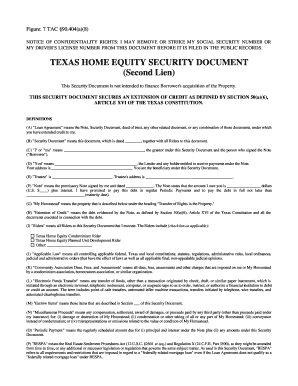
The Texas Home Equity Security Document is a crucial form for securing a home equity loan. This guide provides clear, step-by-step instructions for completing the document online, ensuring that you can navigate through the process smoothly and effectively.
Follow the steps to fill out the TX Home Equity Security Document online
- Click the 'Get Form' button to access the TX Home Equity Security Document and open it in your web browser.
- Fill in the date on which you are completing the document at the designated field. This date is important for establishing the validity of the agreement.
- Enter your full name where it states 'I' or 'me'. This identifies you as the grantor of the security document.
- In the field labeled 'You', provide the lender's name and address. This identifies who will receive payments under the agreement.
- Identify the Trustee by entering their name and address in the specified sections. The Trustee plays a vital role in the execution of the security agreement.
- Input the details related to the Note, including the loan amount and within the space provided, fill in the maturity date. This outlines the payment plan.
- Describe 'My Homestead' by entering the property details requested under 'Transfer of Rights in the Property.' Include street address, city, state, and zip code.
- If applicable, check the box next to any riders that you will be including with this document, such as the Texas Home Equity Condominium Rider.
- Review the secured agreement section and make sure all information is accurate regarding the terms of the agreement.
- At the end of the form, ensure that all parties sign and date the document in the specified areas. Remember, do not sign if any fields are left blank.
- Finally, save your changes and download the completed document. You may also choose to print or share the document as needed.
Complete the TX Home Equity Security Document online today to secure your home equity loan.
Experience a faster way to fill out and sign forms on the web. Access the most extensive library of templates available.
Related content
This security instrument secures an extension of credit that is the type of credit defined...
Texas Administrative Code · Title 7 - BANKING AND SECURITIES · Part 8 - JOINT ... §...
Dec 21, 2011 — You can help bring these children home by. Social Security Card. This...
Get answers to your most pressing questions about US Legal Forms API.
Does the Texas home equity affidavit and agreement need to be recorded?
Yes, the Texas home equity affidavit and agreement must be recorded to protect both the lender and the borrower. Recording this document is crucial as it ensures the legality of the transaction and secures the lender’s interest in your property. This process is part of the formalities that accompany the TX Home Equity Security Document.
What is the monthly payment on a $50000 home equity line of credit?
The monthly payment for a $50,000 home equity line of credit varies based on interest rates and your repayment terms. If the interest rate is around 4.5%, your payment may be approximately $250 per month, depending on whether you only make interest payments during the draw period. Remember, the TX Home Equity Security Document outlines your payment structure, helping you understand your obligations.
What credit score is needed for a home equity line of credit?
While specific requirements can vary, most lenders prefer a credit score of at least 620 for a home equity line of credit. A higher score often results in more favorable terms, including lower interest rates. Your credit score influences not only your eligibility but also the conditions tied to the TX Home Equity Security Document.
What disqualifies you from getting a HELOC?
Several factors might disqualify you from obtaining a home equity line of credit. Common reasons include low credit scores, high debt-to-income ratios, or a lack of sufficient equity in your home. Additionally, if you have previously declared bankruptcy or have unresolved issues on your credit report, lenders may view you as a higher risk despite the advantages of the TX Home Equity Security Document.
How do I get a home equity LOC?
To obtain a home equity line of credit (LOC), start by determining your home’s equity. Next, check your credit score and gather necessary documents, such as proof of income and existing debt. After this, approach a lender offering home equity loans, including those utilizing the TX Home Equity Security Document, and submit your application. The lender will evaluate your financial status and your home’s value before deciding.
Does an affidavit of completion need to be recorded in Texas?
In Texas, it is crucial to record an affidavit of completion to ensure that all parties acknowledge the completion of construction or repairs on a property. Recording this affidavit provides additional legal protection and formalizes the process. Incorporating it into your TX Home Equity Security Document can significantly enhance your legal standing.
Does a deed of trust have to be recorded in Texas?
Yes, a deed of trust must be recorded in Texas to protect the lender's interest in the property. Recording the deed provides public notice of the lender's rights, making it an essential step in the process. This action secures the TX Home Equity Security Document and ensures that all transactions are legally recognized. Always consider official recording to maintain clear ownership records.
What is the 2% rule in Texas?
The 2% rule in Texas regulates home equity loans by limiting the amount of equity you can borrow. Specifically, it restricts borrowing to 80% of the home's appraised value, allowing for responsible lending practices. This rule helps homeowners maintain some level of equity, ensuring fiscal safety. Understanding the 2% rule is essential in relation to the TX Home Equity Security Document.
What is a Texas 50 F )( 2 loan?
This is a friendly reminder about the new amendments to Texas Constitution, Article XVI, Section 50, effective January 1, 2018, wherein authority is established under Section 50(f)(2) to refinance an existing home equity loan (an Existing Section 50(a)(6) Loan ), with a new non-home equity loan.
Is it better to refinance or sell home?
Generally speaking, it's a good idea to refinance to lower your monthly mortgage payment. At this time, with interest rates being near record lows, refinancing is even more attractive, but that also means a new mortgage will come with a lower rate.
Use professional pre-built templates to fill in and sign documents online faster. Get access to thousands of forms.
If you believe that this page should be taken down, please follow our DMCA take down process here.