Loading
Form preview
  • US Legal Forms
  • Other Templates
  • Legal Forms
  • South Dakota Legal Forms
  • Sd Ujs-380 2015

Get Sd Ujs-380 2015-2026

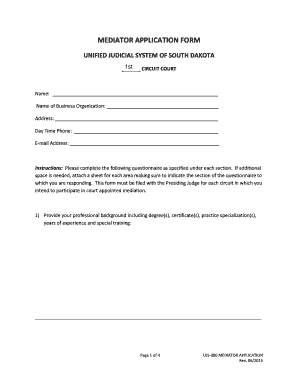
Address: Day Time Phone: E-mail Address: Instructions: Please complete the following questionnaire as specified under each section. If additional space is needed, attach a sheet for each area making sure to indicate the section of the questionnaire to which you are responding. This form must.

How it works

  1. Open form

    Open form follow the instructions

  2. Easily sign form

    Easily sign the form with your finger

  3. Share form

    Send filled & signed form or save

How to fill out the SD UJS-380 online

Filling out the SD UJS-380 mediator application form is an essential step for those wishing to participate in court-appointed mediation in South Dakota. This guide provides clear and user-friendly instructions to help you navigate the form effectively.

Follow the steps to successfully complete the SD UJS-380 online.

  1. Click the ‘Get Form’ button to access the application form in your online editor.
  2. Enter your full name in the designated field at the top of the form. Make sure to use your legal name as it appears on official documents.
  3. Provide the name of your business organization, if applicable. This is important for identifying your professional affiliation.
  4. Fill in your current address, ensuring it is up to date to facilitate correspondence.
  5. Include your daytime phone number and email address for potential follow-up or clarification on your application.
  6. Begin the questionnaire by detailing your professional background. Specify your degrees, certifications, practice specializations, years of experience, and any special training you have received.
  7. Next, disclose all your professional employment experiences, whether related to mediation or other fields. This information is crucial for assessing your qualifications.
  8. Provide comprehensive details about any pertinent training, seminars, or workshops you have attended that relate to mediation.
  9. Indicate the number of mediations you have participated in, including approximate dates and outcomes. This helps illustrate your practical experience.
  10. Describe the methods of mediation you regularly use and include how much time it typically takes to conduct a mediation session.
  11. Explain how fees and costs associated with mediation are calculated, giving clarity on your financial practices.
  12. Describe the specific requirements for payment of fees to complete a mediation, ensuring transparency.
  13. Review the form for accuracy. Once all sections are complete, provide your signature and date at the bottom to confirm your agreement to abide by the guidelines.
  14. Finally, save your changes, download a copy of the completed form, print it if necessary, or share it electronically as required for submission.

Complete the SD UJS-380 application form online today to take the next step in your mediation career.

Get form

Experience a faster way to fill out and sign forms on the web. Access the most extensive library of templates available.
Get form

Related content

Mediator Application Form
Page 1. Page 1 of 3. FORM UJS-380. REV. 06/2015. Mediator Application Form. Unified...
Learn more
Pioneer Inv. Servs. v. Brunswick Assocs., 507 U.S...
On appeal, the District Court affirmed in part and reversed in part. The court found...
Learn more
Report (pdf)
by SE Ragone · 1988 · Cited by 2 — In October 1985, a meeting was held on Cape. Cod...
Learn more

Related links form

MT Parenting Plan 2004 MT Statutory Form Power of Attorney Charlotte-Mecklenburg Schools Residency Affidavit NC 3-day Notices 2006

Questions & Answers

Get answers to your most pressing questions about US Legal Forms API.

Contact support

Qualifications for a mediator often include educational background, experience in mediation or related fields, and successful completion of designated training programs as specified in SD UJS-380. A strong foundation in communication skills and a deep understanding of the mediation process also enhance your effectiveness in this role. Platforms like uslegalforms can provide additional resources and guidance to help you meet these qualifications efficiently.

The court system in South Dakota consists of multiple levels, including circuit courts, magistrate courts, and the Supreme Court. Each level addresses different types of cases and legal matters, including those that involve mediation under SD UJS-380. Understanding this structure helps you navigate legal issues more effectively and access appropriate resources for resolution.

The requirements for a mediator in South Dakota generally include formal training, such as courses recognized under SD UJS-380, and experience in the field of conflict resolution. Most mediators also need to demonstrate good ethical standards and commitment to impartiality. Familiarity with the judicial process and any particular requirements set forth by the state is crucial for success in this role.

The three main types of mediators include facilitative, evaluative, and transformative mediators. Facilitative mediators guide discussions without offering solutions, while evaluative mediators provide opinions and help parties assess their situations. Transformative mediators focus on improving relationships and empowering parties, playing diverse roles. Understanding these types is beneficial when navigating mediation processes like those related to SD UJS-380.

To become a mediator in South Dakota, you need to complete a mediation training program approved by the state's mediation commission. Often, these programs equip individuals with essential skills such as negotiation, communication, and conflict resolution. After training, you may also need to meet specific requirements as outlined in SD UJS-380 to register as a mediator, ensuring you are officially recognized in the court system.

Once the divorce paperwork has been filed in court, it usually takes 30 to 90 days for a divorce to be final. The start to finish time of the divorce may vary depending on the caseload of the court and the availability of judges to sign the final Judgment of Divorce.

If your case goes to trial and the judge issues a judgment, the judgment is confirmed when the decree is signed and dated by the judge and court clerk. You will be sent a copy, via mail, of your final decree of divorce after it has been signed and entered into the court records.

At trial, a judge decides all of the outstanding issues in your divorce. Once that's done, the judge grants your divorce and it becomes final. A divorce hearing usually happens while your divorce case is pending. ... The final divorce judgment usually (but not always) replaces every temporary ruling in any divorce case.

You can find your final divorce date by looking in court and public records. Contact the registrar's office in the county where you were divorced to obtain a copy of your divorce decree, which is public record. Look on the office's website for instructions on how to submit your request for a copy.

You must wait 20 days from the date the divorce was filed to have your divorce hearing. The judge cannot sign your Decree until 60 days after your spouse is either served or signs a Voluntary Appearance. Then, the divorce is finalized 30 days after the Decree is signed by the judge.

Get This Form Now!

Use professional pre-built templates to fill in and sign documents online faster. Get access to thousands of forms.
Get form
If you believe that this page should be taken down, please follow our DMCA take down processhere.
Get SD UJS-380
Get form
  • Adoption
  • Bankruptcy
  • Contractors
  • Divorce
  • Home Sales
  • Employment
  • Identity Theft
  • Incorporation
  • Landlord Tenant
  • Living Trust
  • Name Change
  • Personal Planning
  • Small Business
  • Wills & Estates
  • Packages A-Z
  • Affidavits
  • Bankruptcy
  • Bill of Sale
  • Corporate - LLC
  • Divorce
  • Employment
  • Identity Theft
  • Internet Technology
  • Landlord Tenant
  • Living Wills
  • Name Change
  • Power of Attorney
  • Real Estate
  • Small Estates
  • Wills
  • All Forms
  • Forms A-Z
  • Other Templates
  • Legal Hub
  • About Us
  • Help Portal
  • Legal Resources
  • Blog
  • Affiliates
  • Contact Us
  • Delete My Account
  • Site Map
  • Industries
  • Forms in Spanish
  • Localized Forms
  • State-specific Forms
  • Forms Kit
  • Real Estate Handbook
  • All Guides
  • Notarize
  • Incorporation services
  • For Consumers
  • For Small Business
  • For Attorneys
  • USLegal
  • FormsPass
  • pdfFiller
  • signNow
  • altaFlow
  • DocHub
  • Instapage
Form Packages
  • Adoption
  • Bankruptcy
  • Contractors
  • Divorce
  • Home Sales
  • Employment
  • Identity Theft
  • Incorporation
  • Landlord Tenant
  • Living Trust
  • Name Change
  • Personal Planning
  • Small Business
  • Wills & Estates
  • Packages A-Z
Form Categories
  • Affidavits
  • Bankruptcy
  • Bill of Sale
  • Corporate - LLC
  • Divorce
  • Employment
  • Identity Theft
  • Internet Technology
  • Landlord Tenant
  • Living Wills
  • Name Change
  • Power of Attorney
  • Real Estate
  • Small Estates
  • Wills
  • All Forms
  • Forms A-Z
  • Other Templates
Customer Service
  • Legal Hub
  • About Us
  • Help Portal
  • Legal Resources
  • Blog
  • Affiliates
  • Contact Us
  • Delete My Account
  • Site Map
  • Industries
  • Forms in Spanish
  • Localized Forms
  • State-specific Forms
  • Forms Kit
Legal Guides
  • Real Estate Handbook
  • All Guides
Prepared for you
  • Notarize
  • Incorporation services
Our Customers
  • For Consumers
  • For Small Business
  • For Attorneys
Our Sites
  • USLegal
  • FormsPass
  • pdfFiller
  • signNow
  • altaFlow
  • DocHub
  • Instapage
Social Media
Call us now toll free:
+1 833 426 79 33
As seen in:
© Copyright 1999-2026 airSlate Legal Forms, Inc. 17 Station Street, Suite 303, Brookline, MA 02445
  • Your Privacy Choices
  • Terms of Service
  • Privacy Notice
  • Content Takedown Policy
  • Bug Bounty Program